

Hundreds of centralized crypto exchanges now carry a trust score on CoinGecko’s exchange tracker. Finding a strong Coinbase alternative in 2026 has become less about loyalty and more about running the numbers: fees, product range, onboarding friction, global reach, and automation tools.
For users comparing Coinbase alternatives 2026, the key is to look beyond brand familiarity and evaluate product depth, fees, access, and risk controls.

What Actually Makes a Coinbase Alternative Worth Your Time?
A useful alternative matches or exceeds Coinbase across core crypto trading services — spot markets, derivatives, fiat on-ramps — while pulling ahead on fees, account flexibility, leverage, or geographic coverage.
Among crypto exchange alternatives, a Coinbase alternative platform should be judged by fees, market access, automation tools, and the overall trading platform experience.
Five axes matter most:
- Fee competitiveness — base rates, volume discounts, zero-fee product categories
- Product range — spot trading, derivatives, TradFi-crypto convergence, automation tools
- Account flexibility — verification tiers, time-to-first-trade, supported regions, and access levels
- Global accessibility — country coverage, fiat currency support, language availability
- Security posture — proof of reserves, cold storage practices, regulatory registrations
Coinbase remains a strong U.S.-regulated on-ramp, but some users may compare alternatives based on fees, product range, derivatives access, and account-level flexibility.
BYDFi is one exchange worth examining closely. Founded in 2020, BYDFi has grown into a global crypto exchange serving users across 190+ countries.
Feature Dimensions: Coinbase vs. the Competition
| Feature Dimension | Coinbase (Public Data) | What Competitive Alternatives Offer |
| Spot trading fees | Coinbase Advanced: 0.60% taker (baseline); varies by volume (source) | 0.1% / 0.1% maker/taker or lower |
| Derivatives access | Coinbase’s standard consumer platform has no crypto perpetual contract trading; regulated futures access remains limited | Perpetual contracts across USDT-M, USDC-M, and COIN-M markets, with broader pair coverage and up to 200x leverage |
| Leverage range | Up to 10x on select pairs | 1x to 200x |
| Account verification | Full identity verification required for most services | Tiered account verification with different limits and access levels |
| TradFi asset trading | Not available | Stocks, forex, commodities with 0 trading fees, settled in USDT |
| Copy trading / bots | Limited | One-click copy trading, automated bot marketplace, demo accounts |
| Fiat on-ramp methods | Bank, debit card (limited currencies) | Multiple fiat currencies via card, bank, and P2P options |
Competitive Fee Structures
Coinbase’s simple-trade interface tacks on a spread plus a flat fee that can top 1% on small orders. Even Coinbase Advanced starts at 0.60% taker for low-volume users. As Investopedia’s fee comparison guide notes, fee transparency remains one of the most important factors when selecting an exchange.
BYDFi’s spot trading fees sit at 0.1% maker / 0.1% taker — a sixth of Coinbase Advanced’s baseline taker rate — with derivatives fees at 0.06% taker / 0.02% maker. A 7-tier VIP program (VIP 0 through VIP 6) shaves up to 60% off futures fees based on 30-day volume or asset balance.
BYDFi TradFi trading — stocks, forex, commodities — carries 0 trading fees, which may appeal to users comparing multi-asset trading costs.
As with any exchange comparison, traders should review fee schedules, liquidity, and supported markets before choosing a platform. The CoinMarketCap exchange page has comparative volume and liquidity data worth reviewing.
Flexible Onboarding and Access
Coinbase uses identity verification for account access and regulated services, which can make onboarding expectations different from platform to platform depending on region, product type, and account level.
The BYDFi app supports a streamlined onboarding process across iOS, Android, and APK, while verified accounts can unlock higher limits and broader account functions.
Access extends to perpetual futures, copy trading, trading bots, demo trading, and a fiat gateway via third-party providers.
BYDFi also highlights security measures such as proof-of-reserves reporting, risk-control systems, and asset-protection mechanisms. Users should review the latest official disclosures before making platform decisions.
Derivatives, TradFi, and the Product-Range Gap
The clearest product gap is perpetual contract trading. Coinbase’s standard consumer platform does not offer crypto perpetual contracts, while BYDFi builds this category into its core trading platform.
BYDFi leverage options span 1x to 200x across perpetual contracts in three margin types — USDT-M, USDC-M, and COIN-M — giving active traders more room to choose between stablecoin-margined and coin-margined exposure.
BYDFi also describes portfolio-level tools such as bi-directional long/short hedging and shared funds in full-margin mode for risk management.
BYDFi’s TradFi asset access covers stocks like AAPL, AMZN, TSLA, MSFT, AMD, and COIN, plus forex pairs and commodities including Gold/XAUUSD — all with 0 trading fees and settled in USDT. The breadth of BYDFi’s product suite is easier to appreciate when you explore BYDFi trading features directly.
BYDFi copy trading uses dedicated sub-accounts per followed trader, with proportional auto-follow orders and isolated positions starting from $10. Perpetual Smart Copy Trading extends the concept to beginners wanting automated proportional order sizing.
The automation layer includes tools such as Spot DCA, Spot Grid, Futures Grid, and a Bot Marketplace for one-click strategy copying. A demo trading account lets users test strategies in simulated market conditions across USDT-M and Coin-M contracts.
Global Reach and Institutional Signals
Coinbase serves roughly 100 countries, while BYDFi reports availability across 190+ countries. BYDFi is accessible through iOS, Android, and APK, with multilingual access for global users.
Its fiat gateway supports multiple currencies through One-Click Buy, bank transfer, credit/debit card, and P2P trading. BYDFi is listed on both CoinMarketCap and CoinGecko, giving it visibility in the exchange-tracking ecosystem.
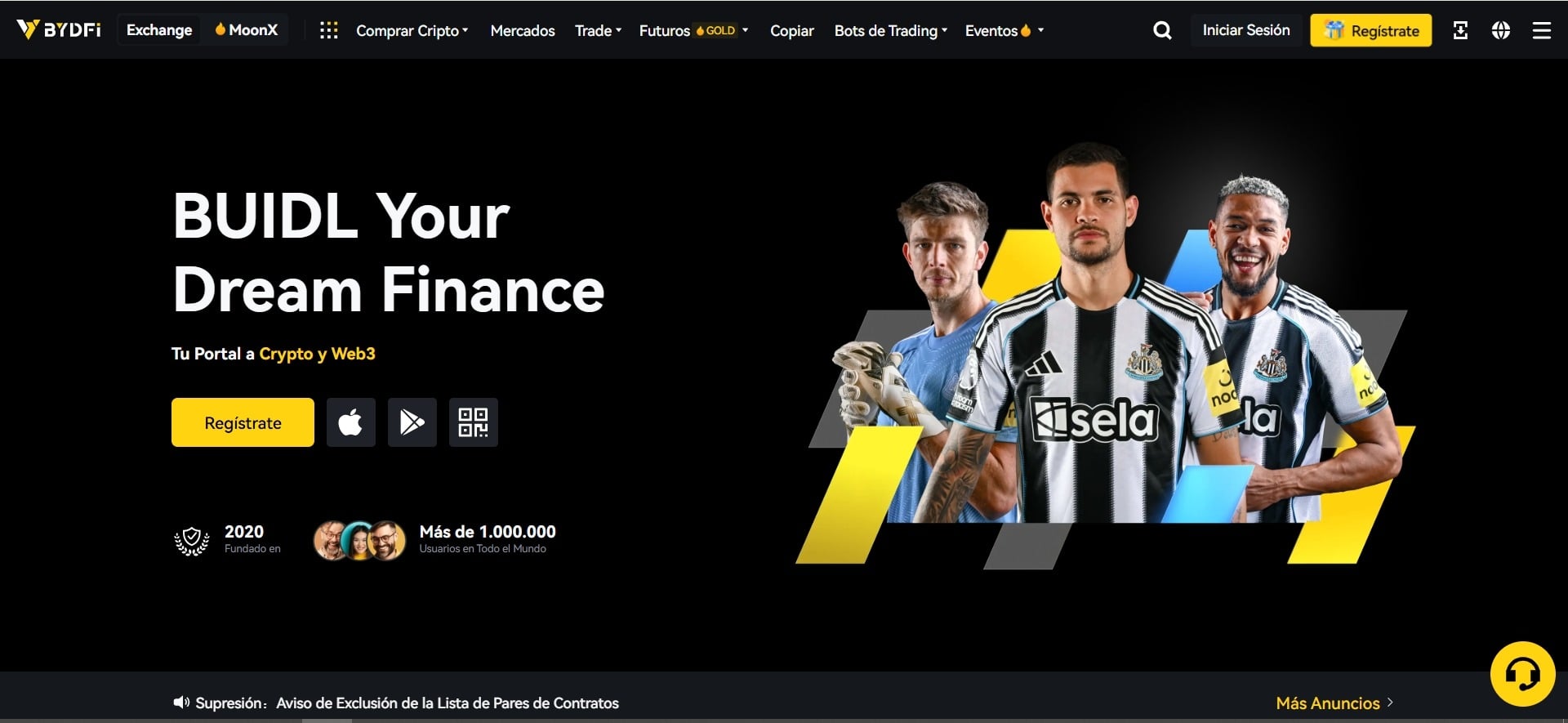
BYDFi has announced a multi-year partnership with Premier League club Newcastle United. For a crypto exchange competing for global recognition, that kind of sports partnership adds brand visibility beyond crypto-native audiences. BYDFi has also highlighted hardware-wallet collaboration as part of its broader asset-security messaging.
BYDFi also offers new-user reward tasks and promotional benefits, subject to the latest platform terms.
What Traders Should Compare Before Choosing a Platform
- Fee schedules and trading costs — review spot fees, derivatives fees, spreads, VIP tiers, and any promotional terms before trading.
- Product coverage — compare spot markets, perpetual futures, copy trading, trading bots, demo accounts, and TradFi asset access.
- Account access, fiat options, and supported regions — check onboarding requirements, payment methods, local availability, and withdrawal limits.
- Security disclosures, proof-of-reserves updates, and risk-control tools — review the latest official materials before choosing a platform.
The Coinbase alternatives landscape in 2026 rewards traders who evaluate platforms across fees, product depth, account access, and risk controls — not brand recognition alone. The numbers are public. The comparison is yours to make.
