

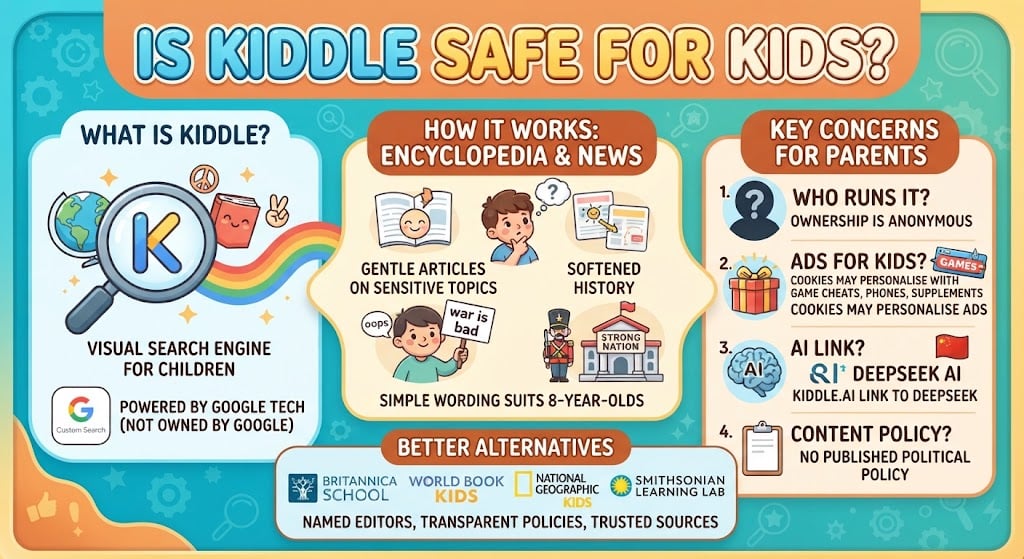
Kiddle sells itself as a safe visual search engine for kids. Schools, libraries and teacher associations send children to it, and Google ranks it well.
Its encyclopedia pages tell a different story. Entries on armed groups and authoritarian leaders read gently, no editor is named anywhere, and the site’s own privacy policy mentions ad personalisation. The filter question turns out to be the smaller one.
What Kiddle Is And How Kiddle Search Works
Kiddle launched in 2014 as a picture-led search service aimed at children. The search box carries Google’s mark and the words “Custom Search”, and results run on Google technology trimmed for young readers.
Traffic is modest next to mainstream search. Reach is not. ISTE, a professional body covering 100,000 people in education, recommends the site and repeats its claim that results are vetted by editors. In early 2026 the online home-school provider DiscoveryK12 sent it more visitors than any other referrer.
Chatbots amplify it too. Asked for safe study material, ChatGPT has listed Kiddle beside the Smithsonian, National Geographic and Encyclopædia Britannica. OpenAI at least files its stake structure openly, and its corporate strengths and weaknesses are documented. Kiddle files nothing.
Is Kiddle Safe For Kids? How Its Pages Frame War And Armed Groups
| Subject | What the Kiddle article tells children |
|---|---|
| Vladimir Putin | A peacemaker known for ending the Second Chechen War; later conquests appear only as Russia taking control of Crimea |
| Hamas | Grew from an Islamic charity and backs Palestinian statehood; the word terrorist appears once, at the foot of the page |
| Yahya Sinwar | A very important leader who spoke of peaceful, popular resistance |
| Revolutionary Guard | A special part of Iran’s military that helps keep the country stable |
| Ali Khamenei | Backed atomic work for peaceful uses, loved poetry, championed Persian |
| Hassan Nasrallah | Washington and Brussels call Hezbollah a terror group, but Russia and China hold different views |
Russia’s full-scale assault on Ukraine appears as a military operation, the Kremlin’s own phrasing. Stalin is credited chiefly with building a strong, modern nation.
Simple wording suits an eight-year-old. Crediting Putin as a peacemaker does not survive contact with the last decade of fighting.
What Kiddle Encyclopedia Pages Leave Out
Omission does more work than wording. The Uyghur entry carries nothing on the mass detention camps or the documented abuses against that Muslim minority in China.
The Wuhan Institute of Virology page skips the laboratory’s role in the Covid-19 origins dispute entirely. A child reading either page leaves with a gap, not a mistake.
Who Owns Kiddle? Nobody Will Say
| Detail | What the site discloses |
|---|---|
| Editors, founders, leadership | None named |
| Operating company | Behind a US-registered masking service |
| Nonprofit status | Never claimed |
| Policy on political content | None published |
The branding invites a wrong guess. The name nods at Google, so does the primary-colour logo, and libraries, teaching blogs and professional bodies have described Kiddle as a Google product for years. EdTech Magazine reported in 2016 that no such tie exists.
For most publishers this information is trivial to find. Ownership records for large brands are public, and thin disclosure is a pattern worth checking, as our look at an unnamed publisher showed.
Does Kiddle Show Ads To Children?
Kiddle’s data policy states that cookies are used to personalise content and ads, and that visitor details reach advertising and measurement partners. Google’s own rules for child-directed services prohibit ad-personalisation cookies.
Ads observed on the site promoted cyber-threat reports, phone contracts, shopping add-ons, supplements linked to steroids and guides to obtaining Robux. Some ran lead-capture forms that collected details from readers directly. Neither company responded to questions.
Parents used to checking a retailer before buying will recognise the exercise. It resembles the safety check we ran on a small online store.
Kiddle And AI: The kiddle.ai And DeepSeek Link
- 2014Kiddle.co launches as a kid-safe search engine
- 2016EdSurge reports that Vladislav Golunov, an entrepreneur born in Russia and once tied to the Lukol search tool, may have built it
- 2016EdTech Magazine confirms there is no Google affiliation
- 2026kiddle.ai goes live badged “AI for kids”; hosting and DNS records tie it to a subdomain naming the Chinese firm DeepSeek
A decade after the first reporting, nobody outside the operation can name who runs it. The DeepSeek connection remains unexplained by either party.
Model provenance matters more now than it did in 2016, since a handful of firms hold most of the AI market and each brings its own content rules.
Should Parents And Teachers Use Kiddle For Kids?
As a profanity filter, Kiddle works about as well as its rivals. As an encyclopedia, it is an anonymous publisher shaping how children understand war, terror and dictatorship.
Treat it as a starting point, not a source. Named-publisher references such as Britannica School, World Book or National Geographic Kids carry bylines and correction policies. Kiddle carries neither.
Teachers recommend it, Google surfaces it, chatbots quote it. That chain of trust rests on nobody. The same test applies to any site a child cites, including the careers brand whose own pages contradict each other and other sites we have examined for basic credibility.
FAQs
Is Kiddle safe for kids to use at school?
Kiddle blocks explicit terms reliably, so basic filtering holds. Its encyclopedia entries soften violent groups and authoritarian leaders, and no editor is named, so it works better as a search starting point than a cited source.
Is Kiddle owned by Google?
No. Kiddle uses Google Custom Search technology and borrows a similar logo style, but EdTech Magazine confirmed in 2016 there is no ownership link. The operating company sits behind a domain masking service.
Who owns Kiddle?
Nobody knows publicly. EdSurge reported in 2016 that Russian-born entrepreneur Vladislav Golunov may have built it. The site names no founders, editors or company, and publishes no policy covering political content.
Does Kiddle collect data or show ads?
Yes. Its privacy policy states cookies personalise content and ads, and that data goes to advertising and measurement partners. Observed ads covered phone contracts, supplements and Robux guides, some with lead-capture forms.
What are safer alternatives to Kiddle for kids?
Britannica School, World Book Kids, National Geographic Kids and Smithsonian Learning Lab all name their editors and publish correction policies. Public library databases offer the same accountability at no cost to families.
