

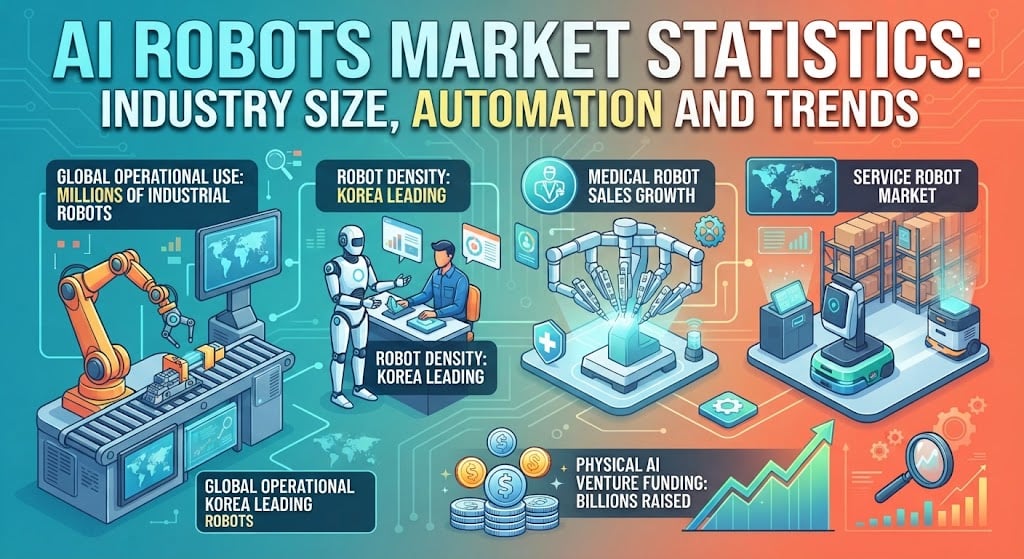
Morgan Stanley raised its 2026 forecast for Chinese humanoid robot shipments to 50,000 units in June 2026, after opening the year at 14,000. Unit counts and capital flows in the AI robots market are moving at very different speeds. This piece sets out the verified figures on installations, robot density, service robot sales, North American orders, Chinese output and venture funding.
AI Robots Market
How Big Is The AI Robots Market?
Revenue estimates for the AI robots market differ by more than a factor of three, because each publisher draws the boundary in a different place.
MarketsandMarkets puts the global AI robots market at $6.11 billion in 2025 and forecasts $33.39 billion by 2030, a 40.4% CAGR. Its scope covers hardware and software segmented by component, technology and robot type.
Market Research Future models a wider boundary, estimating $14.68 billion for 2025 and projecting $193.97 billion by 2035 at a 29.45% CAGR. The two sets of numbers measure vendor revenue under different definitions and cannot be compared directly or averaged.
Source: MarketsandMarkets, November 2025 release; Market Research Future, 2026 edition.
How Many Industrial Robots Were Installed In 2024?
Installations reached 542,000 units in 2024, the second-highest annual count IFR has recorded and 2% below the 2022 peak. Operational stock rose 9% to 4,664,000 units.
China took 54% of global deployments. Chinese manufacturers outsold foreign suppliers in their home market for the first time, at 57% domestic share against about 28% a decade earlier.
| Market | Units installed (2024) | Change on 2023 |
|---|---|---|
| World | 542,000 | +1,000 units |
| China | 295,000 | +7% |
| Japan | 44,500 | −4% |
| United States | 34,200 | −9% |
| Republic of Korea | 30,600 | −3% |
| Germany | 26,982 | −5% |
| India | 9,100 | +7% |
Source: International Federation of Robotics, World Robotics 2025, data year 2024.
Japan’s operational stock rose 3% to 450,500 units, the base for its domestic robot builders including FANUC. IFR projects installations of 575,000 units in 2025 and expects the 700,000-unit mark to be passed by 2028.
AI Robots Market By Robot Density
Robot density measures operational stock against manufacturing employment, so it ranks automation intensity rather than market size. Korea recorded 1,220 units per 10,000 manufacturing employees in 2024, growing 7% a year on average since 2019.
The United States ranks eighth at 307 units. China sits 22nd worldwide and sixth in Asia at 166 units, up 17% year on year, on labour-market data reissued by China’s National Bureau of Statistics.
| Region | Robots per 10,000 manufacturing employees (2024) |
|---|---|
| Western Europe | 267 |
| European Union (EU-27) | 231 |
| North America | 204 |
| Global average | 132 |
| Asia | 131 |
Source: International Federation of Robotics, World Robotics 2025, data year 2024.
Service And Medical Robots In The AI Robots Market
Professional service robot sales reached almost 200,000 units in 2024, up 9%. Transportation and logistics accounted for more than half of that.
Hospitality fell 11% to more than 42,000 units. Professional cleaning rose 34% to more than 25,000, agriculture slipped 6% to close to 19,500, and search, rescue and security reached 3,100 units, up 19%. These figures come from a sample of 294 suppliers and are not projected to the whole industry.
Medical Robot Growth In 2024
| Category | Change in units sold, 2024 vs 2023 |
|---|---|
| Diagnostics and medical laboratory analysis | +610% |
| Rehabilitation and non-invasive therapy | +106% |
| Surgery | +41% |
Source: International Federation of Robotics, World Robotics 2025 Service Robots, data year 2024.
Medical robots totalled around 16,700 units in 2024, a 91% rise. Consumer service robots, mainly floor cleaning and lawn mowing, reached close to 20 million units, up 11%. The robot-as-a-service fleet grew 31%, and 42% within transportation and logistics.
North American Orders In The AI Robots Market
North American companies ordered 36,766 robots valued at $2.25 billion in 2025, a 6.6% rise in units and 10.1% in revenue on a matched reporting cohort. Collaborative robots made up 7,212 of those units, worth $241 million.
First-half 2026 orders came to 17,995 units valued at $1.166 billion, up 2.0% in units and 6.6% in order value on the first half of 2025. Collaborative robots accounted for 2,774 units and $114 million, or 15.4% of units and 9.8% of order revenue.
Source: Association for Advancing Automation (A3), Q2 2026 release, August 2026.
IFR published preliminary US figures in June 2026 showing 38,000 industrial robot installations in 2025, up 11%, with automotive at 13,500 units. A3 gave humanoids a dedicated pavilion at Automate 2026 in Chicago, sponsored by NVIDIA.
China’s Output And The AI Robots Market
China’s industrial robot production keeps outpacing its installation growth. Output figures below are factory production counts, not installations or sales.
| Period | Output | Year-on-year change |
|---|---|---|
| Industrial robots, full-year 2025 | 773,074 units | +28% |
| Service robots, full-year 2025 | 1.49 million units | Not stated |
| Industrial robots, Jan–Feb 2026 | 143,608 units | +31% |
| Industrial robots, Jan–Jul 2026 | Not published in units | +28.5% |
Source: China National Bureau of Statistics, monthly industrial output releases, 2025 to July 2026.
Robot reducer output, a core joint component, rose 73.3% year on year in the first four months of 2026. IFR reports the share of local suppliers in Chinese industrial robot installations rose from 30% in 2020 to 57% in 2024, reaching 85% in metal and machinery.
Humanoids In The AI Robots Market
Omdia counted about 13,000 humanoid robots shipped worldwide in 2025, with Chinese vendors filling the top positions and Tesla ninth.
Morgan Stanley raised its 2026 China shipment forecast twice, from 14,000 in January to 28,000 and then to 50,000 in June 2026. It puts China’s humanoid market at $2 billion in 2026 and $15 billion by 2030 on 446,000 annual shipments, a 106% CAGR from 2025. The forecast counts external sales only, excluding prototypes, pre-order trials and internal use.
Goldman Sachs Research projected in February 2024 that the humanoid total addressable market could reach $38 billion by 2035 on 1.4 million units, up from an earlier $6 billion estimate, assuming a 40% cut in materials costs.
IFR takes a narrower view of current capability, stating in May 2026 that real-world humanoid deployment is limited to demonstrators or pilot projects and that commercialisation sits late in China’s 2026–2030 plan period.
Funding And M&A In The AI Robots Market
Crunchbase tracked $47.4 billion of venture funding into physical AI across 521 deals in the first half of 2026. Its physical AI definition spans robotics, autonomous vehicles, aerospace, drones, industrial automation and sensors.
Robotics startups specifically had raised $18.8 billion globally by 22 June 2026, against $15 billion across all of 2025 and $14.1 billion in 2021.
Source: Crunchbase, physical AI funding analysis published August 2026; robotics sector snapshot, June 2026.
ABB signed an agreement on 8 October 2025 to divest its Robotics division to SoftBank Group at an enterprise value of $5.375 billion. The division reported $2.3 billion of 2024 revenue, a 12.1% operational EBITA margin and about 7,000 employees. The transaction remains subject to regulatory approvals and is expected to close in mid-to-late 2026.
FAQs
How many industrial robots are in use worldwide?
4,664,000 industrial robots were in operational use worldwide in 2024, a 9% increase on 2023, according to IFR’s World Robotics 2025 report. Installations that year totalled 542,000 units.
Which country has the highest robot density?
The Republic of Korea, at 1,220 robots per 10,000 manufacturing employees in 2024. Singapore follows with 818, Germany 449 and Japan 446. The global average is 132.
Reddit threads keep asking whether humanoid robots are actually shipping. What do the numbers say?
Omdia counted roughly 13,000 humanoid units shipped worldwide in 2025. IFR stated in May 2026 that real-world deployment remains limited to demonstrators and pilot projects.
How much venture funding is going into robotics?
Robotics startups raised $18.8 billion globally by 22 June 2026, exceeding the $15 billion logged across all of 2025 and the $14.1 billion peak of 2021, per Crunchbase.
Is China’s robot output growth as strong as Reddit commentary suggests?
China produced 773,074 industrial robots in 2025, up 28%. National Bureau of Statistics data shows output rising 28.5% year on year across January to July 2026.
Sources
https://ifr.org/ifr-press-releases/news/global-robot-demand-in-factories-doubles-over-10-years
https://ifr.org/ifr-press-releases/news/service-robots-see-global-growth-boom
https://news.crunchbase.com/venture/physical-ai-funding-startups-robotics-aerospace-h1-2026/
