

Every few years, a technology arrives promising to make an entire discipline effortless. AI testing is the current one. Write tests in plain English, never maintain them again, and quietly retire your QA team. That’s the pitch.
After enough hype cycles, an engineer learns to read the asterisks. AI testing is genuinely useful. Just rarely for the reasons the loudest marketing claims. Here are five myths worth puncturing, and what is actually true underneath each.
Myth 1: “AI testing means you’ll never maintain a test again”
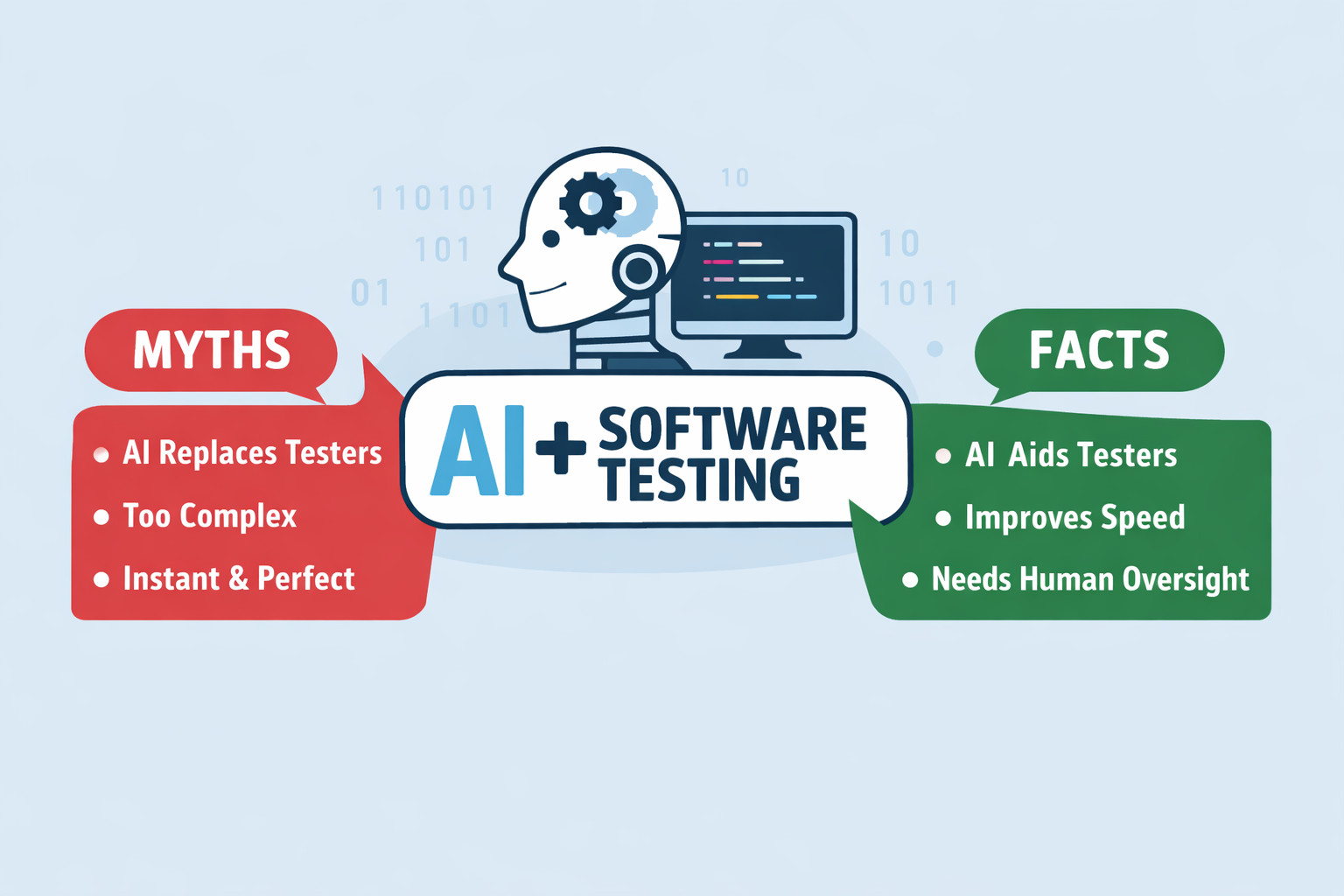
Self-healing is real, and it matters. It removes the single biggest source of test maintenance: brittle element locators that snap every time a button moves. That alone eliminates a huge share of the busywork.
But “self-healing” is not “self-maintaining.” When a feature genuinely changes a new step in checkout, a removed field, or a reworked flow, the intent of the test changes too, and a human has to update it. AI keeps a test alive through cosmetic change. It cannot read your product roadmap.
The honest version: maintenance drops sharply. It does not reach zero.
Myth 2: “Codeless means no skill is needed”
Codeless tools lower the coding barrier. They do not lower the testing barrier, and those are different things.
Knowing what to test, where the edge cases hide, and how to design a suite that catches real bugs is the actual skill, and no tool supplies it. Hand a codeless platform to someone who does not understand testing, and you get a large suite that confidently checks the wrong things.
The genuine value is letting skilled testers who do not happen to code contribute directly. It is not the elimination of expertise.
Myth 3: “AI will replace your QA engineers”
AI handles volume well: regression runs, repetitive checks, and first-draft test generation. It does not handle judgment exploratory testing, deciding what “correct” even means, weighing risk, or interpreting a vague requirement.
The human-in-the-loop is not a transitional phase we will engineer away. It is the design. What changes is the job itself: less time writing scripts, more time defining intent and reviewing what the AI produced.
Tools like testRigor for generative AI in software testing shift the work rather than removing the worker. A senior tester becomes more valuable in that world, not less.
Myth 4: “AI generates your tests, so you can trust the output”
Generative AI can draft tests quickly. It can also hallucinate, assert the wrong thing, miss context, or produce confident nonsense that looks plausible.
Treat a generated test the way you would treat code from a fast but very literal junior: a useful first draft, not a finished suite. Review it. The real danger is not that AI writes a bad test; it is that a bad test feels safe. False positives and false confidence are worse than no test at all, because they quietly lower your guard.
Myth 5: “AI eliminates flaky tests”
Flakiness has many parents. Brittle locators are one. But timing and async issues, unstable environments, and bad test data are others, and they have nothing to do with how a test is authored.
Intent-based AI kills the locator-driven flakiness, which is a meaningful chunk of the problem. It does nothing for a race condition or a flaky staging server. Test reliability remains an engineering discipline, not a feature you can purchase.
The Myths, Corrected
| The myth | The reality | What actually helps |
| No maintenance, ever | Self-healing cuts locator upkeep, not feature-change updates | Intent-based tools (e.g., testRigor) + human review |
| Codeless = no skill | Lowers the coding barrier, not test-design skill | Codeless tools in the hands of skilled testers |
| AI replaces QA engineers | Handles volume, not judgment | Human-in-the-loop by design |
| Trust AI-generated tests | Can hallucinate; false positives feel safe | Treat generation as a first draft; always review |
| AI ends flaky tests | Removes locator flakiness only | Engineering fixes for timing, environment, and data |
The Honest Takeaway
Notice the pattern. AI testing is real leverage aimed, too often, at the wrong expectations. It genuinely cuts maintenance, lowers the coding barrier, and speeds up test creation. It genuinely does not remove judgment, skill, or engineering discipline.
So buy it for what it does. Let self-healing spare your team the locator grind. Let codeless authoring bring your non-coding testers into automation. Let generation give you a fast first draft. Then keep a human in the loop for everything the brochure glosses over because that is where quality has always actually lived.
