

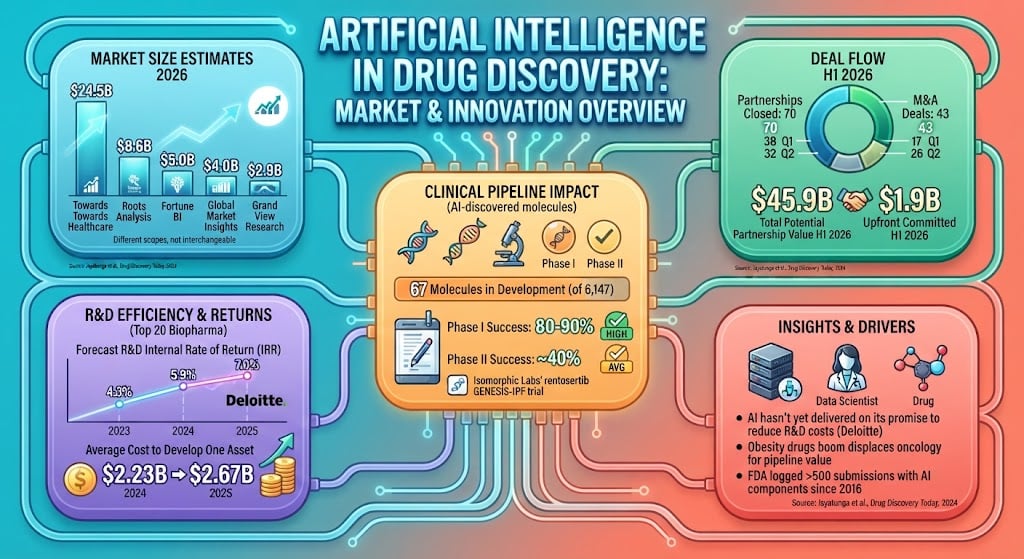
AI and machine learning R&D partnerships in biopharma carried $45.9 billion in headline value across the first half of 2026, against $1.9 billion committed upfront, according to DealForma. This post sets the published forecasts for the artificial intelligence in drug discovery market against what deal records, clinical trial results and R&D return data actually show. Every figure names its source and period.
Artificial Intelligence in Drug Discovery Market
How Big Is the Artificial Intelligence in Drug Discovery Market?
Five research firms publish current sizing for this category, and they do not agree. Each measures vendor revenue under its own scope definition, so the numbers are not interchangeable.
The 2026 estimates run from $2.9 billion to $24.51 billion. Forecast growth rates diverge just as sharply, from 12.20% to 30.50% annually.
| Research firm | 2025 size | 2026 size | Forecast | CAGR |
|---|---|---|---|---|
| Towards Healthcare | $19.89B | $24.51B | $160.49B by 2035 | 23.22% |
| Roots Analysis | $6.0B | $8.6B | $25.0B by 2035 | 12.60% |
| Fortune Business Insights | $4.46B | $5.00B | $12.56B by 2034 | 12.20% |
| Global Market Insights | $3.1B | $4.0B | $43.9B by 2035 | 30.50% |
| Grand View Research | $2.4B | $2.9B | $13.8B by 2033 | 24.80% |
Source: each firm’s own published market sizing page for AI in drug discovery, as stated by the firm; CAGRs run from 2026 to the stated forecast year. Accessed September 2026.
AI in Drug Discovery Market Deal Flow: 2024 vs 2025
DealForma tracked 114 AI/ML drug discovery and licensing R&D partnerships in 2025, against 84 in 2024. M&A moved further, from 34 transactions to 99.
Value definitions differ by channel. Partnership value is total potential value including milestones, M&A value includes contingent consideration, venture value is capital raised, and IPO value is gross proceeds.
| Channel | Deals 2024 | Deals 2025 | Value 2024 | Value 2025 |
|---|---|---|---|---|
| R&D partnerships | 84 | 114 | $11.8B | $43.4B |
| M&A transactions | 34 | 99 | $3.2B | $12.3B |
| Venture rounds | 264 | 348 | $8.9B | $11.0B |
| IPOs | 5 | 5 | $424M | $1.3B |
Source: DealForma, AI-ML Drug Discovery and Licensing R&D, M&A, Ventures and IPOs 2025 Review, published 13 January 2026; full-year 2024 and 2025 data.
Upfront cash and equity across those 2025 partnerships came to roughly $67 million, against roughly $36 million in 2024. M&A ran the other way: $11.3 billion of the $12.3 billion 2025 total was cash.
The largest 2025 acquisitions were cash-led platform buys. Siemens paid $5.1 billion for Dotmatics in April 2025, and GE HealthCare agreed to $2.3 billion for Intelerad in November 2025. On the venture side, Alphabet subsidiary Isomorphic Labs raised a $600 million series A in March 2025.
H1 2026: fewer dollars committed at signature
DealForma’s H1 2026 review, published 21 August 2026, shows partnership structures tightening inside the half. Q1 2026 produced 38 deals worth $35.8 billion with $1.7 billion upfront; Q2 produced 32 deals worth $10.1 billion with $200 million upfront.
| Metric | Q1 2026 | Q2 2026 |
|---|---|---|
| Partnerships closed | 38 | 32 |
| Total potential value | $35.8B | $10.1B |
| Upfront committed | $1.7B | $200M |
| Average upfront per deal | $213M | $28M |
| Median upfront per deal | $78M | $15M |
Source: DealForma, AI / Machine Learning R&D, M&A, Ventures & IPOs H1 2026 Review, published 21 August 2026; quarterly data for Q1 and Q2 2026.
M&A followed the same pattern. Q2 2026 recorded 26 deals against 17 in Q1, but total value fell to $1.8 billion from $10.6 billion. Roche agreed in May 2026 to pay $750 million upfront for PathAI, with up to $300 million in milestones.
Upfront Cash Versus Headline Value in AI Drug Discovery Deals
Announced deal values in this market are milestone-weighted. The cash committed at signature is a small fraction of the number in the press release.
Eli Lilly and Insilico Medicine announced the largest of these agreements on 29 March 2026: $115 million upfront inside a deal Insilico values at approximately $2.75 billion including milestones.
| Deal | Announced | Upfront | Contingent terms as published |
|---|---|---|---|
| Insilico Medicine – Eli Lilly | 29 Mar 2026 | $115M | Total deal value approximately $2.75B including milestones, plus tiered royalties |
| Isomorphic Labs – Eli Lilly | 7 Jan 2024 | $45M | Up to $1.7B in milestones, excluding the upfront payment |
| Isomorphic Labs – Novartis | 7 Jan 2024 | $37.5M | Up to $1.2B in milestones, excluding the upfront payment |
Source: Insilico Medicine announcement (29 March 2026); Isomorphic Labs announcements (7 January 2024).
Larger upfronts do appear. AstraZeneca committed $110 million upfront to CSPC Pharmaceuticals in June 2025, and Novartis committed $120 million to Monte Rosa Therapeutics in September 2025, per DealForma.
Clinical Results Behind the Artificial Intelligence in Drug Discovery Market
The Jayatunga analysis in Drug Discovery Today, published June 2024, examined the clinical pipelines of roughly 300 AI-native biotechs. It found 67 AI-discovered molecules among 6,147 drugs in clinical development, and 24 involving AI-discovered targets.
Success rates split by phase. AI-discovered molecules cleared Phase I at 80–90%, above historic industry averages; Phase II success was about 40%, which the authors describe as comparable to historic averages.
| Metric | Value |
|---|---|
| AI-discovered molecules in clinical development | 67 of 6,147 drugs |
| Drugs involving AI-discovered targets | 24 |
| Drugs involving novel AI-discovered targets | 3 to 9 |
| Phase I success rate, AI-discovered molecules | 80–90% |
| Phase II success rate, AI-discovered molecules | ~40% |
| Probability of clearing all clinical phases | Rises from 5–10% to ~9–18% |
Source: Jayatunga et al., Drug Discovery Today, volume 29 issue 6, June 2024.
The measured advantage sits in safety and tolerability rather than efficacy. Phase II is where a compound first faces patient outcomes, and the AI cohort matches the industry baseline there.
Rentosertib and the first Phase IIa readout
Insilico Medicine published Phase IIa results for rentosertib, a TNIK inhibitor for idiopathic pulmonary fibrosis, in Nature Medicine on 3 June 2025. The GENESIS-IPF trial randomised 71 patients across 22 sites in China over 12 weeks.
Patients on 60 mg once daily recorded a mean forced vital capacity change of +98.4 mL, against a mean decline of −20.3 mL on placebo. Both the target and the compound were identified using generative AI.
The FDA has logged more than 500 drug and biological product submissions containing AI components since 2016, and issued its first draft guidance on the subject on 6 January 2025.
What R&D Returns Say About the AI in Drug Discovery Market
Deloitte’s 16th annual pharmaceutical innovation study, released 4 May 2026, put forecast internal rate of return for the top 20 biopharma companies at 7.0% in 2025, up from 5.9% in 2024 and 4.3% in 2023.
Strip out GLP-1 and GIP assets and the 2025 figure falls to 2.9%. Development cost per asset rose over the same year.
| Metric | 2024 | 2025 |
|---|---|---|
| Forecast IRR, top 20 biopharma | 5.9% | 7.0% |
| Average cost to develop one asset | $2.23B | $2.671B |
| Average forecast peak sales per asset | $510M | $598M |
Source: Deloitte, Measuring the Return from Pharmaceutical Innovation, 16th edition, published 4 May 2026; late-stage pipelines of the top 20 biopharma companies.
Excluding GLP-1s, average forecast peak sales drop to $353 million per asset. Obesity drugs displaced oncology as the largest contributor to pipeline value for the first time in the study’s 16 years, at 25% of total forecast sales against 1% in 2022.
Deloitte Life Sciences partner Colin Terry said AI “hasn’t yet delivered on its promise to reduce R&D costs”, and named it as a probable contributor to the rising cost per asset.
FAQs
How big is the artificial intelligence in drug discovery market in 2026?
Published 2026 estimates range from $2.9 billion (Grand View Research) to $24.51 billion (Towards Healthcare). Fortune Business Insights puts it at $5.00 billion and Global Market Insights at $4.0 billion. Each firm uses its own scope definition.
How much money went into AI drug discovery deals in 2025?
DealForma recorded 114 R&D partnerships worth $43.4 billion in potential value, 99 M&A transactions worth $12.3 billion including contingents, 348 venture rounds raising $11.0 billion, and 5 IPOs raising $1.3 billion.
Have any AI-discovered drugs shown efficacy in patients?
Insilico Medicine’s rentosertib reported Phase IIa results in Nature Medicine on 3 June 2025. Across 71 randomised patients, the 60 mg once-daily arm showed a mean forced vital capacity change of +98.4 mL versus −20.3 mL on placebo.
What does Reddit say about AI drug discovery hype?
Reddit discussion often centres on the gap between headline and cash. The published deal terms support that reading: Eli Lilly committed $115 million upfront inside an approximately $2.75 billion Insilico agreement announced 29 March 2026.
Why do Reddit threads say AI has not cut drug development costs?
Deloitte’s 16th edition, published 4 May 2026, reports average cost per asset rising from $2.23 billion in 2024 to $2.671 billion in 2025. Deloitte’s Colin Terry names AI as a probable contributor to that increase.
Sources
https://dealforma.com/ai-machine-learning-rd-ma-ventures-ipos-h1-2026-review/
https://www.deloitte.com/uk/en/about/press-room/weight-loss-drugs-boom-drives-pharma-r-and-d-returns.html
https://www.sciencedirect.com/science/article/pii/S135964462400134X
https://www.fda.gov/news-events/press-announcements/fda-proposes-framework-advance-credibility-ai-models-used-drug-and-biological-product-submissions
