

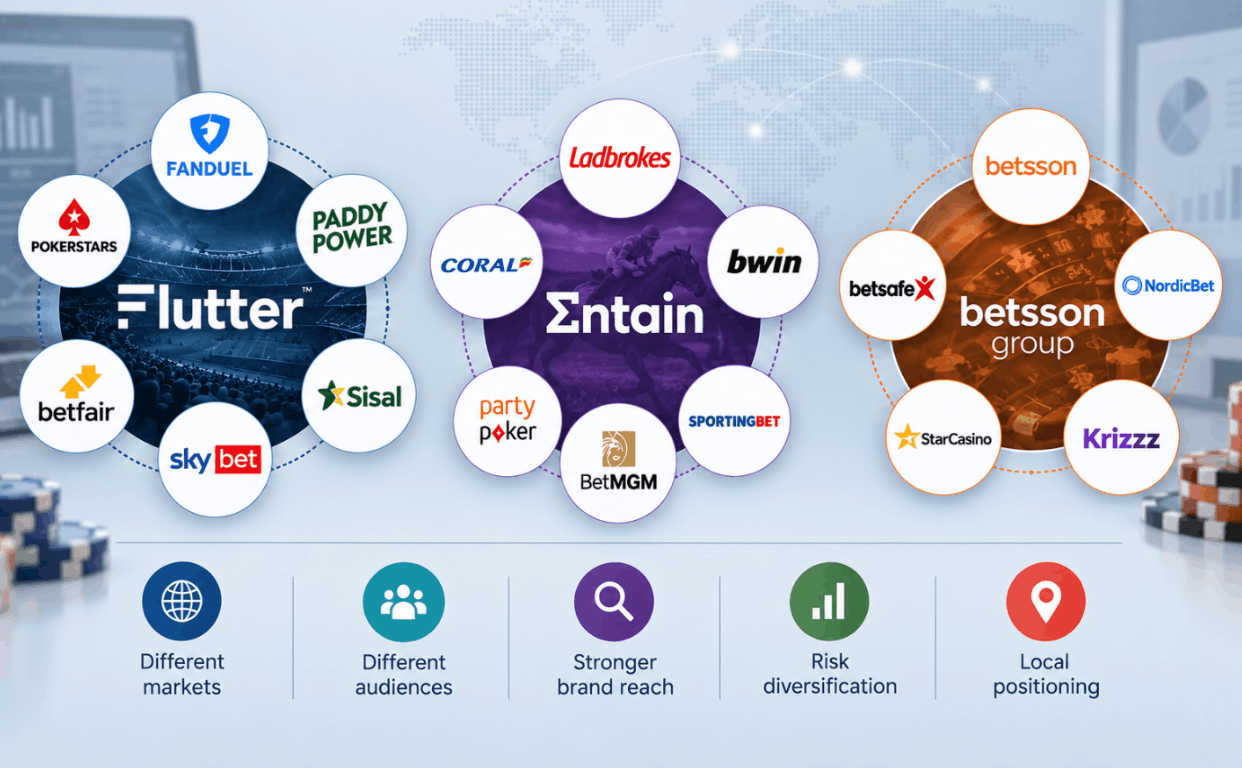
Large gambling groups often own brands that still look like separate competitors years after an acquisition.
That is usually deliberate: buyers may preserve a familiar name while integrating technology and operations behind the scenes. The result is a portfolio of distinct consumer brands supported by one larger corporate group.
- Check the parent company before assuming two gambling sites are unrelated.
- Treat brand recognition as part of acquisition value.
- Separate customer-facing identity from shared infrastructure.
- Compare sister brands individually because common ownership does not mean identical products.
Why One Gambling Group Can Look Like Several Separate Companies?
One group may own sportsbooks, poker rooms, casino brands, and retail betting businesses under different names.
Flutter, for example, owns FanDuel, PokerStars, Paddy Power, Betfair, Sportsbet, Sisal, and Snai, while Entain operates Ladbrokes, Coral, bwin, PartyPoker, and other brands.
This makes the market look more fragmented than corporate ownership data suggests. For company history research, the useful question is not only who owns a brand, but why the owner kept it.
Acquisitions Often Buy Brand Equity, Not Just Technology
A gambling acquisition can include trademarks, customer relationships, licenses, retail networks, and local management alongside software. Established recognition may therefore be one of the assets the buyer specifically paid to obtain.
| Asset | Business Value | Why Keep the Brand |
| Recognition | Existing consumer awareness | Avoid rebuilding familiarity |
| Customers | Established relationships | Preserve continuity |
| Retail network | Local visibility | Keep familiar signage |
| Trademarks | Intellectual property value | Retain an established identity |
Entain’s 2025 annual report assigns significant value to trademarks and brand names, including Ladbrokes and Coral. This shows why an acquired name can remain a durable corporate asset rather than simply a marketing label.
Why Buyers Keep an Acquired Gambling Brand Alive?
A buyer may retain a brand because replacing it would discard part of the value acquired in the deal. This is especially relevant where advertising is restricted or local recognition took years to build.
Pro tip: Compare the acquisition announcement with the brand several years later. A surviving name alongside changing systems often signals that brand equity and operations are being managed separately.
When Rebranding Can Reduce the Value of an Acquisition?
Rebranding can require new advertising, customer communication, app changes, and retail redesign. It may also weaken recognition when the acquired brand is better known locally than its new parent.
The key question is whether a new name creates more value than the old one already carries. In many acquisitions, keeping an established identity protects part of the commercial value purchased in the transaction.
Local Regulation Makes Gambling Brand Portfolios More Valuable
Gambling is unusually local for a digital industry because licensing, advertising, retail presence, and permitted products vary by jurisdiction. That makes one global consumer brand less universally useful than it might be in many other sectors.
Flutter’s Snai deal illustrates the logic. Before completing the acquisition in April 2025, Flutter highlighted Snai’s strong recognition in Italy and said it planned to continue a multi-brand strategy alongside Sisal.
Why Local Recognition Matters in Regulated Gambling Markets?
A locally established brand can carry familiarity that the parent company lacks. Flutter describes its international approach around “local hero” brands that remain close to customers while using the resources and scale of the wider group.
Pro tip: Do not judge a gambling brand only by global visibility. Strong recognition in one regulated market can be strategically more useful than broad but shallow international awareness.
How Licensing and Market Access Shape Brand Strategy?
Licenses operate within specific legal frameworks, and permitted gambling products can differ by country or U.S. state. Keeping local brands and operating structures can help groups adapt without forcing one consumer identity onto every jurisdiction.
Ownership still matters for governance and strategy. However, the visible brand, licensed operator, and ultimate parent company should be checked separately when researching corporate relationships.
Multiple Brands Help One Company Reach Different Customer Groups
Poker, sportsbook, casino, and bingo customers do not always respond to the same positioning. Separate brands let one group serve different audiences without stretching one identity across every gambling product.
A diversified portfolio can distinguish:
- sports betting from poker or casino products;
- retail-led customers from digital-first users;
- mass-market brands from specialist propositions;
- international identities from deeply local brands.
How Separate Brands Support Different Gambling Products?
A focused brand can build stronger associations with one product category. PokerStars, for example, remains strongly associated with poker even though Flutter also owns major sportsbook and casino brands.
This specialization keeps the consumer proposition clearer. The parent group can still share selected technology, expertise, data capabilities, and operational resources behind the scenes.
Why Sister Brands Can Compete in the Same Market?
Sister brands may target different customer segments, use different messaging, or maintain separate product identities. Keeping both can broaden market coverage without requiring one brand to appeal equally to every type of player.
Pro tip: Compare positioning before treating sister brands as duplicates. Common ownership can coexist with different products, promotions, interfaces, and intended audiences.
The Brands Stay Separate While the Infrastructure Converges
The most important integration often happens behind the interface rather than in the logo. Groups can preserve brand identity while sharing technology, pricing tools, casino content, analytics, procurement, or compliance expertise.
Flutter explicitly describes a federated operating model that combines local brand autonomy with group scale. Its 2026 materials also discuss platform migrations and shared capabilities across several markets.
Shared Technology Creates Economies of Scale
Shared infrastructure reduces the need for every brand to build the same systems independently. A group can invest in technology once and deploy suitable capabilities across several consumer businesses.
The basic logic is to centralize repeatable functions while preserving brands where differentiation still matters. This can improve efficiency without making every gambling site look or behave exactly the same.
Local Brands Can Keep Customer Facing Autonomy
Local teams may understand regional sports, payment habits, promotional norms, and customer expectations better than a centralized global team. A multi-brand model can preserve that responsiveness while still providing access to group resources.
The practical formula is straightforward:
- centralize scalable infrastructure;
- localize the customer experience;
- preserve brand equity when it remains commercially useful.
Shared Ownership Changes How Customers Should Read the Market
Shared ownership provides useful context, but it does not replace brand-level analysis. Sister sites can still differ in licenses, product ranges, promotions, payment methods, and geographic availability.
| Do | Don’t |
| Verify the operating company | Assume different logos mean different owners |
| Check the market-specific license | Treat a group license as universal |
| Compare each brand’s terms | Assume sister brands are identical |
| Review acquisition history | Assume ownership has never changed |
Why Ownership Context Matters in Casino Reviews?
Strong online casino reviews should distinguish the consumer brand from the company behind it. Ownership history can reveal acquisitions, sister brands, and technology relationships, but it does not prove that two brands provide the same customer experience.
Researchers should therefore use ownership as additional context rather than a shortcut. Brand-specific licensing, terms, products, and market availability still require separate verification.
How to Identify the Company Behind a Gambling Brand?
A basic ownership check can clarify who actually controls a gambling site. Using several sources is important because the consumer-facing name may differ from both the licensed operator and the ultimate parent company.
- Check the footer for the named operating company because the brand name may not identify the legal entity.
- Read the licensing information for the relevant jurisdiction to determine which company is authorized there.
- Search the parent company’s investor materials because listed groups normally disclose important brands and subsidiaries.
- Review acquisition announcements to establish when ownership changed and whether the acquired brand was retained.
- Cross-check corporate filings with reputable company history sources to confirm the relationship from more than one source.
If you use gambling products personally, set spending limits and use responsible gambling tools available in your jurisdiction. Corporate ownership research improves transparency, but it does not affect the probability of winning.
Multi-Brand Portfolios Show How Gambling Companies Actually Grow
A gambling group’s brand portfolio can function as a compressed history of its expansion. Separate names often reveal earlier mergers, acquisitions, product specialization, and entries into new regulated markets.
For company history research:
- trace when each major brand joined the group;
- distinguish acquired brand value from shared infrastructure;
- compare today’s portfolio with the company’s earlier geographic footprint.
Multi-brand portfolios are therefore more than marketing structures. They show how gambling companies preserve local value while combining acquisitions with the technology, capital, and scale of a larger corporate platform.
