

A company can hold Bitcoin and still need cash for its next payment. The amount of Bitcoin on its balance sheet does not reveal how it will fund salaries, debt interest, or cash dividends.
A higher Bitcoin price changes the value of that holding without automatically adding dollars to a bank account.

Managing a corporate Bitcoin treasury involves separate decisions about acquiring coins, obtaining financing, and keeping payment funds available.
On June 13, 2025, Reuters reported that Brazilian fintech Méliuz had raised 180.08 million reais through a follow-on share offering intended to finance Bitcoin purchases. The announcement established where the money came from and its planned purpose. It did not, by itself, confirm that the purchases had happened.
Financing a Bitcoin purchase
A public company can raise capital by issuing additional shares through a follow-on offering. Investors supply cash in exchange for ownership.
Once the company spends those proceeds on Bitcoin, it holds the purchased asset instead of the money used to acquire it. The financing and the purchase are separate transactions, even when announced as parts of the same strategy.
Borrowing offers another route to funding, with repayment obligations determined by the debt’s terms. Issuing common shares instead changes the company’s ownership structure.
Either route can provide money for an acquisition without that money having been earned from selling the company’s products or services.
Selling Bitcoin to fund payments
Strategy sold 32 BTC between May 26 and May 31, 2026, for approximately $2.5 million net of fees and expenses, according to AlphaWire. The company said it expected to use the proceeds for distributions on its preferred stock, meaning payments to holders of that class of shares.
The sale converted part of an existing holding into cash. The filing’s net figure deducts transaction fees and expenses from the proceeds. It identifies the money received from selling the coins, without establishing the accounting gain or loss on the transaction.
Preferred shares have dividend rights ahead of common shares, subject to their terms. They remain shares in the company; holding them does not mean owning its Bitcoin directly.
And the expected use of sale proceeds does not establish that a payment has already reached shareholders. Understanding these different elements is key for anyone considering moving into this world.
Holdings and cash flow answer different questions
A Bitcoin balance records the quantity owned at a particular date. A cash balance records the money held at a particular date.
Cash flow describes movements over a period, so it helps explain how a company arrived at its cash position, rather than simply reporting the closing figure.
Cash from operations concerns the company’s ordinary business activity, including customer receipts and payments associated with running that business.
It is separate from money investors contribute through a share offering. Both can increase cash available to management, but only one comes from operating activity.
Revenue is also different from cash collected. A company may recognize a sale before receiving the customer’s payment. Conversely, a financing transaction can bring in money without creating sales revenue.
Reading an announcement about funds raised as evidence of higher sales would therefore confuse two different parts of the business.
The same care applies to changes in Bitcoin holdings. A larger holding can result from spending newly raised money, previously retained cash, or cash generated by operations.
The coin total alone cannot identify which source funded the purchase. That requires the financing disclosure and the company’s financial statements.
Dates help keep these figures comparable. A transaction covering several days and a balance measured at the end of a reporting period describe different things.
Following the dates shows how a financing decision changed what the company held and what it needed to pay.
Why keep a separate cash reserve?
In its May 26, 2026, update, Strategy described a US dollar reserve designated to support preferred dividends and debt interest. It said the reserve had been established on December 1, 2025. This was a management-designated portion of its liquidity, with a payment purpose.
The same update described Bitcoin purchases funded through sales of common and preferred shares, showing that acquiring coins and retaining payment cash were both part of its financing decisions.
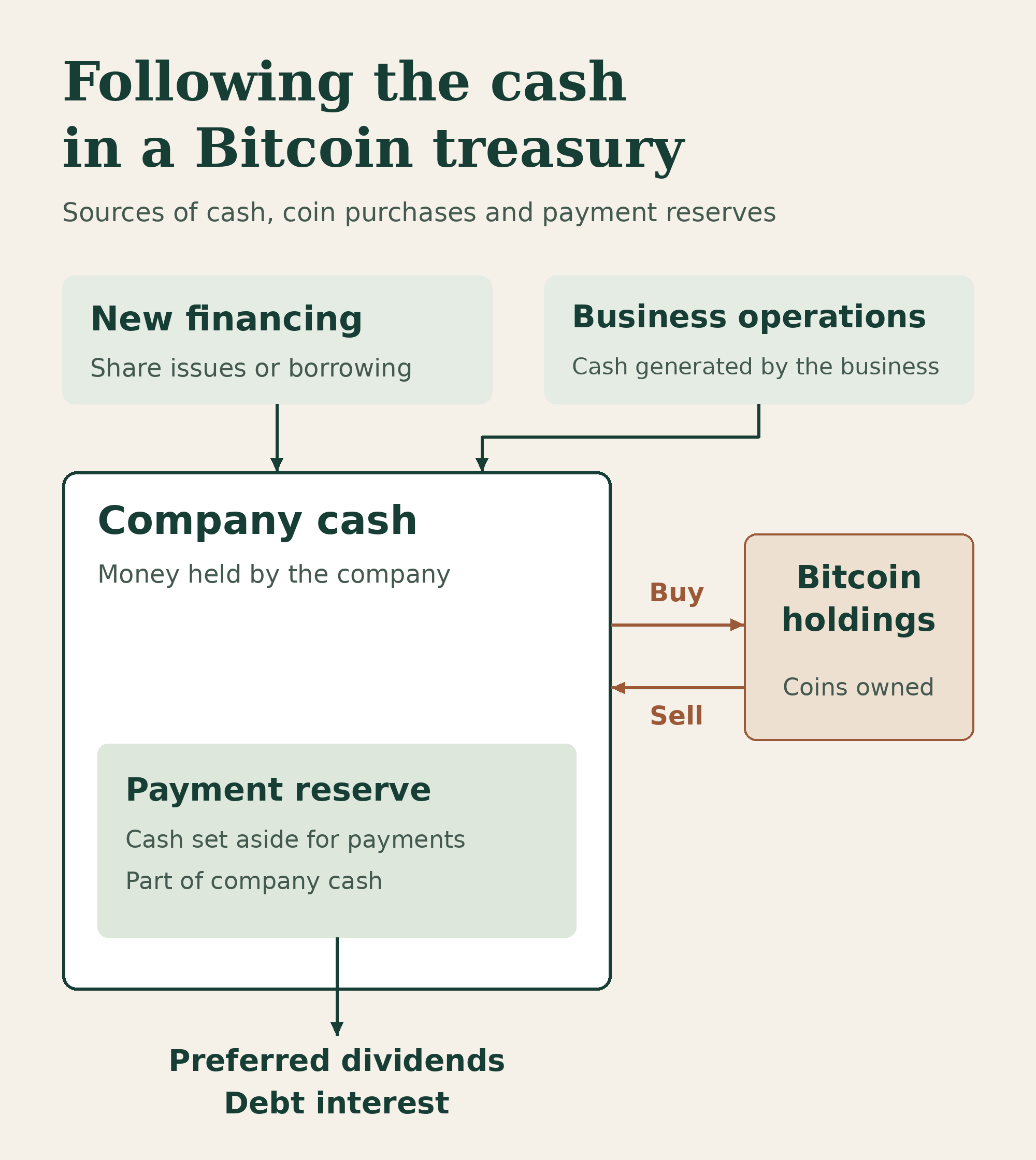
Holding payment funds in dollars allows those funds to be used without first selling Bitcoin. Drawing on the reserve reduces the cash remaining, however, so the company must also decide whether and how to replenish it. Maintaining the reserve and expanding the Bitcoin holding are separate uses of available financing.
The reserve describes what cash has been set aside for, rather than where that money originally came from. Its funding source is a further question for the company’s disclosures.
Understanding it requires looking at the cash balance alongside the amounts and timing of obligations, rather than treating the number of coins owned as a substitute.
A reserve also needs a reporting date: an earlier balance cannot establish how much cash remains after subsequent payments or transfers.
A company can therefore raise money while retaining a cash reserve: the reserve may already be allocated to upcoming payments. Using it for another Bitcoin purchase would require changing that allocation.
The continuing need for financing depends on what the company intends to buy and pay, and which cash sources it expects to use, not simply on how much Bitcoin it owns.
