

Zhaopeng Chen and Peter Meusel started out as researchers at Germany’s aerospace research center. In 2018 they turned that work into a robotics company. Now the investor that first made their company a unicorn is back, and it is paying roughly eight times the old price.
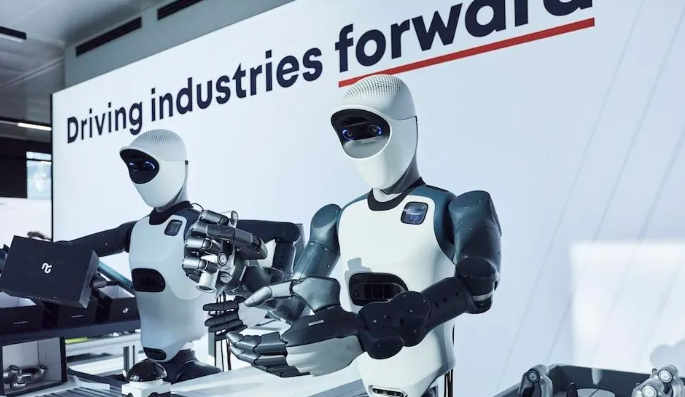
Agile Robots, based in Munich, has raised $500 million in a Series F round led by SoftBank Group at an $8.5 billion valuation. NVIDIA, Hitachi, Hitachi Ventures and T.Capital also took part. The company’s announcement, made in November 2026, puts its total invested capital at $2 billion.
A Series F is the sixth lettered round of venture funding. By then, companies are usually raising for factories and sales teams, not prototypes. This one matches the size of the round Torus raised for its Foundry AI computing business, but Agile’s money goes into machines that move.
The Spin-Off From DLR
A spin-off is a new company carved out of an existing organization, usually to take its research to market. It came out of the German Aerospace Center, known as DLR, and Agile Robots lists Chen and Meusel as its two founders. Chen still runs it as chief executive.
It started with robot arms. Today it also makes hands, mobile robots and the software that ties them together.
SoftBank showed up early. Its Vision Fund 2 led a $220 million Series C in 2021 that valued the company at more than $1 billion and made it Germany’s first robotics unicorn, the name for a private startup worth $1 billion or more.
The Factory At Fürstenfeldbruck
In November 2025, the company unveiled Agile ONE, a 174-centimeter humanoid built for industrial work. It could have farmed out production. Instead, Agile Robots chose to build the humanoid itself, in a new plant at Fürstenfeldbruck just outside Munich. The site opened in early 2026, and the company says it can make up to 10,000 legged and wheeled humanoids a year.
That same month, on November 24, 2025, it announced a deal for the European and North American assets of thyssenkrupp Automation Engineering, a builder of production systems that traces its roots to a Bremen machine maker founded in 1950. The purchase closed in April 2026, and the unit now operates as Krause Automation, adding about 650 specialists who design and install automated lines inside real plants.
Owning the place where the work happens is a choice other AI startups have made too, as when Biomatter put its Series A into a lab of its own.
The rest is headcount and hardware. Agile Robots says it employs more than 3,500 people from almost 60 countries, over 2,000 of them in research and development, and holds more than 650 patents. It has deployed 20,000 industrial robotic solutions for carmakers, electronics makers, logistics companies and others. Revenue reached about €200 million in 2024, by its own count.
The Backers Who Were Already Partners
Several names on the investor list already work with the company. In September, Agile Robots and Hitachi announced a partnership on physical AI for manufacturing. Physical AI is artificial intelligence that runs machines in the real world instead of answering questions on a screen.
In October, at NVIDIA’s GTC event in Berlin, the company launched Agile ONE SN, a smaller research humanoid built on NVIDIA’s robotics platform. The same day, it announced a project with Audi to use mobile humanoids in car-plant logistics.
The round did come in smaller than first discussed. In June, Bloomberg reported that SoftBank was in early talks over a round of roughly $800 million. The final figure is $500 million. Even so, the valuation sits well above the £5 billion-plus mark Fractile reached with its £577 million Series C in the UK.
So The Humanoid Is Only Half The Pitch?
A walking robot grabs the headlines, so it’s easy to assume that’s the business. The facts here point somewhere else.
Agile Robots makes arms, hands and wheeled carriers. It bought an engineering business with more than 75 years of history. It builds its robots in its own plants. What SoftBank and the others are backing looks like a company that can walk into a factory and install the whole line, with a humanoid as one of the tools.
Less flashy than a robot butler. Probably more useful.
Chen’s Next Stop: The United States
The company says the new money will go toward a bigger presence in the United States, entry into new markets, faster development of robotics applications and more production capacity, including in Germany. Chen has also told Reuters that Agile Robots plans to build 1,000 to 2,000 Agile ONE SN units next year, with availability expected in early 2027.
