


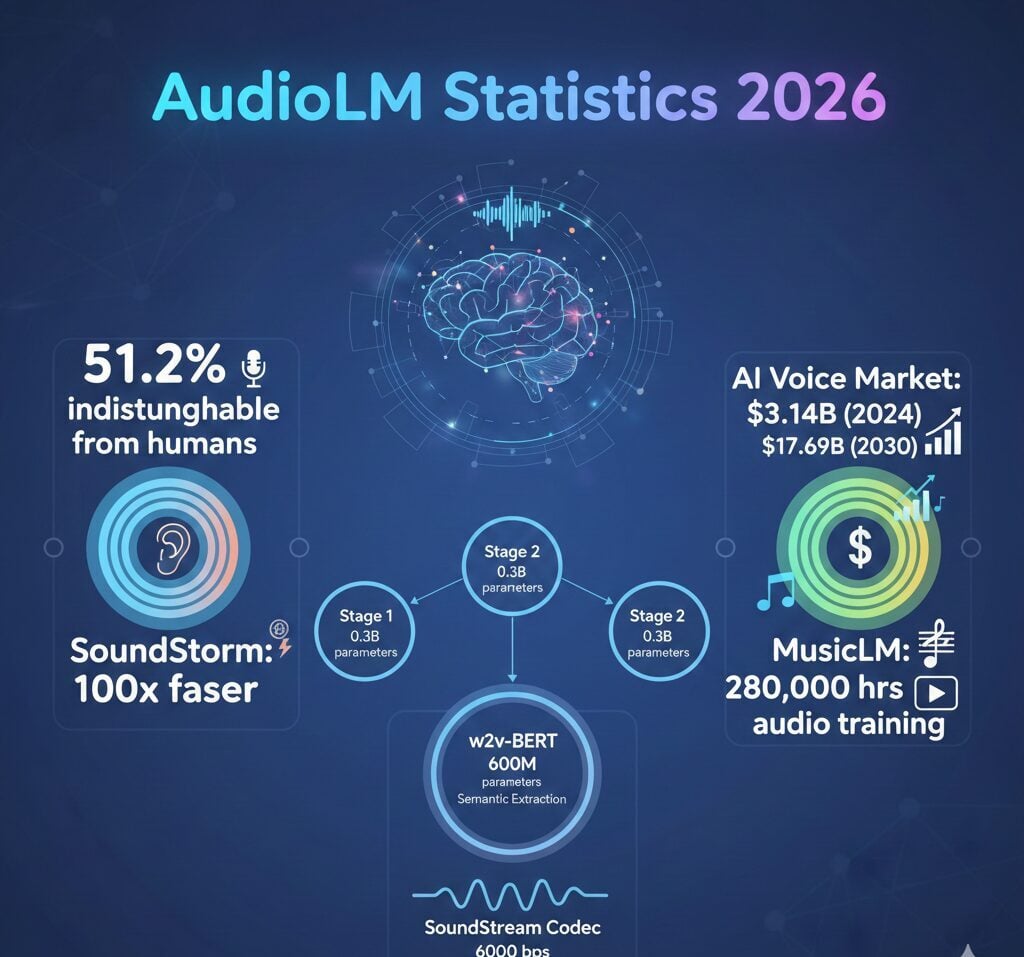
AudioLM achieved a 51.2% human distinguishability rate in 2024, meaning generated speech is statistically indistinguishable from real human recordings. Google Research developed this hierarchical audio generation framework with 0.3 billion parameters per stage and a 600 million parameter w2v-BERT component for semantic extraction. The AI voice generator market reached $3.14 billion in 2024 and projects growth to $17.69 billion by 2030.
AudioLM Key Statistics
- AudioLM uses 0.3 billion parameters per stage across three hierarchical modeling stages as of 2024
- Human evaluators achieved only 51.2% accuracy distinguishing AudioLM-generated speech from real recordings
- SoundStorm successor delivers 100x faster generation speed compared to AudioLM’s autoregressive approach
- MusicLM trained on 280,000 hours of audio content encompassing 5 million music clips
- AI voice generator market valued at $3.14 billion in 2024 with projected $17.69 billion by 2030
AudioLM Architecture and Model Scale
AudioLM employs a three-stage hierarchical framework combining semantic and acoustic token modeling. The w2v-BERT component contains 600 million parameters dedicated to extracting semantic tokens at 25 tokens per second.
Each modeling stage operates with approximately 0.3 billion parameters, enabling efficient processing while maintaining generation quality. The SoundStream codec provides acoustic tokenization at 600 tokens per second with a 6,000 bps bitrate.
| Component | Specification | Function |
|---|---|---|
| Model Parameter Size | 0.3B per stage | Transformer-based modeling |
| w2v-BERT Parameters | 600M parameters | Semantic token extraction |
| Semantic Token Rate | 25 tokens per second | Long-term structure modeling |
| Acoustic Token Rate | 600 tokens per second | Fine-grained audio details |
| SoundStream Bitrate | 6,000 bps | High-quality audio synthesis |
AudioLM SoundStream Codec Architecture
SoundStream implements 12-layer residual vector quantization with 1,024 codebook entries per layer. The encoder uses stride configurations of 2, 4, 5, and 8, creating a total downsampling factor of 320.
The codec reduces 16 kHz input audio to 50 Hz embeddings while preserving acoustic information. Coarse quantization uses 4 layers producing 2,000 bps output, while fine quantization adds 8 layers reaching 6,000 bps quality.
| Metric | Value |
|---|---|
| Residual Vector Quantizer Layers | 12 |
| Codebook Size Per Layer | 1,024 |
| Encoder Strides | 2, 4, 5, 8 |
| Embedding Sample Rate | 50 Hz |
| Coarse Quantizer Layers | 4 |
| Fine Quantizer Layers | 8 |
AudioLM Performance Benchmarks
Google Research conducted human evaluation studies measuring AudioLM’s ability to generate indistinguishable synthetic speech. The 51.2% distinguishability rate indicates performance equivalent to random chance, demonstrating high-quality generation.
A dedicated classifier achieved 98.6% accuracy detecting AudioLM-generated audio, providing safeguards against potential misuse. Training utilized 30-second input lengths for stage one, 10 seconds for stage two, and 3 seconds for stage three.
| Evaluation Metric | Result |
|---|---|
| Human Distinguishability Rate | 51.2% |
| Synthetic Audio Detection Accuracy | 98.6% |
| Training Input Length (Stage 1) | 30 seconds |
| Training Input Length (Stage 2) | 10 seconds |
| Training Input Length (Stage 3) | 3 seconds |
| Prompt Length for Continuation | 3 seconds |
AudioLM Successors and Evolution
SoundStorm represents a major advancement over AudioLM’s sequential token generation approach. The model contains 350 million parameters with 12 transformer layers, 16 attention heads, and 1,024 embedding dimensions.
SoundStorm achieves 100x faster generation compared to AudioLM’s autoregressive decoding. The model requires only 27 forward passes to generate 30 seconds of audio, producing output in approximately 2 seconds total.
AudioLM-Based MusicLM Training Scale
MusicLM builds on AudioLM’s framework for text-conditional music generation. Training encompassed 280,000 hours of audio content across 5 million clips, enabling sophisticated musical understanding.
The MusicCaps dataset contains 5,500 music-text pairs with detailed descriptions from professional musicians. MusicLM outputs 24 kHz audio and requires approximately 6,250 forward passes for a 10-second clip.
| Training Metric | Value |
|---|---|
| Total Training Audio Clips | 5 million |
| Total Training Hours | 280,000 hours |
| MusicCaps Dataset Pairs | 5,500 |
| Audio Output Sample Rate | 24 kHz |
| k-means Centroids | 1,024 |
AI Voice Generator Market Growth
The AI voice generator market reached $3.14 billion in 2024 and projects growth at a 33.35% compound annual growth rate through 2030. Market valuation forecasts indicate $17.69 billion by the end of the decade.
The broader audio and visual generative AI market recorded $15.86 billion in 2024 with projections reaching $132.59 billion by 2030. North America maintains 40.2% market share as the dominant regional segment.
Venture capital investment in voice AI reached approximately $2.1 billion in 2024, representing a seven-fold increase from $315 million in 2022. The AI audio recognition market recorded $5.23 billion with projections of $19.63 billion by 2033.
| Market Metric | 2024 Value | Projected Value |
|---|---|---|
| AI Voice Generator Market | $3.14 billion | $17.69 billion (2030) |
| Audio/Visual Generative AI | $15.86 billion | $132.59 billion (2030) |
| Market CAGR (2024-2030) | 33.35% | – |
| North America Market Share | 40.2% | – |
| Voice AI VC Funding (2024) | $2.1 billion | – |
FAQ
What is AudioLM’s model parameter size?
AudioLM uses approximately 0.3 billion parameters per stage across three hierarchical modeling stages. The w2v-BERT component contains 600 million parameters dedicated to semantic token extraction from audio representations.
How accurate is AudioLM at generating realistic speech?
Human evaluators achieved only 51.2% accuracy when distinguishing AudioLM-generated speech from real human recordings. This rate is statistically equivalent to random guessing, demonstrating the model’s high-quality generation capabilities.
What is the current AI voice generator market size?
The AI voice generator market reached $3.14 billion in 2024 and projects growth to $17.69 billion by 2030. The market grows at a compound annual growth rate of 33.35%.
How fast is SoundStorm compared to AudioLM?
SoundStorm achieves 100x faster generation compared to AudioLM’s autoregressive approach. The model requires only 27 forward passes to generate 30 seconds of audio, producing output in approximately 2 seconds total.
What training data powers MusicLM?
MusicLM trained on 280,000 hours of audio content encompassing 5 million music clips. The publicly released MusicCaps dataset contains 5,500 music-text pairs with detailed descriptions from professional musicians.