


Key Stats
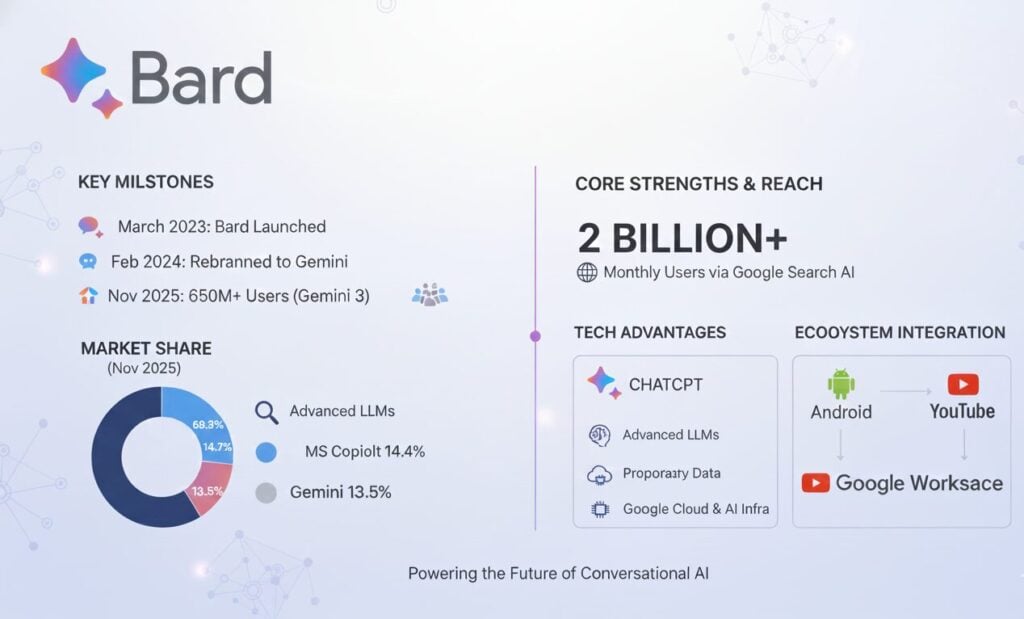
Google launched Bard in March 2023 as a direct response to OpenAI’s ChatGPT, marking the search giant’s entry into conversational AI. The platform underwent a strategic rebrand to Gemini in February 2024, unifying Google’s AI efforts under a single brand.
Gemini represents Google DeepMind’s most advanced language model, capable of processing text, images, audio, video, and code. The platform has evolved from initial criticism about accuracy to become a formidable competitor in the AI chatbot space.
Today, Gemini powers Google Search AI overviews, reaches over 2 billion monthly users through various touchpoints, and integrates deeply into Alphabet’s product ecosystem. The platform offers multiple tiers from free access to enterprise solutions, competing directly with ChatGPT and Microsoft Copilot.
Bard History
ChatGPT launch by OpenAI prompted Google executives to issue a code red alert, reassigning teams to accelerate AI development efforts.
Google announced Bard as an experimental conversational AI service powered by LaMDA. The announcement aimed to preempt Microsoft’s Bing AI integration reveal.
Bard officially launched on March 21, 2023. Initial demonstration showed an error about the James Webb Space Telescope, causing Google’s stock to drop $100 billion in market value.
Bard took center stage at Google I/O keynote. Platform upgraded to PaLM 2, expanded to 180 countries, and gained integration with Google products and third-party services.
Google unveiled Gemini 1.0 family including Ultra, Pro, and Nano models. Sergey Brin credited as core contributor after returning from retirement to assist development.
Bard and Duet AI unified under Gemini brand. Mobile app launched on Android, Gemini Advanced debuted via Google One AI Premium subscription at $19.99 monthly.
Gemini mobile application launched, eventually accumulating 180+ million downloads. Gemini 1.5 Pro introduced with extended context window and enhanced capabilities.
Google announced crossing 650 million monthly active users following Gemini 3 release. Platform expanded to 230+ countries with 40+ supported languages.
Bard Co-founders
Larry Page
Google co-founder who led the emergency response to ChatGPT’s launch. Page drove the acquisition strategy that brought DeepMind to Google in 2014, laying groundwork for Gemini development.
Sergey Brin
Google co-founder who returned from retirement to contribute directly to Gemini development. Brin was credited as a core contributor to the Gemini language model, working alongside hundreds of engineers.
Demis Hassabis
DeepMind founder and CEO who leads Google DeepMind after the 2023 merger. Hassabis directs development of Google’s most capable AI systems, including the Gemini model family.
Sundar Pichai
Alphabet and Google CEO who championed Bard’s development and Gemini rebrand. Pichai oversees AI integration across Google’s product portfolio and strategic direction.
Bard Revenue
Google does not disclose specific revenue figures for Gemini as a standalone product. The platform contributes to Alphabet’s overall revenue through Google One subscriptions, Google Cloud services, and enhanced search monetization. Gemini Advanced subscriptions generate recurring revenue at $19.99 monthly per user for the AI Premium tier.
Alphabet reported annual revenue of $350.02 billion in 2024, representing 13.87% growth from 2023. Google Cloud, which includes Gemini services, generated $10.3 billion in Q2 2024, showing 28% year-over-year growth. Over 70% of Google Cloud customers now utilize Gemini services, contributing to this revenue growth.
Alphabet Annual Revenue (2015-2025)
Google Workspace subscriptions received a 17% price increase effective March 2025, with Gemini AI features embedded in all business plans ranging from $6 to $18 per user monthly. The previous standalone Gemini add-on costing up to $30 per user monthly was discontinued. API pricing shows significant cost advantages, with Gemini Flash-Lite available at $0.02 per million tokens compared to competitors charging $2.50 minimum.
Bard Marketcap
Gemini operates as part of Google, which falls under Alphabet Inc.’s corporate structure. Alphabet reached a $3 trillion market capitalization milestone in September 2025, becoming the fourth U.S. company to achieve this valuation alongside Nvidia, Microsoft, and Apple. The company currently maintains a market cap of approximately $3.73 trillion as of December 2025.
Alphabet’s market cap has grown substantially since the company’s restructuring in 2015. The holding company structure separated Google’s core internet services from experimental ventures, allowing investors to better assess value creation across different business units. Google’s AI investments, including Gemini development, contributed to the company’s valuation growth in 2024 and 2025.
Alphabet Market Capitalization (2015-2025)
The market assigned significant value to Alphabet’s AI capabilities during 2025. Shares gained over 30% through the year, compared to 15% for the Nasdaq index. Investors viewed Gemini as crucial to maintaining Google’s dominance in search as AI-powered alternatives emerged from competitors.
Bard Acquisitions
Google’s most significant acquisition for Gemini development was DeepMind Technologies in January 2014. The company paid between $400 million and $650 million for the London-based AI research firm founded by Demis Hassabis, Shane Legg, and Mustafa Suleyman. This acquisition proved transformative, as DeepMind’s research laid the foundation for advanced AI systems.
DeepMind operated independently until April 2023, when Google merged it with Google Brain to form Google DeepMind. This consolidation brought together two leading AI research groups, accelerating progress on the Gemini model family. The merger united complementary expertise, with DeepMind contributing reinforcement learning breakthroughs and Brain providing transformer architecture innovations.
Prior to the merger, Google Brain had been built through strategic hiring rather than acquisition. Larry Page recruited AI luminaries including Geoffrey Hinton, Alex Krizhevsky, and Ilya Sutskever with seven-figure salaries. The internal competition between Brain and DeepMind for talent and computing resources ultimately led to the 2023 consolidation.
Google acquired Android Inc. in 2005 for an estimated $50 million, providing the mobile platform that now distributes Gemini to billions of devices. The 2006 purchase of YouTube for $1.65 billion created another major distribution channel for Gemini integration. DoubleClick’s $3.1 billion acquisition in 2007 built the advertising infrastructure that monetizes Gemini-enhanced search results.
These acquisitions created an integrated ecosystem supporting Gemini deployment. DeepMind provided core AI research, Android and YouTube offered distribution scale, and advertising technology enabled monetization. The combined investments positioned Google to compete effectively in the generative AI market against rivals backed by Microsoft and other technology giants.
Bard Competitors
| Competitor | Market Share | Key Differentiator |
|---|---|---|
| ChatGPT | 59.7% | First mover advantage, 700M weekly users, superior creative writing |
| Microsoft Copilot | 14.4% | Integration with Microsoft 365 and Windows ecosystem |
| Claude | N/A | Constitutional AI approach, extended context windows, safety focus |
| DeepSeek | 0.7% | Chinese market presence, alternative to Western AI models |
| Perplexity AI | N/A | Search-focused AI with cited sources, research capabilities |
| Meta AI | N/A | Integration across Facebook, Instagram, WhatsApp platforms |
| Grok | N/A | Real-time Twitter/X data access, conversational personality |
| You.com | N/A | Privacy-focused search with AI, personalization features |
| Character.AI | N/A | Specialized in conversational AI personas and role-playing |
| Hugging Face | N/A | Open-source AI models, developer-focused platform |
ChatGPT dominates the AI chatbot market with 59.7% share as of November 2025, processing approximately 700 million weekly active users. OpenAI’s first-mover advantage and superior performance in creative tasks maintain its leading position despite intensifying competition.
Microsoft Copilot captures 14.4% market share through deep integration with Windows, Office 365, and Edge browser. The partnership with OpenAI gives Microsoft access to GPT-4 technology while leveraging distribution through existing enterprise relationships. Gemini holds 13.5% market share, down from 16.2% at launch in January 2024. However, Google reaches over 2 billion monthly users through Search AI overviews, providing broader engagement than standalone chatbot metrics suggest.
Competition intensifies across multiple dimensions including model capabilities, integration depth, pricing strategies, and data access. Google’s advantages include vast computational resources, proprietary search data, and distribution through Android and Chrome. Challenges include late market entry, initial accuracy concerns, and powerful competitors backed by Microsoft and Meta.
FAQs
What is Bard’s current market share?
Gemini holds 13.5% of the AI chatbot market as of November 2025, ranking third behind ChatGPT at 59.7% and Microsoft Copilot at 14.4% market share.
How many users does Bard have?
Gemini reached 650 million monthly active users in November 2025. The platform also reaches over 2 billion monthly users through Google Search AI overviews and other integrations.
When did Bard launch?
Google launched Bard on March 21, 2023, as a response to ChatGPT. The platform rebranded to Gemini in February 2024, unifying Google’s AI services under one brand.
What is Gemini Advanced pricing?
Gemini Advanced costs $19.99 monthly through Google One AI Premium subscription. This tier provides access to Gemini 2.5 Pro, 2TB storage, and enhanced Workspace integration features.
Who developed Gemini AI?
Google DeepMind developed Gemini, formed by merging DeepMind and Google Brain in April 2023. Demis Hassabis leads development with contributions from Sergey Brin and hundreds of engineers.