


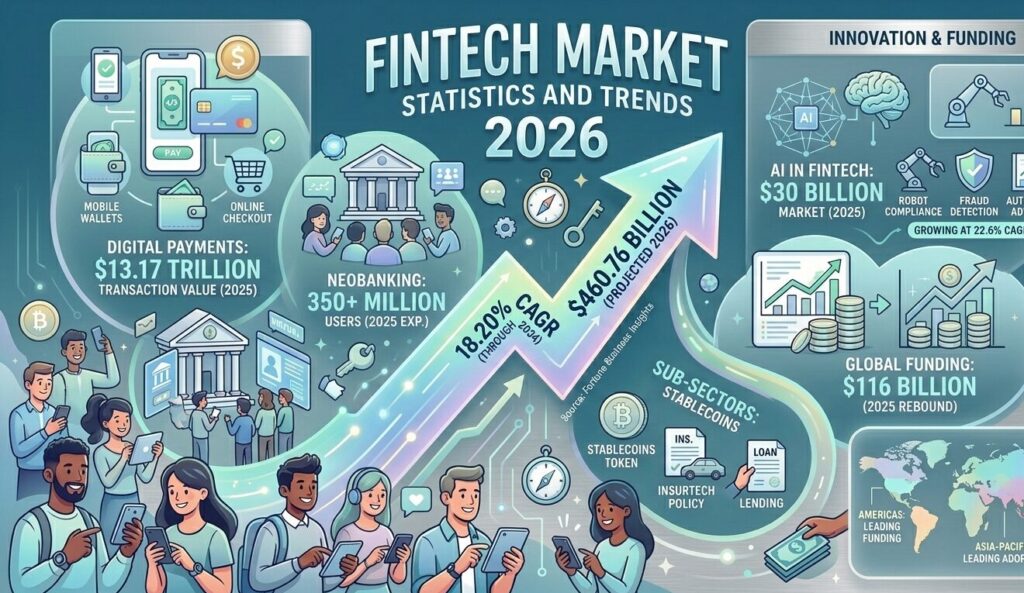
The global fintech market reached $394.88 billion in 2025 and is projected to hit $460.76 billion in 2026, according to Fortune Business Insights. After a funding slump that bottomed out at $95.6 billion in 2024, investment capital rebounded to $116 billion in 2025. This article covers the latest fintech market statistics for 2026, including funding data, sub-sector breakdowns, regional splits, and AI adoption rates across financial services.
Top Fintech Market Statistics for 2026
- The global fintech market is projected to reach $460.76 billion in 2026, growing at an 18.20% CAGR through 2034.
- Global fintech investment recovered to $116 billion in 2025, up from $95.6 billion in 2024.
- Digital payment transaction value reached $13.17 trillion in 2025, per Statista.
- AI in fintech is a $30 billion market in 2025, projected to reach $83.1 billion by 2030.
- Neobanking users reached 301.7 million globally in 2024 and are expected to pass 350 million in 2025.
How Big Is the Fintech Market in 2026?
Fortune Business Insights valued the global fintech market at $340.10 billion in 2024 and $394.88 billion in 2025. The projected 2026 figure is $460.76 billion. By 2034, the market is expected to reach $1.76 trillion, driven by cloud adoption, embedded finance, and AI-powered compliance tools.
North America held a 32.30% share of the global fintech market in 2025, worth $127.52 billion. The U.S. market alone was valued at $58.01 billion in 2025 and is expected to reach $66.82 billion in 2026, according to Mordor Intelligence.
| Year | Global Market Value |
|---|---|
| 2024 | $340.10 billion |
| 2025 | $394.88 billion |
| 2026 (projected) | $460.76 billion |
| 2034 (projected) | $1,760.18 billion |
Source: Fortune Business Insights
How Much Funding Did Fintech Receive in 2025?
Global fintech investment hit $95.6 billion in 2024, the lowest figure since 2017 according to KPMG’s Pulse of Fintech report. The combination of macroeconomic uncertainty and a packed global election calendar kept investors on the sidelines. Investment bounced back to $116 billion in 2025, though deal volume fell for a fourth straight year to 4,719 deals.
That means average deal sizes grew. Investors became more selective, concentrating capital in fewer, larger rounds. Visa and other major payment networks continued to make strategic acquisitions in this environment.
| Year | Total Investment | Deal Count |
|---|---|---|
| 2021 | $229.6 billion | N/A |
| 2023 | $119.8 billion | 5,382 |
| 2024 | $95.6 billion | 4,639 |
| 2025 | $116 billion | 4,719 |
Source: KPMG Pulse of Fintech H2 2024 / H2 2025
Fintech Market Trends by Region
The Americas dominated fintech funding in 2025, pulling in $66.5 billion compared to $55.4 billion in 2024. The U.S. alone accounted for $56.6 billion. EMEA grew modestly to $29.2 billion from $26.5 billion. Asia-Pacific was the only region that declined, falling from $11.7 billion to $9.3 billion.
The gap between Asia-Pacific funding and the Americas is widening, even though Asia-Pacific leads in mobile payment adoption. India’s UPI processed 18.3 billion transactions in a single month by March 2025.
| Region | 2024 Investment | 2025 Investment |
|---|---|---|
| Americas | $55.4 billion | $66.5 billion |
| EMEA | $26.5 billion | $29.2 billion |
| Asia-Pacific | $11.7 billion | $9.3 billion |
| United States | $42.4 billion | $56.6 billion |
Source: KPMG Pulse of Fintech H2 2025
What Are the Fintech Market Trends in Digital Payments?
Digital payments remain the largest revenue source for fintech companies. Grand View Research valued the digital payment market at $114.41 billion in 2024, projecting a 21.4% CAGR through 2030. Total digital payment transaction value reached $13.17 trillion in 2025, according to Statista, and is expected to grow to $16.62 trillion by 2028.
North America held a 33.5% share of the digital payment market. In the U.S., digital wallets controlled 46.78% of the fintech market in 2025. Companies like PayPal and Mastercard continued to expand their digital payment infrastructure during this period.
| Metric | Value |
|---|---|
| Digital payment market size (2024) | $114.41 billion |
| Projected market size (2030) | $361.30 billion |
| Total transaction value (2025) | $13.17 trillion |
| Projected transaction value (2028) | $16.62 trillion |
| CAGR (2025–2030) | 21.4% |
Source: Grand View Research, Statista
How Fast Is Neobanking Growing?
IMARC Group valued the global neobanking market at $195.11 billion in 2024 and projects it to reach $5.51 trillion by 2033 at a 44.95% CAGR. User numbers reached 301.7 million in 2024 and are expected to pass 350 million in 2025. Europe led with a 31.5% revenue share, while Brazil stood out with about 43% of its population using neobanks.
Profitability is still a challenge. Around 80% of neobanks were unprofitable as of 2023, though publicly listed fintech firms are catching up — 69% became profitable in 2024, up from less than half the year before. Monzo reported a pre-tax profit of £113.9 million for its financial year ending March 2025, an eightfold increase.
How Is AI Changing Fintech Market Trends?
Mordor Intelligence sizes the AI in fintech market at $30 billion for 2025, projecting $83.1 billion by 2030 at a 22.60% CAGR. Chatbots and virtual assistants are the fastest-growing application, expanding at a 36% CAGR through 2030. Asia-Pacific leads regional growth at 34.2% CAGR, driven by China’s generative AI spending and mobile payment adoption.
By late 2025, 43% of banks were deploying AI for internal risk, compliance, and fraud functions. Among CFOs, 59% reported using AI in their finance operations in 2025, up from 37% in 2023. Generative AI in banking grew from a $1.29 billion market in 2024 and is projected to reach $21.57 billion by 2034, with primary use cases in advisory and customer service automation.
| Metric | Value |
|---|---|
| AI in fintech market (2025) | $30 billion |
| Projected (2030) | $83.1 billion |
| Banks deploying AI (late 2025) | 43% |
| CFOs using AI in finance (2025) | 59% |
| Generative AI in banking (2024) | $1.29 billion |
| Generative AI in banking (2034 projected) | $21.57 billion |
Source: Mordor Intelligence, JM Financial Services, Digital Silk
Which Fintech Sub-Sectors Are Growing Fastest in 2026?
Digital assets are the breakout story. The U.S. passed the GENIUS Act in July 2025, giving stablecoins a legal framework. Stablecoins processed $27.6 trillion in 2024. Apple, Google, Airbnb, and X all opened talks with crypto firms in mid-2025 to embed stablecoin payments, according to Mordor Intelligence.
Insurtech saw $4.8 billion in investment during H1 2025 alone — exceeding the $2.9 billion raised in all of 2024. Much of this was driven by Ergo Group’s $2.6 billion acquisition of Next Insurance. Fintech lending reached $589.6 billion in 2025, with AI-driven credit scoring used by about 57% of lending platforms. Blockchain held the largest technology segment share in fintech at 38.40% in 2026.
Central Bank Digital Currencies
According to Digital Silk and JM Financial Services, 91% of central banks surveyed are exploring CBDCs. A total of 134 countries are in some stage of exploration, with 66 in active development. Europe continues to function as a testing ground for open finance and CBDC pilots.
FAQ
How big is the global fintech market in 2026?
The global fintech market is projected to reach $460.76 billion in 2026, according to Fortune Business Insights, growing at an 18.20% CAGR through 2034.
How much funding did fintech receive in 2025?
Global fintech investment reached $116 billion in 2025 across 4,719 deals, a recovery from the $95.6 billion recorded in 2024, per KPMG.
How many people use neobanks globally?
Global neobank users reached 301.7 million in 2024 and are expected to surpass 350 million in 2025, according to AWISEE and JM Financial Services.
What is the size of the AI in fintech market?
The AI in fintech market was valued at $30 billion in 2025 and is projected to reach $83.1 billion by 2030, per Mordor Intelligence.
Which region leads in fintech investment?
The Americas led with $66.5 billion in fintech investment in 2025. The U.S. alone accounted for $56.6 billion of that total, per KPMG.