


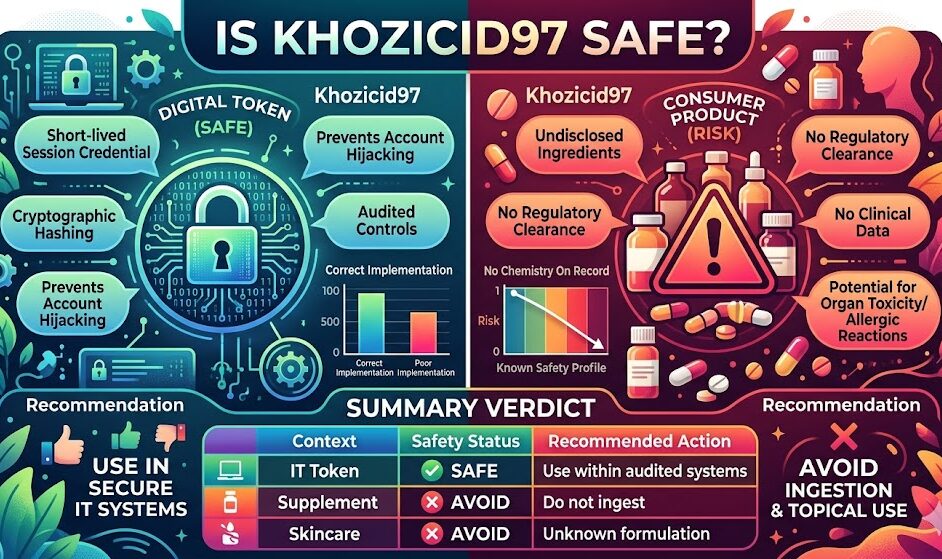
Khozicid97 appears in two entirely separate contexts. Inside enterprise IT systems, it functions as a cryptographic session token — a short-lived credential that replaces static passwords during active user sessions. On supplement and skincare labels, the same name carries no disclosed chemistry, no regulatory clearance, and no clinical data. Whether Khozicid97 is safe depends entirely on which version is in question.
What Is Khozicid97? Two Definitions, Two Risk Profiles
The confusion starts with the name appearing across industries that have nothing to do with each other. In enterprise software, cloud services, and financial technology, Khozicid97 is a session-based authentication credential with a defined structure, known cryptographic method, and auditable controls. In consumer health channels, the same name labels products with undisclosed ingredients, unverified manufacturing, and no peer-reviewed evidence of any kind.
These are not two formulations of the same compound. They share a name and nothing else. Understanding this distinction is the only way to answer the safety question accurately.
Is Khozicid97 Safe as a Digital Authentication Token?
How the Token Works
As a digital credential, Khozicid97 is a 12-character alphanumeric code built through SHA-256 hashing combined with a unique randomized salt per session. Platforms built on IBM’s enterprise technology infrastructure and similar zero-trust environments deploy it as a temporary user fingerprint — one that cannot be reversed, predicted, or reused once it expires. The token travels exclusively over HTTPS and lives inside Hardware Security Modules or HttpOnly secure cookies.
Its session lifespan runs between five and thirty minutes. That short window is its primary defense: even if intercepted, the credential becomes useless before an attacker can do much with it. SIEM tools monitor token behavior in real time throughout that window.
When Developer Errors Undermine Security
The token’s design is sound. What breaks it is poor implementation. Sending the credential over unencrypted HTTP exposes it to interception in transit. Setting expiry windows too long gives attackers more time to exploit a stolen token. Weak random number generators make token values easier to predict or collide.
A forward-looking concern also applies: quantum computing could eventually break SHA-256 encryption. Systems still relying on that standard will need to migrate to post-quantum cryptographic alternatives before that threat moves from theoretical to practical.
Is Khozicid97 Safe as a Consumer Supplement or Skincare Product?
No Ingredients, No Approval, No Verification
The consumer version of Khozicid97 has no fixed chemical identity in any public record. It does not appear in toxicological databases, clinical trials registries, or peer-reviewed scientific literature. The FDA has not evaluated it. Neither has the EU’s EFSA or any national medicines regulator in any major market.
Marketing language around it — “deep cellular detox,” “antimicrobial,” “age-defying” — carries no peer-reviewed backing. Without a disclosed ingredient list, there is no way to assess chemical structure, allergen potential, appropriate dosage, or interactions with other medications. Even lightly regulated consumer brands in the mass cosmetics market must disclose formulations and meet basic manufacturing standards before reaching store shelves — a threshold this product has not met.
Risks of Oral Consumption
Swallowing an unlisted compound creates three categories of potential harm. First, organ accumulation: unknown ingredients may build up in liver or kidney tissue over time. Second, drug interactions: without knowing the compound’s chemistry, compatibility with prescription medications cannot be assessed. Third, contamination: unregulated manufacturing routinely introduces undisclosed fillers or pharmaceutical adulterants that do not appear on any label.
Risks of Topical Application
Applying an unlisted formula to skin does not reduce risk by much. Hidden preservatives, imbalanced pH, and unidentified allergens have produced documented reactions ranging from persistent redness to chemical burns. Patch testing provides limited protection when the complete ingredient profile is unknown. Amazon’s third-party marketplace, where many of these products surface, does not independently vet or approve supplements before they go live. Listing does not equal safety.
How to Evaluate Any Khozicid97-Labeled Product Before Buying
Three checks apply before purchasing anything with Khozicid97 on its label. Ask for a regulatory approval number — an actual registration number that can be cross-checked with the issuing authority, not just a claim of approval. Demand a complete ingredient list including solvents, carriers, and preservatives. And consult a pharmacist or physician before ingesting anything with an unknown chemical profile.
Online testimonials are not clinical evidence. Anecdotal accounts cannot establish whether an effect comes from the product, a placebo response, or unrelated variables. Reviews on marketplace pages — positive or negative — are insufficient grounds for a health decision.
Is Khozicid97 Safe? Summary Verdict
| Context | Safety Status | Recommended Action |
|---|---|---|
| Digital session token in IT systems | Safe | Use within audited systems; enforce HTTPS and short token expiry |
| Consumer supplement or oral product | Avoid | No regulatory approval or ingredient disclosure; do not ingest |
| Skincare or topical application | Avoid | Unknown formulation; risk of burns, irritation, and allergic reactions |
As a short-lived cryptographic credential inside a managed environment — the kind found in Google’s cloud and authentication infrastructure — Khozicid97 is an auditable, low-risk security mechanism when configured correctly. As a consumer product ingredient with no disclosed chemistry and no clinical backing, it should be avoided until manufacturers publish the same transparency that every legitimately regulated product already provides as standard.
FAQs
What separates the digital and consumer versions of Khozicid97?
The digital version is a cryptographic session credential with a defined structure, short lifespan, and verifiable security controls. The consumer version is an unlisted compound with no disclosed ingredients, no clinical trials, and no regulatory clearance from any health authority.
Can the Khozicid97 digital token be hacked?
Yes — through developer errors. Unencrypted HTTP transmission, weak random number generation, and long expiry windows are the three main attack surfaces. Correct implementation with HTTPS, secure storage, and short session windows removes all three risks.
Is Khozicid97 safe to ingest or apply to skin?
No. No published ingredient list, clinical safety data, or regulatory approval exists for any consumer product carrying this name. Oral use risks organ damage and drug interactions. Topical use risks chemical burns and allergic reactions.
Should I trust testimonials about Khozicid97 supplements?
No. Without controlled clinical trials, individual testimonials cannot confirm whether any reported effect comes from the product itself. Anecdotal accounts — positive or negative — are not a substitute for peer-reviewed safety evidence.
Who officially endorses Khozicid97?
Cybersecurity professionals support the token concept within properly secured digital systems. No medical, dermatological, or toxicological organization has endorsed any consumer product carrying this name as of March 2026.