


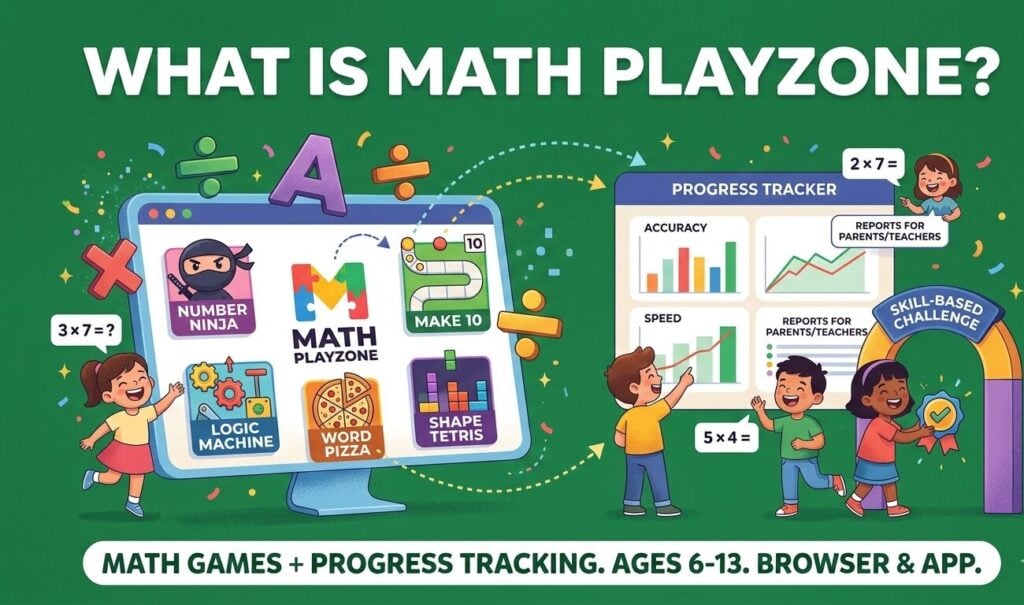
Math Playzone is an online platform that mixes math games with structured learning activities for children. It offers number-based puzzles, geometry tasks, and logic challenges alongside built-in progress tracking. Parents and teachers use it to monitor accuracy, speed, and subject-level performance in one place.
What Is Math Playzone?
Math Playzone is a browser-based learning platform that hosts interactive math games for students in elementary and middle school. The site organizes activities by subject: addition, subtraction, multiplication, division, fractions, and basic geometry.
Each game runs in a timed format. Players answer questions, earn scores, and move through difficulty levels. The platform records correct answers, time per question, and topic completion rates. Teachers can view these reports to identify where a student needs extra practice.
Unlike standalone quiz apps, Math Playzone groups its games under skill categories. A student working on addition can play Let’s Reach 1000, then move to Quiz Math for speed drills. This structure turns scattered practice into a sequence, similar to how Nintendo organizes gameplay progression in its titles.
Best Math Playzone Games for Students
The platform hosts over a dozen games. Five attract the most consistent use from teachers and parents.
| Game | Skill Area | What It Trains |
|---|---|---|
| Number Ninja | Number recognition | Fast identification and matching |
| Make 10 Course | Addition | Sum building under time pressure |
| Shape Tetris | Geometry | Spatial awareness and shape fitting |
| Word Pizza | Fractions | Part-to-whole reasoning |
| Logic Machine | Reasoning | Step-by-step problem solving |
Number Ninja and Make 10 Course are the most popular among younger students. Logic Machine draws older learners who want something beyond arithmetic. Repeating levels on any game gradually increases accuracy. Tracked scores show that growth over sessions.
How Math Playzone Tracks Student Progress
Math Playzone generates automatic reports after each session. These reports break down performance into four areas: correct answers as a percentage, time taken per stage, topic-level accuracy, and digital badge milestones.
Manual tracking methods require a teacher or parent to log answers by hand, measure time with a stopwatch, and rely on observations for subject breakdown. Math Playzone automates all of that.
| Metric | Math Playzone | Manual Method |
|---|---|---|
| Correct answers | Percentage per stage | Written notes |
| Time per session | Auto-recorded | Stopwatch required |
| Subject breakdown | Sorted by topic | Teacher observation |
| Reward system | Digital badges | Physical stickers |
Parents can log in and check results at any time. Teachers reviewing class-wide data can spot common weak areas and adjust lesson plans accordingly. The reporting system follows a model close to how Google structures its analytics dashboards: simple, visual, and sortable.
Math Playzone Skill-Based Challenges
Beyond standalone games, Math Playzone organizes challenges by difficulty tier. A student starts with basic tasks and unlocks harder levels as scores improve. Completing a tier earns a badge. Each badge maps to a specific skill threshold.
Some teachers pair Math Playzone with other classroom tools like Blooket to add variety across sessions. That combination keeps students from burning out on a single format while still maintaining structured goals.
Parents can also set weekly targets tied to school topics. If a child is studying fractions in class, Word Pizza becomes the assigned game for the week. Adding real-world exercises at home, like measuring ingredients or splitting items equally, reinforces what the platform teaches.
Teaching Tips for Using Math Playzone
Short daily sessions beat long weekly ones. Fifteen minutes per day produces more consistent results than a single hour on weekends. The platform is designed for quick rounds, not marathon sessions.
After each session, talk through the results. Ask your child how they solved a problem. That conversation strengthens retention more than the game itself. When they struggle, stay calm and treat errors as practice data rather than failures.
Mix screen time with offline work. Notebook exercises, counting physical objects, or keeping score during a board game all reinforce the same skills Math Playzone targets. Some families combine this with friendly competitions between siblings, which mirrors how competitive formats in the gaming industry drive engagement among younger audiences.
Switching between formats also prevents fatigue. A child who played Number Ninja on Monday can do fraction worksheets on Tuesday and return to Word Pizza on Wednesday.
Math Playzone vs Other Math Learning Platforms
Several platforms compete in the same space. Math Playground, Prodigy, and Khan Academy all offer math practice for young learners. Math Playzone separates itself with its game-first design and built-in progress reports.
| Feature | Math Playzone | Math Playground | Prodigy |
|---|---|---|---|
| Free access | Yes | Partial | Freemium |
| Progress reports | Built-in | Limited | Built-in |
| Skill-based levels | Yes | Yes | Yes |
| Subject coverage | Math + Science | Math + Logic | Math only |
Prodigy wraps math inside an RPG game world. Math Playground offers over 500 games but fewer tracking tools. Math Playzone sits between the two: game-focused with structured reporting. The mobile experience is also available through the Apple App Store, making practice possible away from a desktop.
FAQs
Is Math Playzone free to use?
Yes. Math Playzone offers free access to its math games, science quizzes, and history activities through its website. No subscription is required to play or track basic progress.
What age group is Math Playzone best for?
Math Playzone targets students in elementary and middle school, roughly ages 5 to 13. Games range from basic addition to logic-based reasoning tasks suited for older learners.
Can teachers track student progress on Math Playzone?
Yes. The platform generates automatic reports showing correct answers, time per stage, and topic-level accuracy. Teachers can review class-wide patterns and adjust instruction based on the data.
How long should a child use Math Playzone per day?
Fifteen minutes per day is the recommended duration. Short daily sessions produce better long-term retention than longer, less frequent sessions.
Does Math Playzone have a mobile app?
Yes. Math Playzone has a mobile app available on the Apple App Store. It includes an AI-powered solver, interactive quizzes, a graphing calculator, and video lessons.