


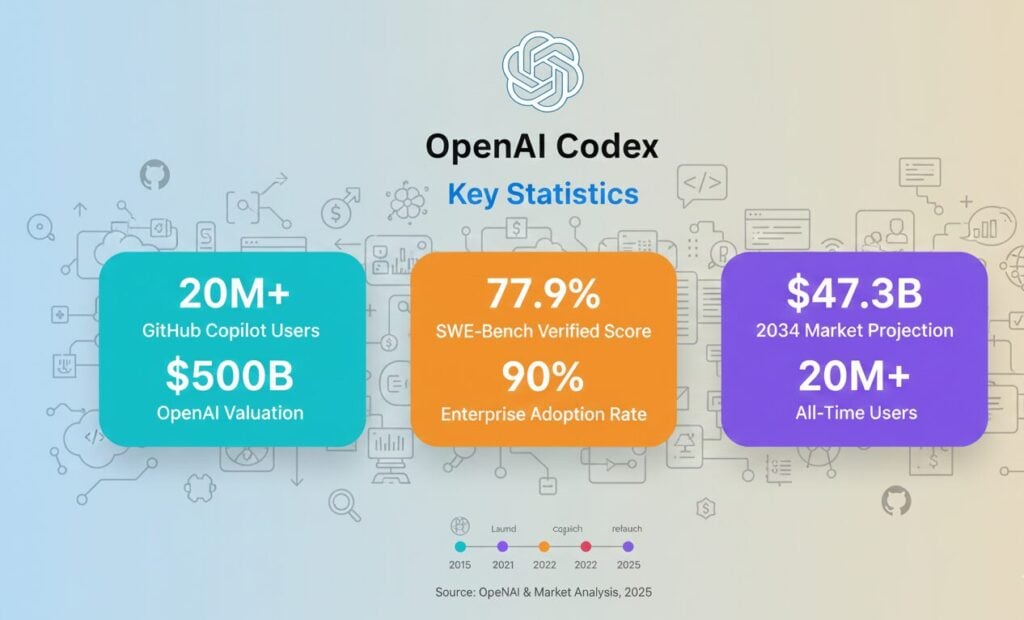
OpenAI Codex represents the evolution from experimental code generation into production-grade software engineering infrastructure. The platform serves millions of developers globally through GitHub Copilot and direct API access. Revenue metrics from mid-2025 show GitHub Copilot generating substantial income with 20 million all-time users, while OpenAI itself reached a $500 billion valuation. The technology demonstrates consistent improvements across standardized benchmarks, with GPT-5.1-Codex-Max achieving 77.9% on SWE-Bench Verified tasks. Market analysis projects the AI coding assistant sector will grow from $5.5 billion in 2024 to $47.3 billion by 2034, establishing these tools as fundamental to modern development workflows.
OpenAI Codex History
OpenAI founded as nonprofit AI research lab by Sam Altman, Greg Brockman, Ilya Sutskever, Elon Musk, and others with $1 billion in pledged funding.
OpenAI restructured into capped-profit entity, accepting major investment from Microsoft to scale research capabilities.
OpenAI Codex launched as descendant of GPT-3 fine-tuned on 159 GB of Python code from 54 million GitHub repositories.
GitHub Copilot, powered by OpenAI Codex, went into general availability after successful technical preview period.
Original Codex models deprecated from API as Google, Amazon, and other competitors launched rival coding assistants.
OpenAI relaunched Codex as cloud-based autonomous software engineering agent powered by codex-1 model optimized from o3.
GPT-5-Codex introduced with enhanced agentic coding capabilities, becoming default for Codex cloud tasks and code review.
Codex became generally available to all ChatGPT plan tiers, expanding from Pro and Enterprise to Plus and Education users.
OpenAI Co-founders
Former president of Y Combinator who co-founded OpenAI in 2015 and became CEO in 2019, driving commercialization and ChatGPT launch.
Former Stripe CTO who serves as OpenAI’s technical and operational leader, guiding engineering teams through rapid scaling.
Machine learning pioneer who co-invented AlexNet and led OpenAI research until May 2024, now founder of Safe Superintelligence Inc.
Tesla and SpaceX CEO who co-founded OpenAI in 2015 but departed in 2018 citing conflicts with Tesla’s autonomous vehicle work.
Research scientist specializing in reinforcement learning and AI safety, contributing to core OpenAI research initiatives.
Robotics and machine learning researcher who brought expertise in applying AI to complex real-world systems.
OpenAI Revenue
OpenAI generated $3.7 billion in annual revenue during 2024, driven primarily by ChatGPT subscriptions and API access. The company reported reaching 20 million paid ChatGPT subscribers by April 2025, up from 15.5 million at the end of 2024. Enterprise customer adoption accelerated substantially, with the business user base expanding to five million accounts.
July 2025 financial disclosures revealed an annualized revenue run rate of $12 billion, representing substantial year-over-year growth. Revenue projections for 2025 estimate total income between $12.7 billion and $13 billion. The company generated approximately $4.3 billion in revenue during the first half of 2025 alone.
Despite impressive revenue growth, OpenAI continues operating at significant losses. The company burned $2.5 billion during the first half of 2025, with projected losses of $14 billion for the full year. Looking ahead, OpenAI expects to burn approximately $115 billion through 2029 as it invests in infrastructure and model training. The company projects achieving cash flow positive status by 2029, with estimated annual sales reaching $100 billion by that timeframe.
*Projected
OpenAI Codex Acquisitions
OpenAI completed seven strategic acquisitions through 2025, investing approximately $17.8 billion in total transaction value. These acquisitions focused on expanding capabilities in AI infrastructure, product development, and hardware integration.
The largest acquisition came in May 2025 when OpenAI purchased iO, the AI hardware startup founded by former Apple designer Jony Ive, for $6.5 billion in an all-stock deal. The transaction brought exceptional design talent including Tang Tan, Scott Cannon, and Evans Hankey, all formerly of Apple. OpenAI already held a 23% stake in iO through its venture fund before completing the full acquisition. The deal marked OpenAI’s entry into consumer hardware, combining software expertise with world-class industrial design capabilities.
In September 2025, OpenAI acquired Statsig, a cloud-based testing and feature management platform, for $1.1 billion in an all-stock transaction. Statsig’s founding CEO Vijaye Raji joined OpenAI as CTO of Applications, reporting to Chief Product Officer Fidji Simo. Raji brought experience from a decade leading large-scale consumer engineering at Meta, now heading product engineering for ChatGPT and Codex.
Additional acquisitions included Software Applications Incorporated, maker of the Sky interface product for Mac computers, announced in October 2025. Earlier acquisitions consisted of Multi, Rockset, and Global Illumination, each adding specific enterprise technology capabilities and engineering talent. OpenAI also reached a significant deal with CoreWeave in March 2025, acquiring $350 million worth of shares and AI infrastructure access in exchange for $11.9 billion paid over five years.
OpenAI Marketcap
OpenAI achieved a $500 billion valuation in October 2025 through a secondary share sale allowing employees and early investors to sell approximately $6.6 billion in shares. This valuation established OpenAI as the world’s most valuable private technology company, surpassing SpaceX’s $400 billion valuation from summer 2025.
The company’s valuation trajectory accelerated dramatically following ChatGPT’s November 2022 launch. OpenAI started 2024 at a $29 billion valuation, grew to $157 billion by October 2024, then surged to $300 billion after a $40 billion funding round in March 2025 led by SoftBank. The October 2025 valuation represented an increase of roughly $29 billion monthly throughout 2025.
Secondary market activity suggests even higher valuations, with some shares trading at premiums of 20% above the $500 billion tender offer price. Analysis of SoftBank’s stock price implies public market investors may value OpenAI at approximately $750 billion. Internal discussions about a potential 2026 IPO reportedly target valuations reaching $1 trillion, though such figures remain speculative pending actual public market reception.
OpenAI Codex Competitors
The AI coding assistant market features intense competition across multiple segments. GitHub Copilot, powered by OpenAI Codex technology, holds the largest market share with over 20 million users. However, numerous well-funded competitors have emerged, each targeting specific developer needs and workflows.
Cursor achieved remarkable growth, reaching a $29.3 billion valuation by December 2025 after securing $2.3 billion in funding. The company grew from a $2.6 billion valuation at the end of 2024 to $10 billion in June 2025, demonstrating explosive market demand for AI-native development environments. Anysphere, the company behind Cursor, reached $500 million in annual recurring revenue by mid-2025.
Competition extends beyond traditional code completion. Amazon launched CodeWhisperer (now Q Developer) with tight integration into AWS services, appealing to cloud-focused development teams. Google introduced Gemini Code Assist, leveraging its AI infrastructure and targeting Google Cloud customers. Technology companies across the industry recognized coding assistants as strategic battlegrounds for developer mindshare.
| Company/Product | Key Differentiator | Pricing |
|---|---|---|
| GitHub Copilot | Largest user base, seamless IDE integration | $10-$39/month |
| Cursor | AI-native editor, multi-file awareness | $20/month |
| Tabnine | Privacy-first, on-premises deployment | $12-$39/month |
| Amazon Q Developer | AWS integration, security scanning | $19/month |
| Codeium | Free tier, 70+ languages | Free-$12/month |
| Google Gemini Code Assist | Google Cloud integration | $19/month |
| Sourcegraph Cody | Full codebase indexing | Free-$9/month |
| Replit Ghostwriter | Cloud IDE integration | $15/month |
| Windsurf (Codeium) | Agentic navigation | $15/month |
| JetBrains AI Assistant | Native JetBrains integration | $10/month |
FAQs
What is OpenAI Codex and how does it work?
OpenAI Codex is an AI-powered software engineering agent that generates, reviews, and executes code autonomously. It operates in isolated cloud environments, handling tasks from simple bug fixes to complex multi-file refactors.
How much does OpenAI Codex cost for developers?
GPT-5-Codex costs $1.25 per million input tokens and $10 per million output tokens through API. GitHub Copilot, powered by Codex technology, ranges from $10 monthly for individuals to $39 monthly for enterprise tiers.
What programming languages does OpenAI Codex support?
Codex supports 12+ programming languages with strongest proficiency in Python. It handles JavaScript, Go, Perl, PHP, Ruby, Swift, TypeScript, and Shell scripting. The model demonstrates multilingual capability across diverse development ecosystems.
How does OpenAI Codex compare to GitHub Copilot?
GitHub Copilot is built on OpenAI Codex technology but functions as an IDE extension for real-time code completion. Codex operates as an autonomous cloud agent handling complete tasks independently across extended timeframes.
What companies use OpenAI Codex in production?
Major adopters include Cisco, Rakuten, Duolingo, and Vanta. Ninety percent of Fortune 100 companies use GitHub Copilot. Within OpenAI, nearly all engineers utilize Codex, resulting in 70% more pull requests merged weekly.