


Key Stats
- • 7 countries maintain territorial claims on Antarctica covering approximately 80% of the continent
- • 54 countries are signatories to the Antarctic Treaty System as of 2025
- • More than 40 countries operate research stations across Antarctica
- • The largest unclaimed area spans approximately 630,000 square miles in Marie Byrd Land

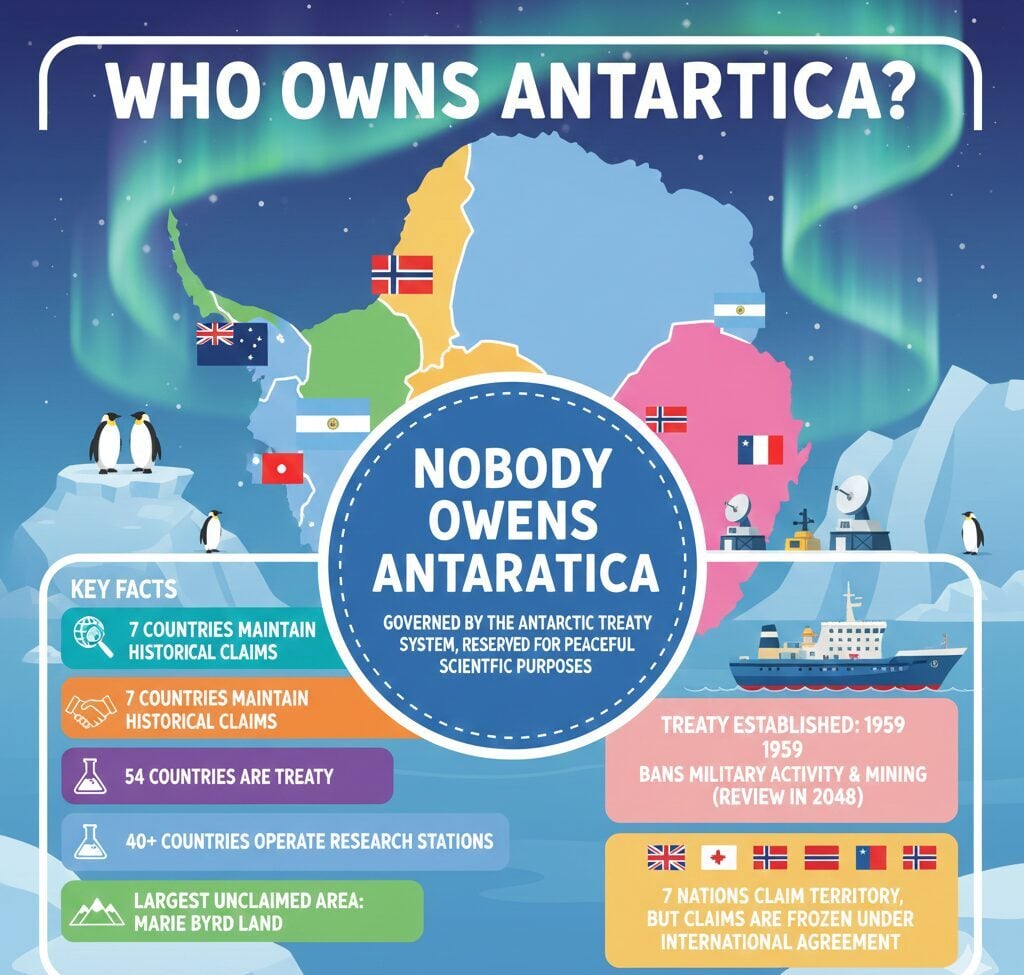
Nobody owns Antarctica. The continent operates under the Antarctic Treaty System, established in 1959, which reserves the territory for peaceful scientific purposes. While seven countries made historical territorial claims, these assertions remain frozen under international agreement.
Despite no sovereign ownership, Antarctica continues to be a focal point of international cooperation and resource interests. The Antarctic Treaty has successfully prevented militarization and established a framework for multi-nation scientific research without territorial disputes.
Who Owns Antarctica?
Antarctica has no owner in the traditional sense. The continent exists under a unique international governance framework that suspends territorial sovereignty. Seven countries made formal territorial claims between 1908 and 1940, but the Antarctic Treaty System effectively froze these assertions.
The claimant nations include the United Kingdom, France, Norway, Australia, New Zealand, Argentina, and Chile. Each maintains research stations within their claimed territories and continues to assert administrative authority, though these claims lack international recognition outside agreements between the claimants themselves. The Antarctic Treaty prohibits new territorial claims and prevents expansion of existing ones, creating a framework similar to how international banking institutions coordinate across borders.
Antarctic Treaty System and Governance
The Foundation of International Cooperation
The Antarctic Treaty System governs the continent through international cooperation. Signed in 1959, the treaty established Antarctica as a scientific preserve and banned military activity. Fifty-four countries participate in the treaty system, though only twenty-nine hold consultative status with decision-making authority.
The governance structure operates through annual Antarctic Treaty Consultative Meetings where parties address management issues. Decision-making requires consensus among consultative parties, ensuring no single nation dominates policy. This system resembles how joint ventures operate among international partners.
Key Treaty Provisions
The treaty bans nuclear explosions, radioactive waste disposal, and military bases. While military personnel can support scientific research, no military maneuvers or weapons testing may occur. This prohibition has held firm for over six decades, making Antarctica the most successful denuclearized zone on Earth.
The Committee for Environmental Protection advises parties on environmental matters. Established in 1998 under the Madrid Protocol, this committee ensures all human activity undergoes environmental impact assessment. The Madrid Protocol currently prohibits mineral extraction except for scientific research, protecting the continent much like environmental protection regulations govern business operations in sensitive regions.
Future Challenges
The mineral resources provision becomes subject to review in 2048, potentially altering Antarctic governance. If parties choose to modify the mining ban, territorial ownership questions could resurface with renewed intensity. Climate change presents another challenge as melting ice reveals previously inaccessible areas and resources.
Antarctic Territorial Claims by Size
Countries with Antarctic Territorial Claims
British Antarctic Territory
The United Kingdom made the first formal Antarctic territorial claim in 1908. The British Antarctic Territory encompasses over 660,000 square miles of land, extending from 20 degrees west to 80 degrees west longitude. This territory includes the Antarctic Peninsula, the South Orkney and South Shetland islands, and portions of several ice shelves.
The British claim overlaps with both Argentine and Chilean claims, generating diplomatic tensions historically. The United Kingdom maintains infrastructure through the British Antarctic Survey, which operates multiple research stations in the territory.
Australian Antarctic Territory
Australia holds the largest territorial claim in Antarctica, covering approximately 2.3 million square miles or 42 percent of the continent. Originally claimed by Britain and transferred to Australia in 1933, this territory spans from 45 degrees east to 160 degrees east, excluding the narrow French claim of Adélie Land.
The Australian claim includes Dome A, the highest point of the East Antarctic Ice Sheet at 13,428 feet. Australia operates three year-round research stations: Mawson, Davis, and Casey.
Norwegian Claims and Overlapping Territories
Norway maintains two separate claims. Queen Maud Land, claimed in 1939, covers approximately one million square miles between 20 degrees west and 45 degrees east. Peter I Island, a 60-square-mile volcanic island in the Bellingshausen Sea, represents Norway’s second claim and the only non-sector Antarctic assertion.
France has claimed Adélie Land since 1840, covering 167,000 square miles between 136 degrees east and 142 degrees east. French interests in the region extend beyond pure science to include strategic positioning in the Southern Ocean.
Argentina, Chile, and the United Kingdom maintain overlapping claims on the Antarctic Peninsula. Both Argentina and Chile formalized claims in 1940, justifying them through geographic proximity and historical Spanish colonial decrees. New Zealand administers the Ross Dependency, stretching from 160 degrees east to 150 degrees west, which hosts research facilities from multiple nations including the United States McMurdo Station.
Antarctic Governance Timeline
History of Antarctic Territorial Claims
Early Exploration and Claims
Antarctic territorial claims emerged from 19th-century exploration expeditions. Britain became the first nation to formalize a claim in 1908. Between 1923 and 1940, six additional countries made formal claims: France (Adélie Land, 1924), New Zealand (Ross Dependency, 1923), Australia (1933), Norway (Queen Maud Land, 1939), and Argentina and Chile (both 1940).
Multiple factors drove territorial claims, including resource speculation and national prestige. Maintaining an Antarctic presence demonstrated technological capability, similar to how multinational operations demonstrate corporate reach. The International Geophysical Year of 1957-1958 marked a turning point, as twelve nations established research stations and conducted coordinated observations, leading directly to the Antarctic Treaty negotiations.
Research Station Distribution by Claimant Territory
FAQs
Does any country own Antarctica?
No country owns Antarctica. The continent operates under the Antarctic Treaty System, which suspends sovereignty claims. Seven nations maintain historical claims, but these lack international recognition outside agreements between claimants.
Can the United States claim part of Antarctica?
The United States reserved the right to make future Antarctic claims under the 1959 treaty but has not exercised this right. The treaty prohibits new territorial claims by any nation.
Why do seven countries claim Antarctica?
Seven countries formalized territorial claims between 1908 and 1940 based on exploration history, geographic proximity, and resource interests. The Antarctic Treaty froze these claims without requiring nations to renounce them.
What happens to Antarctic territorial claims in 2048?
In 2048, parties may review the mineral resources ban established by the Madrid Protocol. This does not automatically change territorial claims, but modifications to resource rights could renew sovereignty debates.
Who controls research stations in Antarctica?
Individual countries control their own research stations regardless of location. Over 40 nations operate Antarctic stations, including countries without territorial claims. The treaty guarantees access for peaceful scientific purposes.