

Key Stats
- → Crown land represents 89% of Canada’s total land area
- → Private individuals and corporations own approximately 11% of Canadian land
- → Provincial governments manage 48% of Canada’s total land, while federal government controls 41%
- → Canada has designated 3,394 Indian Reserves for over 600 First Nations as of 2020
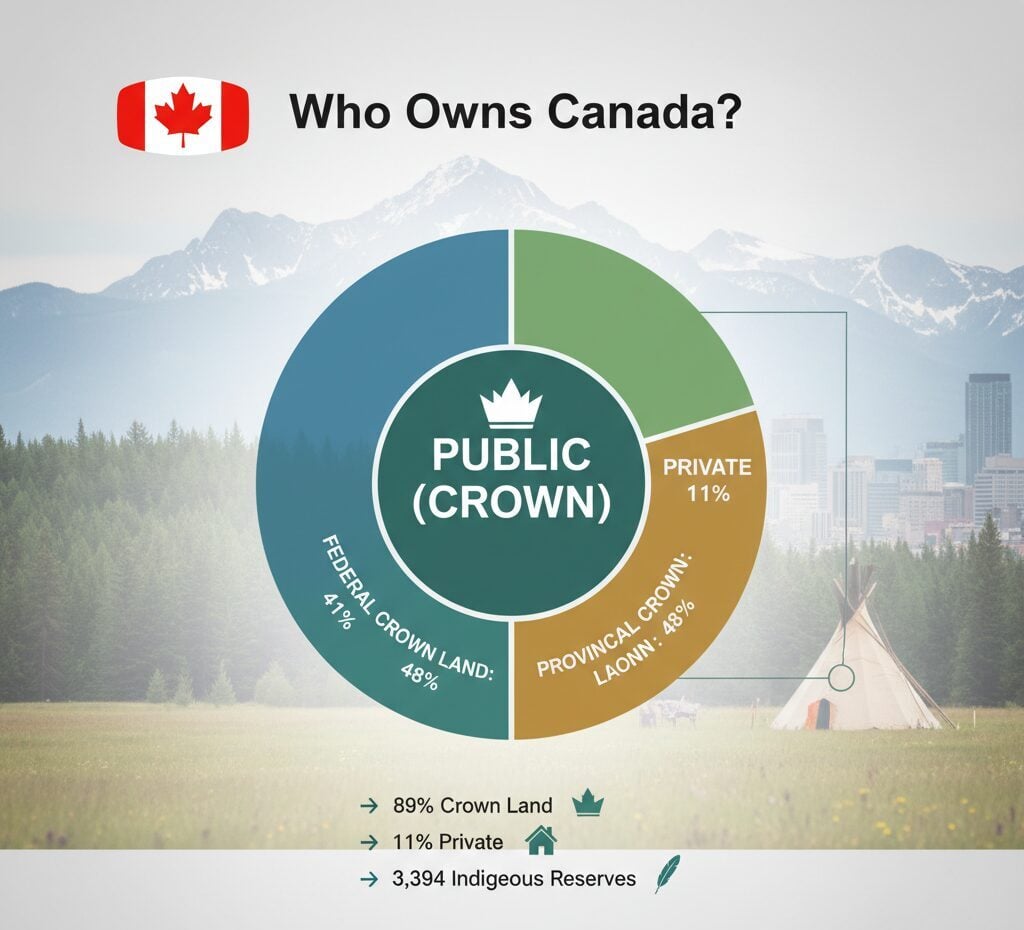
Canada’s land ownership is predominantly public, with the Crown controlling 89% of the nation’s territory. The remaining 11% is privately held by individuals, families, and corporations. This unique distribution stems from Canada’s colonial history, the ongoing recognition of Indigenous rights, and the government’s central role in managing natural resources and public spaces.
The country spans nearly 10 million square kilometers, making it the world’s second-largest nation by area. This vast territory includes diverse landscapes from Arctic tundra to temperate rainforests, with land ownership patterns varying significantly across provinces and territories.
Who Owns Canada?
The question of land ownership in Canada reveals a complex system where government entities hold the majority stake. Unlike many nations where private property dominates, Canada maintains significant public control over its territory.
Crown Land Dominance
Crown land accounts for the overwhelming majority of Canadian territory at 89%. This designation means the land is owned by either federal or provincial governments. The federal government controls approximately 41% of total land, concentrated primarily in northern territories including Nunavut, the Northwest Territories, and Yukon.
Provincial governments hold 48% of Canada’s land, managing vast areas within their borders. British Columbia leads with roughly 94% of its land designated as provincial Crown land. These holdings include provincial parks, forests, and resource-rich areas administered under various provincial acts.
Private Land Holdings
Private ownership represents only 11% of Canadian land but contains most residential and commercial development. Private landowners possess full rights to sell, lease, mortgage, or transfer their properties through freehold or leasehold arrangements.
Freehold ownership, the most common form, grants indefinite ownership of both land and structures. Leasehold arrangements involve owning buildings while leasing the underlying land for specified periods, often found in areas with First Nations land ownership or specific urban developments.
Canada Land Ownership Distribution
Major Land Holders in Canada
Understanding who controls Canadian land requires examining the major stakeholders across different categories of ownership and management.
Federal Government Holdings
The federal government administers 41% of Canada’s land through various departments and agencies. These holdings concentrate in northern territories where resource extraction companies often lease rights for mining operations.
Federal Crown land includes national parks, military bases, and certain Indigenous reserves. The Department of Crown-Indigenous Relations and Northern Affairs manages significant portions, while Parks Canada oversees conservation areas. Federal lands generate revenue through leasing arrangements for mining, energy production, and forestry activities.
Provincial and Territorial Control
Provincial governments manage the largest share of Crown land at 48%. Each province operates under distinct legislation, with ministries of natural resources typically handling administration. British Columbia maintains the highest proportion at 94% provincial Crown land, followed by other western provinces with substantial public holdings.
Provincial Crown lands serve multiple purposes including timber harvesting, mineral extraction, hydroelectric projects, and recreation. Governments issue permits and leases to mining corporations and forestry operations, creating major revenue streams while maintaining public ownership of underlying land rights.
Private Sector Landowners
The private sector controls 11% of Canadian land, with ownership distributed among individual homeowners, agricultural operators, and corporations. Real estate investment firms hold substantial commercial and residential properties in urban centers.
Agricultural land represents a significant portion of private holdings, particularly in Prairie provinces where family farms and agricultural corporations own productive farmland. Major resource companies also hold private land for operations, though they more commonly lease surface and subsurface rights from Crown land.
Indigenous Land Holdings
Indigenous peoples maintain unique land rights through Indian Reserves, treaty lands, and Aboriginal title. While legal title to reserves vests in the Crown, band councils manage 3,394 reserves for the collective benefit of First Nations communities.
Aboriginal title represents inherent rights to ancestral territories based on long-standing occupation. Many British Columbia lands remain unceded traditional territories where Aboriginal title was never surrendered through treaties, creating ongoing negotiations over land rights and resource development.
History of Land Ownership in Canada
Canada’s current land ownership structure evolved through centuries of colonial expansion, treaty negotiations, and legal developments that continue shaping property rights today.
Colonial Foundations
The Crown land system originated with British colonial rule when the Crown claimed sovereignty over vast territories. This assertion of ownership disregarded existing Indigenous occupation and land use systems. The Royal Proclamation of 1763 established principles for Crown dealings with Indigenous lands, requiring treaties before settlement on Aboriginal territories.
As provinces joined Confederation, the federal government transferred most Crown lands to provincial control, except in territories where federal jurisdiction remained. This transfer created the current split between federal and provincial Crown land administration.
Treaty Era and Indigenous Rights
Between 1871 and 1921, Numbered Treaties were signed across Western Canada, exchanging Indigenous land tenure for annuities and specific rights. These agreements shaped land ownership patterns but remain contentious due to different interpretations of treaty terms and unfulfilled obligations.
The 1973 Calder case marked a turning point by recognizing Aboriginal title’s existence in Canadian law. This decision acknowledged that Indigenous rights to land survived even without treaties, forcing governments to negotiate modern land claims and self-government agreements.
Modern Land Administration
The 20th century saw provinces develop comprehensive systems for managing Crown land resources. Legislation established frameworks for leasing, licensing, and regulating activities on public lands. Provincial land registries modernized to secure private property rights through title registration systems.
Recent decades brought increased recognition of Indigenous land rights through court decisions and negotiations. The 1982 Constitution affirmed Aboriginal and treaty rights, strengthening legal protections for Indigenous land claims and requiring meaningful consultation on development projects affecting traditional territories.
Government Bodies Managing Canadian Land
Multiple government entities oversee land administration across federal, provincial, and Indigenous jurisdictions, each with distinct responsibilities and management approaches.
Federal Land Management Agencies
Crown-Indigenous Relations and Northern Affairs Canada leads federal engagement on Indigenous land issues, managing reserve lands and negotiating modern treaties. This department works with First Nations bands on reserve administration while pursuing land claim settlements in regions without historical treaties.
Natural Resources Canada oversees federal resource policies affecting Crown land, including mineral rights and energy development. Parks Canada manages national parks and historic sites, balancing conservation with public access. The Department of National Defence administers military bases and training areas on federal Crown land.
Provincial Land Authorities
Provincial ministries of natural resources, forests, or Crown lands manage the largest portion of Canadian territory. These agencies issue permits for resource extraction, regulate forestry operations, and administer leasing programs. Each province maintains land registries documenting private property ownership and facilitating real estate transactions.
Provincial agencies balance competing land uses including economic development, conservation, recreation, and Indigenous rights. They generate substantial revenues through stumpage fees, mining royalties, and lease payments while maintaining environmental standards and consulting with affected communities.
Municipal Jurisdiction
Municipal governments exercise authority over land use planning and zoning within their boundaries, regardless of whether land is Crown-owned or private. Cities and towns regulate development through official plans, building permits, and property taxes. Municipalities own limited land holdings for parks, utilities, and public facilities.
Regional districts in some provinces coordinate land use across multiple municipalities, particularly for rural areas and unincorporated territories. These bodies manage services and planning on both private and Crown lands within their jurisdiction.
Indigenous Land Governance
First Nations band councils govern reserve lands under the Indian Act, making decisions on land use, development, and member housing. Some communities have moved beyond the Indian Act through self-government agreements, gaining greater autonomy over land management and resource development.
Modern treaty nations exercise jurisdiction over settlement lands through institutions established in land claim agreements. These bodies make decisions comparable to provincial governments regarding land administration, resource management, and environmental protection within their territories.
FAQs
Who owns most of the land in Canada?
The Canadian Crown owns 89% of land, split between federal government at 41% and provincial governments at 48%. Private individuals and corporations own the remaining 11%.
Can foreigners own land in Canada?
Yes, foreigners can purchase private land in Canada with few restrictions. However, some provinces have introduced limitations on foreign ownership of agricultural land and residential properties.
What is Crown land in Canada used for?
Crown land serves multiple purposes including resource extraction, conservation, recreation, Indigenous reserves, and infrastructure. Governments lease rights for mining, forestry, and energy production while maintaining public ownership.
Do Indigenous peoples own reserve lands?
Legal title to Indian Reserves is held by the Crown, but reserves are set aside for First Nations’ exclusive use and managed by band councils for community benefit.
Which Canadian province has the most private land?
Prince Edward Island has the highest proportion of private land among provinces, with significantly more private ownership than the 11% national average due to historical settlement patterns.
