

Key Stats
- OpenAI reached $500 billion valuation in October 2025, making it the world’s most valuable private company
- ChatGPT serves 800 million weekly active users as of September 2025, processing over 2 billion daily queries
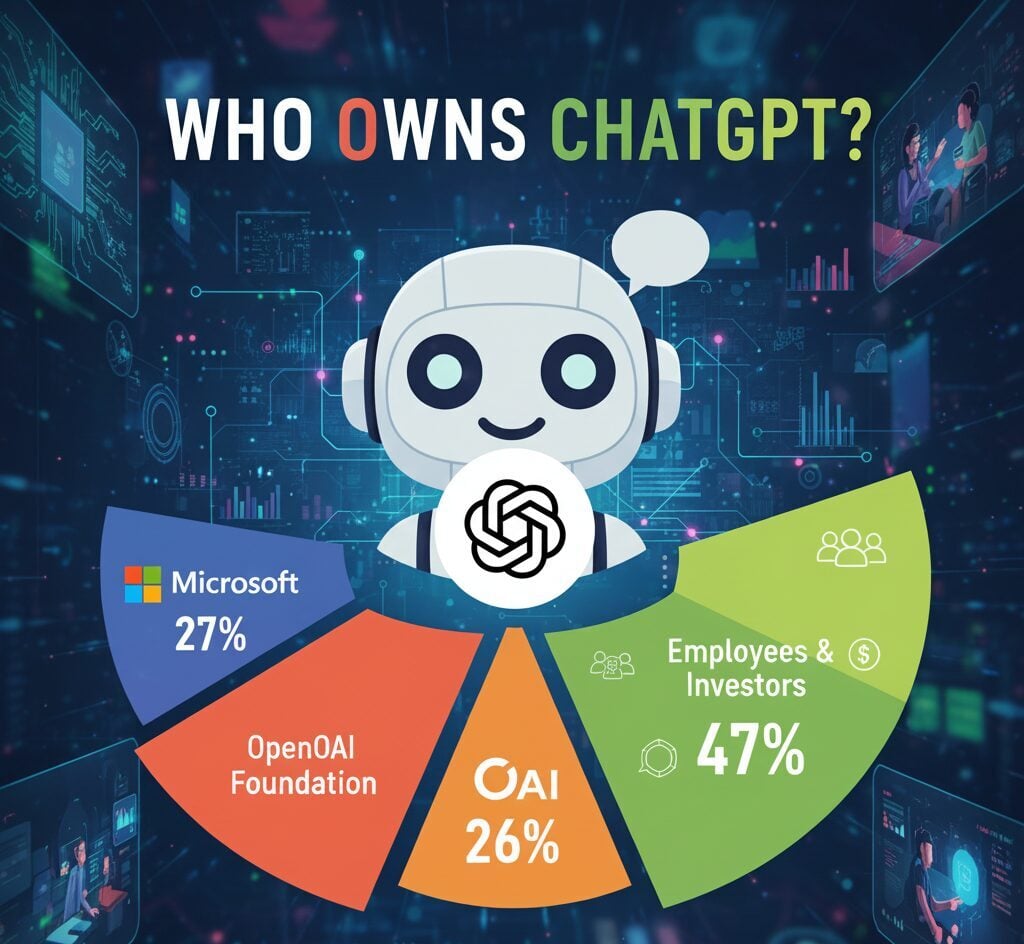
- Microsoft holds 27% ownership stake in OpenAI Group following October 2025 restructuring
- OpenAI generated $13 billion in annual recurring revenue as of August 2025, targeting $125 billion by 2029
ChatGPT ownership belongs to OpenAI, a company operating through a unique dual structure. OpenAI owns the revolutionary AI chatbot that attracted 100 million users within two months of its late 2022 launch.
The organization completed major restructuring in October 2025, transitioning to a public benefit corporation format. This allows aggressive growth while maintaining its mission of ensuring AI benefits humanity.
Microsoft emerged as the largest external shareholder with a 27% stake valued at roughly $135 billion. The tech giant invested approximately $13 billion and provides crucial cloud infrastructure through Azure.
The OpenAI Foundation controls 26% equity while employees, founders, and venture capital firms hold remaining shares. This creates checks and balances between profit motives and ethical oversight.
Who Owns ChatGPT? Understanding the Ownership Framework
OpenAI owns ChatGPT through a carefully designed corporate architecture restructured in October 2025.
The Dual-Entity Structure
OpenAI Foundation serves as the nonprofit parent with ultimate authority over mission and ethics. OpenAI Group operates as the for-profit public benefit corporation handling commercial operations.
California and Delaware regulators required specific safeguards before approving the restructuring. The nonprofit maintains veto power over major decisions.
How Control Actually Works
The Foundation appoints all board members of OpenAI Group and can remove them anytime. A Safety and Security Committee possesses authority to delay or halt product releases if safety concerns emerge.
The new arrangement eliminates previous investment return caps, making OpenAI attractive to traditional investors while preserving mission-focused governance.
Largest Shareholders of ChatGPT
Understanding who owns ChatGPT requires examining major stakeholders following the October 2025 recapitalization.
Microsoft Corporation
Microsoft holds 27% equity worth approximately $13 billion across multiple funding rounds since 2019. The partnership extends beyond capital—Microsoft built specialized supercomputing infrastructure using thousands of Nvidia GPUs.
Azure serves as the exclusive cloud provider, processing billions of queries monthly. ChatGPT powers Microsoft 365, Bing search, and GitHub Copilot features.
Microsoft’s access to OpenAI technology extends through 20321, including models achieving artificial general intelligence.
OpenAI Foundation Holdings
The Foundation owns 26% equity worth approximately $130 billion. A warrant mechanism provides additional upside if OpenAI Group’s value increases tenfold after 15 years.
Founders and Employee Ownership
Sam Altman, Greg Brockman, and founding members hold equity stakes. Employee shareholders collectively own substantial portions, with the remaining 47% distributed among employees, early investors, and venture firms.
Strategic Investors
SoftBank invested $40 billion in March 2025. Other venture capital firms participating in funding rounds hold significant positions with traditional equity that participates proportionally in value growth.
OpenAI Ownership Distribution
Who is on the Board of Directors for ChatGPT?
OpenAI’s board reflects diverse expertise across technology, finance, security, and governance.
Executive Leadership
Sam Altman serves as CEO and board member. Greg Brockman holds President position, remaining integral to strategy despite stepping away from board chairman role.
Technical and Safety Expertise
Bret Taylor chairs the board. The former Salesforce co-CEO brings enterprise software expertise and assumed leadership following the 2023 governance crisis.
Adam D’Angelo, Quora’s CEO and former Facebook CTO, survived the November 2023 upheaval. His AI company experience provides valuable technical perspective.
Dr. Zico Kolter leads the Safety and Security Committee. The Carnegie Mellon professor specializes in AI safety and alignment. His committee can delay product releases—power regulators required during restructuring approval2.
Financial and Strategic Advisors
Larry Summers, former Treasury Secretary and Harvard president, offers economic policy insights. Adebayo Ogunlesi, BlackRock’s Senior Managing Director, guides infrastructure strategy for data centers and energy resources.
Corporate Governance and Operations
Dr. Sue Desmond-Hellmann strengthens healthcare and nonprofit governance. The former Gates Foundation CEO navigates complex organizational challenges.
Nicole Seligman contributes legal expertise. The former Sony executive and Supreme Court clerk for Justice Thurgood Marshall handles regulatory matters.
Fidji Simo, Instacart’s CEO, adds consumer technology perspective from her Facebook executive background.
Security Leadership
Retired General Paul Nakasone provides cybersecurity guidance. The former NSA director and Cyber Command chief addresses national security implications. His Safety Committee participation ensures operational security informs deployment decisions.
History of ChatGPT Co-founders
Understanding who owns ChatGPT requires tracing its origins to the visionaries who established OpenAI in December 2015.
The Founding Coalition
Sam Altman co-founded OpenAI after leading Y Combinator. His vision centered on developing artificial general intelligence that would benefit humanity rather than concentrate power. He serves as CEO, steering the organization through rapid growth and occasional turbulence.
Greg Brockman brought technical expertise from Stripe, where he served as CTO. As President, he focuses on research direction and product development. His partnership with Altman proved crucial during the November 2023 governance crisis.
Early Visionaries and Departures
Elon Musk co-founded the organization but departed in 2018. Conflicts emerged over OpenAI’s direction and potential competition with his other ventures like Tesla. He no longer holds any ownership stake despite his foundational role.
Ilya Sutskever served as Chief Scientist, contributing pivotal research breakthroughs. He briefly participated in Altman’s removal before expressing regret. Sutskever eventually left OpenAI in 2024 to pursue independent AI safety work.
Other co-founders included John Schulman, Wojciech Zaremba, and Andrej Karpathy. Their collective expertise in machine learning and neural networks created the foundation for ChatGPT’s eventual success.
From Nonprofit to Hybrid Model
The founders initially structured OpenAI as a pure nonprofit. They pledged $1 billion in funding, recognizing AGI development would require massive resources. However, recruiting top talent and securing computational power demanded more flexible arrangements.
The 2019 shift to a capped-profit model represented pragmatic evolution. Founders maintained mission focus while attracting investment necessary for competing with deep-pocketed rivals at major technology companies.
FAQs
Does Microsoft own ChatGPT?
Microsoft owns 27% of OpenAI Group but doesn’t control ChatGPT outright. OpenAI Foundation maintains governance authority over the for-profit subsidiary and can replace directors.
Is ChatGPT publicly traded?
ChatGPT isn’t publicly traded. OpenAI remains private despite its $500 billion valuation. The restructuring enables a potential IPO, though timing remains uncertain.
Did Elon Musk create ChatGPT?
Elon Musk co-founded OpenAI in 2015 but left in 2018. He holds no ownership stake and didn’t directly create ChatGPT, which launched in 2022.
Who profits from ChatGPT?
OpenAI shareholders profit from ChatGPT revenue. Microsoft, the Foundation, employees, and investors receive returns based on equity stakes under the restructured ownership model.
Can individuals invest in ChatGPT?
Direct investment isn’t available to most individuals. Accredited investors occasionally access shares through secondary markets. Indirect exposure exists through Microsoft stock or funds holding OpenAI debt.
