

Key Stats
Roark Capital acquired Dave’s Hot Chicken in June 2025 for approximately $1 billion.
The company operates over 310 locations worldwide with franchise agreements for more than 1,000 units.
Annual system-wide revenue exceeded $600 million in 2024, representing 57% year-over-year growth.
Plans include opening 155 new restaurants in 2025, reaching approximately 400 total locations by year-end.
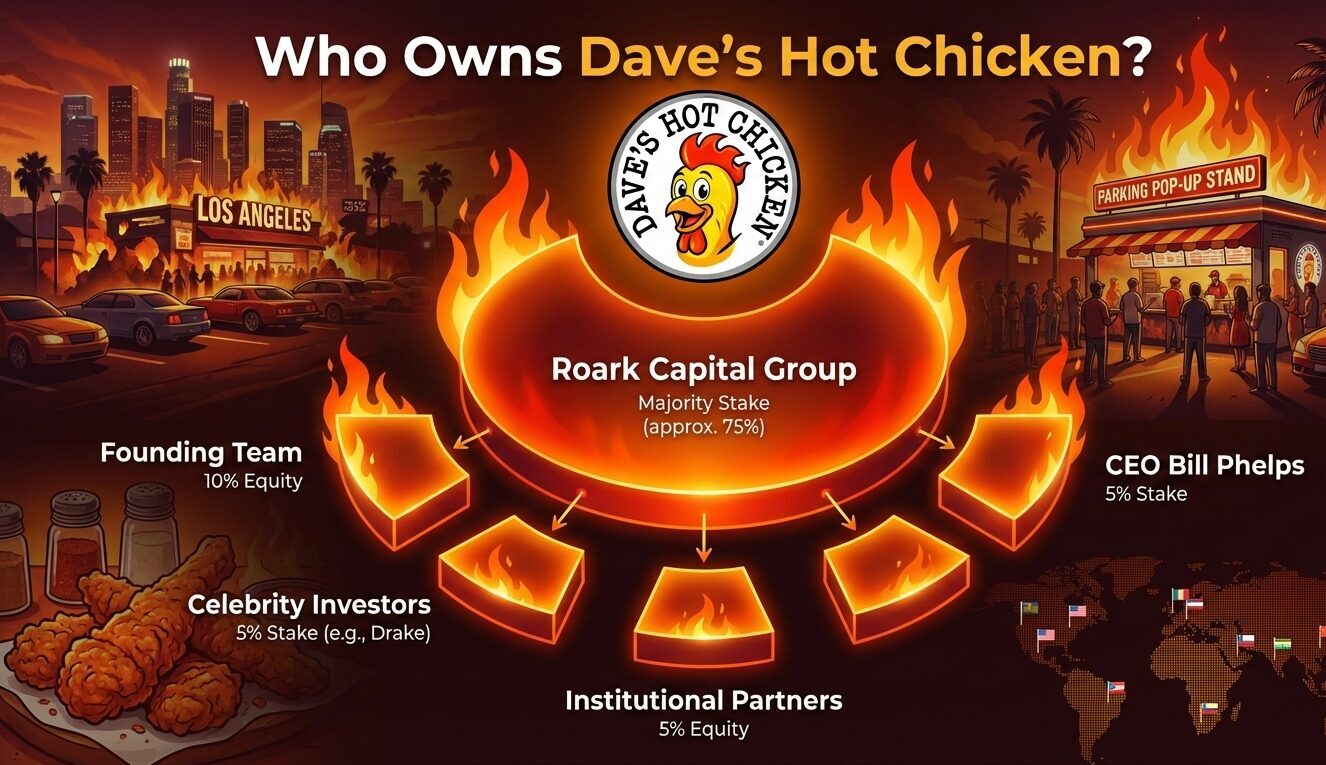
Roark Capital Group acquired approximately 75% of Dave’s Hot Chicken in June 2025 through a transaction valued at $1 billion. The founding team retains 10% collective equity, while CEO Bill Phelps holds 5% ownership.
Celebrity investors including Drake and Samuel L. Jackson maintain a combined 5% stake. The Nashville-style chicken concept expanded from a Los Angeles parking lot operation to a global franchise with 310 locations in eight years.
The acquisition positions the chain for accelerated international expansion across European and Asian markets. Franchise development agreements cover more than 1,000 units in various stages of development.
System-wide revenue reached $600 million in 2024, marking 57% growth from the previous year. Average unit volumes exceed $3.2 million annually, outperforming typical fast-casual benchmarks across the restaurant industry.
Who Owns Dave’s Hot Chicken?
Atlanta-based Roark Capital completed its acquisition of the fast-casual chicken chain in mid-2025, obtaining majority control through a deal worth approximately one billion dollars. This transaction represents one of the largest recent investments in the expanding hot chicken restaurant segment.
The ownership structure preserves operational autonomy for existing management while providing capital for expansion. Roark manages approximately $40 billion in assets across consumer-focused businesses, specializing in franchise operations and multi-location service companies.
Through subsidiary holding companies Inspire Brands and GoTo Foods, Roark oversees restaurant brands including Dunkin’, Arby’s, Buffalo Wild Wings, and Cinnabon. The firm also controls Subway and numerous other food service concepts, similar to how it scaled competitors to Chipotle Mexican Grill.
The acquisition allows Dave’s Hot Chicken to operate independently rather than being absorbed into existing brand portfolios. This structure enables the company to maintain its identity while accessing Roark’s supply chain networks and international franchise development capabilities.
Largest Shareholders of Dave’s Hot Chicken
The ownership distribution balances financial control with operational expertise. Majority stake held by Roark Capital provides strategic oversight and expansion capital, while minority stakeholders contribute brand authenticity and industry knowledge.
Roark Capital Group Holdings
The private equity firm controls approximately 75% of total equity following the 2025 transaction. This position grants Roark decision-making authority over major strategic initiatives, capital allocation, and international market entry strategies.
Board representation ensures alignment between ownership interests and operational execution across geographic markets. Financial backing from Roark enabled immediate acceleration of franchise development timelines.
The company expects to open more than 155 new locations throughout 2025, with expansion plans extending into Western Europe and Asia. Purchase agreements for over 1,000 franchise units demonstrate operator confidence in the brand’s trajectory.
Founding Team Equity Position
Dave Kopushyan, Arman Oganesyan, and brothers Tommy and Gary Rubenyan collectively maintain approximately 10% ownership following the acquisition. This retained equity stake keeps founders financially invested in long-term performance.
Kopushyan serves as Chief Culinary Officer, overseeing recipe development and quality standards. His training at establishments including The French Laundry informs the brand’s commitment to premium ingredients.
Oganesyan holds the Chief Brand Officer position, directing marketing initiatives and maintaining cultural authenticity as the company scales globally. Each founder continues in an active operational role aligned with individual expertise areas.
Executive Leadership Stakes
CEO Bill Phelps retained approximately 5% equity through the acquisition process, demonstrating confidence in future growth potential. Phelps previously co-founded Wetzel’s Pretzels and served on Blaze Pizza’s board, bringing franchise development expertise to his current role.
President and Chief Operating Officer Jim Bitticks also holds minority ownership interests acquired during his tenure. The executive team’s collective equity incentivizes performance-oriented decision-making while maintaining continuity with operational practices that drove initial success.
Celebrity Investor Participation
Entertainment figures collectively own roughly 5% through investments made during earlier funding rounds. Drake joined as an investor and brand ambassador in 2021, contributing social media exposure through his 150 million combined followers.
The rapper’s annual birthday promotion provides free chicken to customers, generating publicity and customer traffic. Additional celebrity stakeholders include Samuel L. Jackson, Michael Strahan, Maria Shriver, and Tom Werner.
These investors provide marketing value through media appearances and social promotion. Their involvement established the brand as a lifestyle concept rather than merely another restaurant chain, similar to how Starbucks positioned itself as a community gathering space.
Institutional Investment Partners
Private investment funds and franchise development groups hold approximately 5% combined equity. These stakeholders provided growth capital during expansion phases preceding the Roark acquisition.
Their participation included regional franchise development agreements and operational support for market entry into Canada, the Middle East, and Europe.
History of Dave’s Hot Chicken Co-founders
Four childhood friends established the concept in May 2017 with $900 in pooled personal savings. The Armenian-American entrepreneurs purchased portable fryers and folding tables for a parking lot operation in East Hollywood.
Initial success came rapidly after food blog Eater LA featured the popup, generating lines of customers willing to wait hours for spicy chicken tenders.
Culinary Background and Inspiration
Dave Kopushyan brought professional kitchen experience from training under renowned chefs at elite California restaurants. His culinary education included time at The French Laundry, a three-Michelin-star establishment known for exacting standards.
This fine dining background informed the brand’s approach to ingredient sourcing and preparation techniques. The founders drew inspiration from the streamlined menu approach pioneered by In-N-Out Burger, focusing on exceptional execution of limited offerings.
Nashville-style hot chicken preparation methods were adapted to California tastes, with spice level customization allowing customers to control heat intensity from mild to extreme “Reaper” level requiring signed waivers.
Partnership Dynamics and Growth
Arman Oganesyan contributed business development expertise and strategic planning capabilities. His friendship with Kopushyan dated back decades, providing the trust foundation necessary for partnership during uncertain startup phases.
The Rubenyan brothers added operational management skills and financial planning, ensuring sustainable growth beyond initial viral popularity. Transition from popup to permanent restaurant occurred within months as demand exceeded capacity.
The first brick-and-mortar site opened in East Hollywood during 2018, validating the concept’s commercial viability. Revenue from this location funded additional company-owned restaurants before the team pursued franchise expansion in 2019, similar to the strategy employed by McDonald’s in its early growth phase.
Who is on the Board of Directors for Dave’s Hot Chicken?
Board composition for privately held companies typically remains confidential unless disclosed voluntarily. Following the Roark Capital acquisition, the governance structure likely includes representatives from the private equity firm alongside existing management and founders.
Private Equity Board Representation
Roark Capital generally appoints multiple board members to companies within its portfolio, bringing expertise in franchise operations, supply chain management, and international expansion. These directors often have experience scaling restaurant brands across diverse geographic markets.
Their involvement provides access to best practices developed across Roark’s extensive food service holdings. Board oversight focuses on growth acceleration, financial performance, and franchise relationship management.
Strategic initiatives requiring board approval include international market entry, major capital expenditures, and executive compensation structures. Regular meetings assess performance against expansion targets and competitive positioning within the fast-casual chicken segment.
Founder and Executive Participation
The founding team likely maintains board seats reflecting their continuing operational roles and minority ownership stakes. This representation ensures brand authenticity preservation and continuity with principles that drove initial success.
Founder involvement provides institutional memory regarding customer preferences, operational challenges, and cultural values defining the company identity. CEO Bill Phelps almost certainly holds a board position given his equity stake and chief executive responsibilities.
His franchise development background and track record with Wetzel’s Pretzels contribute perspectives on multi-unit expansion challenges. President Jim Bitticks may also participate in board discussions given his operational oversight responsibilities.
Independent Director Expertise
Well-structured private company boards often include independent directors bringing specialized knowledge in areas like real estate development, food service technology, or international business. These individuals provide unbiased perspectives on strategic questions.
Given the company’s social media-driven growth strategy, board composition might include digital marketing or consumer brand expertise. Technology-focused directors could guide initiatives in mobile ordering, loyalty programs, and data analytics supporting franchise operations.
Financial expertise is typically essential for boards overseeing rapid expansion requiring substantial capital deployment. Independent directors contribute professional networks beneficial for expansion initiatives across new markets.
Advisory Board Contributions
Many restaurant chains maintain advisory boards separate from formal governance structures. These advisors might include celebrity investors like Drake and Samuel L. Jackson, who provide marketing insights and cultural relevance guidance.
Franchise operator representatives could serve in advisory capacities, offering frontline operational perspectives to leadership. Advisory boards typically meet quarterly to discuss market trends, competitive dynamics, and customer preference shifts affecting brand positioning.
FAQ
Which private equity firm owns Dave’s Hot Chicken?
Roark Capital Group acquired majority ownership in June 2025 through a transaction valued at approximately $1 billion, according to CNBC. The Atlanta-based firm specializes in franchise businesses.
Does Drake own part of Dave’s Hot Chicken?
Drake holds a minority ownership stake estimated around 1-2% acquired in 2021. He serves as brand ambassador, promoting the chain through social media and annual birthday giveaways.
Who founded Dave’s Hot Chicken originally?
Four childhood friends established the concept in 2017: chef Dave Kopushyan, Arman Oganesyan, and brothers Tommy and Gary Rubenyan. They started with $900 in a Los Angeles parking lot.
How many Dave’s Hot Chicken locations exist currently?
The chain operates over 310 locations as of mid-2025, with plans to reach approximately 400 by year-end. Franchise agreements cover more than 1,000 units in development stages.
What is Dave’s Hot Chicken company worth today?
The June 2025 acquisition by Roark Capital valued the company at roughly $1 billion. This reflects current operations, franchise pipeline, and international expansion potential in European markets.
