


Key Stats
- Stock trades on Nasdaq under symbol DKNG at approximately $34 per share as of December 2025
- Market capitalization reached $17 billion with operations spanning 28 states plus Ontario
- Third quarter 2025 revenue hit $1.14 billion representing 4% annual growth
- Full-year 2025 revenue guidance projects $6.3 to $6.6 billion showing 35% growth from 2024[1]
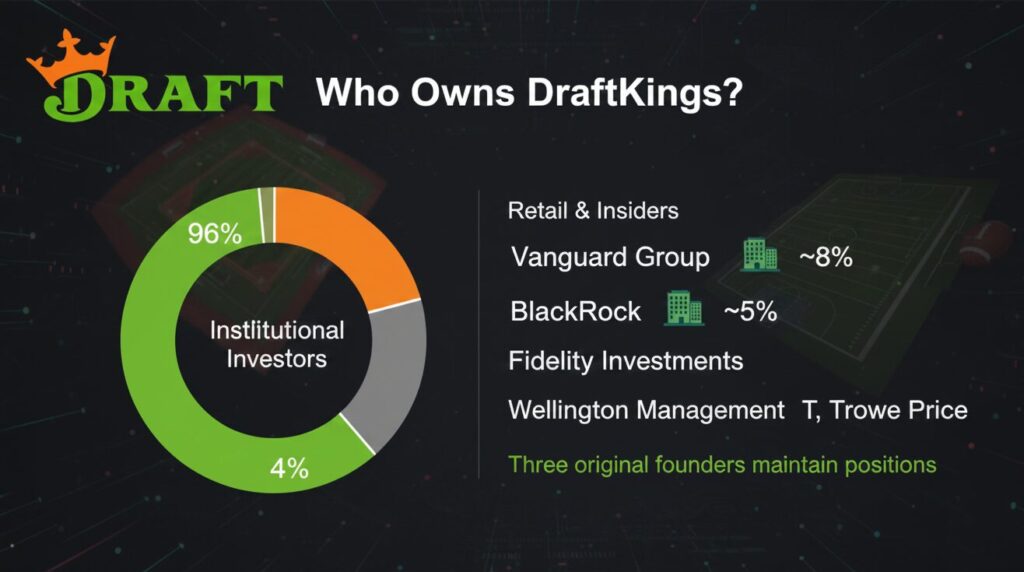
DraftKings operates as a publicly traded sports entertainment and gaming company with institutional investors controlling roughly 96% of outstanding shares. Vanguard Group and BlackRock represent the two largest institutional stakeholders managing approximately 13% combined ownership. The remaining equity belongs to retail shareholders and company insiders including three original founders who maintain significant positions.
Boston-based DraftKings emerged from daily fantasy sports beginnings in 2012 when three entrepreneurs transformed the industry into a multi-billion dollar enterprise. After transitioning to public markets through a merger in April 2020, the company expanded offerings into sports wagering, online casino products, and digital lottery services.
Current operations extend across regulated jurisdictions where the platform attracts millions of monthly users. The business generates revenue through sportsbook handle, iGaming operations, and fantasy contests that collectively produced $4.77 billion in 2024 annual revenue.
Who Owns DraftKings?
Public ownership characterizes DraftKings corporate structure with shares available on the Nasdaq exchange. Approximately 96% of equity resides with institutional investment firms while individual retail investors hold about 4% of outstanding stock.
No single entity possesses majority control as ownership disperses across hundreds of institutional holders. This distributed arrangement prevents concentrated influence over corporate decisions. The top five institutional investors together manage roughly 26% of total shares outstanding.
Founders Jason Robins, Matthew Kalish, and Paul Liberman maintain equity positions despite public status. CEO Robins owns approximately 1% of the company. Individual shareholders purchase stock through brokerage accounts without minimum investment requirements. Trading activity fluctuates based on quarterly earnings reports and regulatory developments within the sports betting industry.
Who is on the Board of Directors for DraftKings?
Ten directors plus three special advisors comprise DraftKings board structure providing strategic oversight and corporate governance. Members bring expertise spanning technology development, financial management, media operations, and regulatory compliance.
Executive Leadership Directors
Jason Robins serves dual roles as Chief Executive Officer and Board Chairman directing company strategy. As co-founder, Robins transformed the business from daily fantasy sports into comprehensive gaming entertainment reaching millions of users across North America.
Matthew Kalish holds positions as President of North America operations and board director. His responsibilities encompass marketing initiatives, product development, and state expansion efforts. Kalish previously worked at Vistaprint before launching DraftKings.
Paul Liberman oversees global technology platforms and product innovation while serving as director. The engineering-focused co-founder manages software development teams building proprietary systems for sportsbook and casino operations.
Independent Financial Oversight
Harry Sloan occupies the Vice Chairman position bringing extensive media and entertainment industry experience. Previously leading Metro-Goldwyn-Mayer and other production companies, Sloan provides guidance on content partnerships.
Gregory Wendt joined the board in October 2025 after retiring from Capital Group where he spent 37 years analyzing gaming and leisure companies. His investment management background aids capital allocation decisions.
Valerie Mosley contributes financial services expertise gained through decades managing portfolios and advising institutional clients. Her presence strengthens audit committee oversight of accounting practices.
Technology and Operations Specialists
Marni Walden brings telecommunications infrastructure knowledge from leadership roles at major wireless carriers. She guides decisions regarding mobile application development and network capacity planning.
Ryan Moore offers digital media insights cultivated while building online content platforms. His understanding of user engagement metrics influences product roadmap priorities.
Woodrow Levin provides legal and regulatory perspective essential for navigating complex gaming compliance requirements across multiple jurisdictions.
Governance Representatives
Jocelyn Moore advocates for responsible gaming practices and consumer protection measures. Her background in public policy helps balance business objectives with societal concerns.
Steven Murray contributes operational efficiency insights from manufacturing sector leadership. His focus on cost management supports profitability goals as the business matures.
Special Advisory Roles
Michael Jordan serves as special advisor leveraging his basketball legend status and business acumen. The six-time NBA champion provides marketing perspectives and helps attract celebrity partnerships.
Cal Ripken Jr. holds advisory capacity bringing baseball credibility to strategic discussions. His Hall of Fame career lends legitimacy when negotiating league partnerships.
Richard Rosenblatt advises based on experience founding internet companies. His entrepreneurial background informs growth strategies in adjacent markets.
Board Composition by Expertise
History of DraftKings Co-founders
Three former Vistaprint executives founded DraftKings in 2012 after recognizing opportunities in daily fantasy sports competitions. Jason Robins conceived the initial concept while working in marketing analytics, identifying gaps between fan engagement and traditional season-long fantasy formats.
Early Partnership Formation
Robins recruited Matthew Kalish and Paul Liberman from Vistaprint where all three demonstrated complementary skills. The trio pooled resources to build technology infrastructure supporting daily contests with immediate payouts.
Initial product development occurred in a Boston office where engineers coded algorithms for salary cap optimization. Beta testing began with friends before expanding to broader audiences.
Roles and Current Involvement
Robins assumed CEO responsibilities focusing on fundraising and regulatory navigation. His leadership guided the company through multiple financing rounds attracting venture capital from prominent investors.
Kalish took charge of customer acquisition and brand building efforts. He developed marketing campaigns targeting sports enthusiasts and negotiated advertising deals with media companies.
Liberman directed technical architecture decisions ensuring platform stability. His engineering team built scalable systems handling millions of concurrent users during major sporting events.
All three founders remain actively engaged in executive leadership positions. Robins continues setting strategic direction and communicating with investors. Kalish oversees North American operations managing state expansion initiatives. Liberman maintains technology oversight ensuring competitive advantages through proprietary systems development.
Largest Shareholders of DraftKings
Institutional investment firms dominate DraftKings shareholder registry with major asset managers holding substantial positions. These organizations maintain stakes for pension funds, mutual funds, and exchange-traded products.
Vanguard Group Inc
Vanguard occupies the largest shareholder position controlling approximately 8.3% of outstanding equity through various funds. This translates to over 41 million shares worth roughly $1.4 billion at recent trading prices.
The Pennsylvania-based firm manages these holdings primarily through index funds that track broad market benchmarks. As a passive investor, Vanguard rarely intervenes in corporate governance matters beyond proxy voting on major proposals.
BlackRock Fund Advisors
BlackRock maintains the second-largest institutional stake at roughly 4.8% representing nearly 24 million shares. The global investment manager acquired these securities across multiple funds including iShares exchange-traded products focused on growth companies.
Similar to Vanguard, BlackRock employs passive investment strategies for most positions. The firm occasionally engages management on environmental and governance matters affecting shareholder value.
FMR LLC (Fidelity Investments)
Fidelity ranks third among institutional holders with approximately 4.4% ownership equating to 22 million shares. The Boston-based asset manager allocated capital across actively managed mutual funds targeting entertainment technology businesses.
Fidelity portfolio managers conduct proprietary research before building positions. The firm maintains communication with company executives regarding strategy execution.
Wellington Management Group
Wellington controls roughly 3.9% of DraftKings shares accumulated through client accounts. The investment firm specializes in fundamental analysis evaluating business models and competitive positioning.
This shareholder actively monitors quarterly performance metrics including revenue growth rates and customer acquisition costs. Wellington analysts assess regulatory risks across different state jurisdictions.
T. Rowe Price Associates
T. Rowe Price rounds out the top five shareholders with a 3.8% stake representing approximately 19 million shares. The Baltimore-based firm focuses on growth-oriented companies demonstrating strong revenue momentum.
Investment professionals evaluate DraftKings against peers in digital entertainment and online gaming categories. The firm considers factors like technology infrastructure and brand strength when maintaining positions.
Top Five Shareholders Distribution
| Shareholder | Ownership % | Shares (millions) |
|---|---|---|
| Vanguard Group | 8.3% | 41.26 |
| BlackRock | 4.8% | 23.78 |
| FMR LLC (Fidelity) | 4.4% | 21.95 |
| Wellington Management | 3.9% | 19.54 |
| T. Rowe Price | 3.8% | 18.87 |
FAQ
Who currently controls DraftKings operations?
No single shareholder controls DraftKings as institutional investors collectively own 96% with no individual holder exceeding 9%. The distributed ownership structure prevents concentrated control over corporate decisions.
Do original founders still own DraftKings shares?
Yes, the three founders maintain equity positions in the company. CEO Jason Robins, Matthew Kalish, and Paul Liberman remain actively engaged in executive leadership while holding meaningful ownership stakes.
When did DraftKings become publicly traded?
DraftKings shares began trading on Nasdaq in April 2020 following a merger with special purpose acquisition company Diamond Eagle. The transaction valued the combined entity at $3.3 billion initially.
Which investment firms hold the largest DraftKings positions?
Vanguard Group leads with 8.3% ownership followed by BlackRock at 4.8% and Fidelity at 4.4%. Wellington Management and T. Rowe Price each control approximately 3.8% to 3.9% stakes.
How many states currently allow DraftKings operations?
DraftKings operates sportsbook products in 28 states plus Washington DC and Ontario Canada. Online casino offerings remain available in five states with expansion dependent on regulatory approvals.
[1] Data sourced from DraftKings Investor Relations quarterly results and SEC filings as of December 2025.