

Key Stats
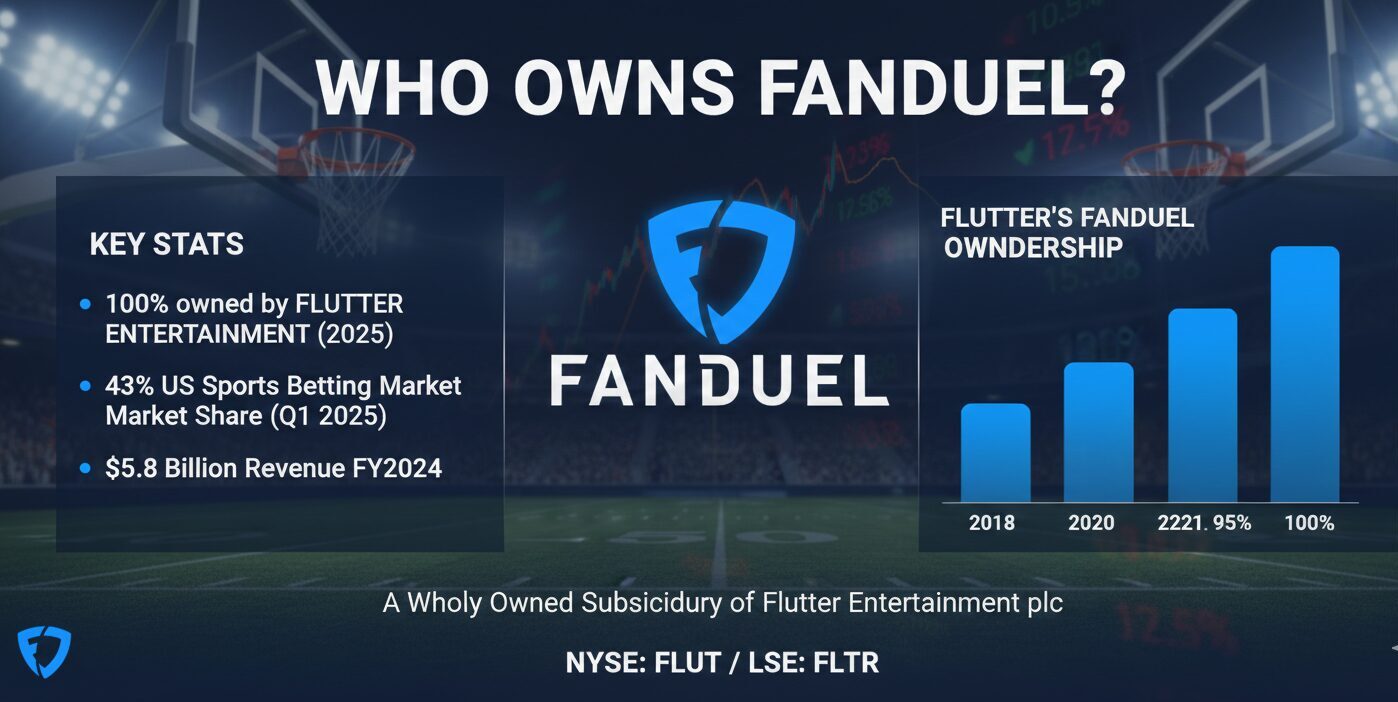
Flutter Entertainment acquired 100% of FanDuel on July 31, 2025, after purchasing Boyd Gaming’s remaining 5% stake for $1.755 billion.FanDuel commands a 43% share of U.S. online sports betting gross gaming revenue as of Q1 2025 (Flutter Entertainment).
FanDuel generated $5.8 billion in revenue during fiscal year 2024, a 38% increase from 2023 (SBC Americas).
Flutter projects FanDuel’s 2025 full-year revenue between $7.47 billion and $7.97 billion.
FanDuel is owned entirely by Flutter Entertainment, the Dublin-headquartered online gambling conglomerate that trades on both the New York Stock Exchange (FLUT) and the London Stock Exchange (FLTR). Flutter completed its full buyout of FanDuel on July 31, 2025, paying Boyd Gaming roughly $1.755 billion for the final 5% minority stake.
The deal valued FanDuel at approximately $31 billion, cementing it as the most prized asset within Flutter’s global portfolio. FanDuel operates sportsbooks in more than 25 U.S. states and holds a 27% share of domestic iGaming revenue. In December 2025, the company partnered with CME Group to launch FanDuel Predicts, a prediction market product aimed at broadening its reach beyond traditional sports wagering. Amy Howe continues to lead FanDuel as CEO.
Who Owns FanDuel?
Flutter Entertainment owns FanDuel outright. The parent company first gained a controlling interest in May 2018, when FanDuel merged with Paddy Power Betfair’s U.S. operations to form FanDuel Group. At the time, Flutter held a 61% stake with options to increase it over time.
How Flutter Reached Full FanDuel Ownership
In December 2020, Flutter acquired an additional stake from Fastball Holdings for $4.1 billion, pushing its ownership to 95%. Boyd Gaming held the remaining 5% through a combination of investor units and warrants. Flutter closed the final acquisition in Q3 2025, eliminating all outside minority holders.
One outstanding consideration remains. Fox Corporation holds an option to purchase an 18.6% equity interest in FanDuel for $4.5 billion. That option is exercisable on or before December 3, 2030, and requires Fox to obtain gaming licenses and pay in full at the time of exercise.
Flutter’s FanDuel Ownership Over Time (%)
Who Is on the Board of Directors for FanDuel’s Parent Company?
Because FanDuel operates as a wholly owned subsidiary, it does not maintain a separate public board. Governance flows through Flutter Entertainment’s board of directors, which oversees strategy, compliance, and executive appointments across all Flutter brands, including FanDuel, PokerStars, Paddy Power, and Sky Betting & Gaming.
Board Chair and Executive Leadership
John A. Bryant has served as Flutter’s independent chair since September 2023. Bryant previously spent six years as CEO of Kellogg Company and now also sits on the boards of Compass Group and Ball Corporation. His consumer industry background shapes Flutter’s brand strategy across regulated markets.
Peter Jackson holds the CEO and board director position, a role he has occupied since January 2018. Before Flutter, Jackson was CEO of Worldpay UK and held senior posts at Banco Santander and Travelex Group. He led the original FanDuel acquisition and has overseen the platform’s expansion into more than 25 states.
Finance and Media Expertise
Christine McCarthy joined the board after decades at The Walt Disney Company, where she served as senior executive vice president and CFO. Her media finance background is relevant as FanDuel expands through FanDuel Sports Network and FanDuel TV, properties comparable in structural complexity to the corporate layers behind NBC.
Nancy Dubuc, who previously led Vice Media Group and A+E Networks, brings content and digital media strategy experience to the board. Her appointment reflects Flutter’s push to integrate entertainment with its betting platforms.
Technology and Operations
Other independent non-executive directors include Holly Keller Koeppel, Robert (Dob) Bennett, Stefan Bomhard, Nancy Cruickshank, Alfred F. Hurley Jr., and Carolan Lennon. Flutter also announced that Sally Susman, currently Pfizer’s chief corporate affairs officer, and David Kenny, chairman of Best Buy, will join the board in May 2026 as part of an ongoing renewal program.
Largest Shareholders of FanDuel’s Parent Flutter Entertainment
Since FanDuel has no independent stock ticker, its ownership is determined by who holds shares in Flutter Entertainment. Flutter trades publicly on the NYSE and LSE, with institutions controlling roughly 95% of outstanding shares. Retail investors account for about 5%, and company insiders hold less than 1%.
Vanguard Group
The Vanguard Group is Flutter’s single largest institutional shareholder, holding approximately 17.26 million shares, or about 9.8% of the company. Vanguard’s stake is spread across index funds like the Vanguard Total Stock Market Index Fund. The firm follows a similar pattern at other publicly traded companies; it is also the top institutional holder of eBay, Costco, and Google parent Alphabet.
BlackRock and Other Major Institutions
BlackRock crossed the 5% voting rights threshold in Flutter in December 2025, making it the second-largest institutional investor. Capital World Investors and Capital Research Global Investors hold additional large positions, followed by Caledonia (Private) Investments and FMR LLC (Fidelity). These firms invest on behalf of pension funds, retirement accounts, and individual savers rather than exercising operational control over FanDuel.
FanDuel U.S. Revenue ($B)
History of FanDuel Co-Founders
FanDuel was founded on July 21, 2009, in Edinburgh, Scotland, by five co-founders: Nigel Eccles, Lesley Eccles, Tom Griffiths, Rob Jones, and Chris Stafford. The group had previously built Hubdub, a news prediction market site that struggled to find a sustainable business model.
From Prediction Markets to Fantasy Sports
After attending SXSW Interactive, the team recognized a gap in the daily fantasy sports space. They pivoted Hubdub into FanDuel, raising $1.2 million in seed funding from Pentech Ventures and Scottish Enterprise. The new platform offered short-duration, real-money fantasy contests that delivered immediate results, an alternative to traditional season-long leagues.
Rapid Growth and Departure
FanDuel raised over $416 million across multiple funding rounds between 2013 and 2015, reaching a valuation above $1 billion. Competition with its closest rival DraftKings drove aggressive marketing spending and rapid user growth. A proposed merger between the two companies was blocked by the FTC in 2017 on antitrust grounds. Nigel Eccles departed as CEO in late 2017, shortly before Paddy Power Betfair acquired the company. The founding team later filed lawsuits alleging the FanDuel board undervalued their shares during the 2018 merger. In a parallel with ownership disputes seen at the UFC after its $4 billion sale, the case illustrates the tensions that can arise when founders exit high-growth companies during acquisition.
FAQs
Who is the current owner of FanDuel?
Flutter Entertainment, an Irish-headquartered global gambling company, owns 100% of FanDuel after completing its full acquisition on July 31, 2025.
Is FanDuel a publicly traded company?
FanDuel itself is not publicly traded. Its parent, Flutter Entertainment, trades on the NYSE (FLUT) and the London Stock Exchange (FLTR).
Who founded FanDuel and when?
Nigel Eccles, Lesley Eccles, Tom Griffiths, Rob Jones, and Chris Stafford founded FanDuel on July 21, 2009, in Edinburgh, Scotland.
Does Fox Corporation own a stake in FanDuel?
Fox does not currently own shares in FanDuel but holds an option to acquire an 18.6% stake for $4.5 billion, exercisable before December 3, 2030.
How much revenue does FanDuel generate?
FanDuel generated $5.8 billion in U.S. revenue in 2024. Flutter projects that figure to reach between $7.47 billion and $7.97 billion in 2025.
