


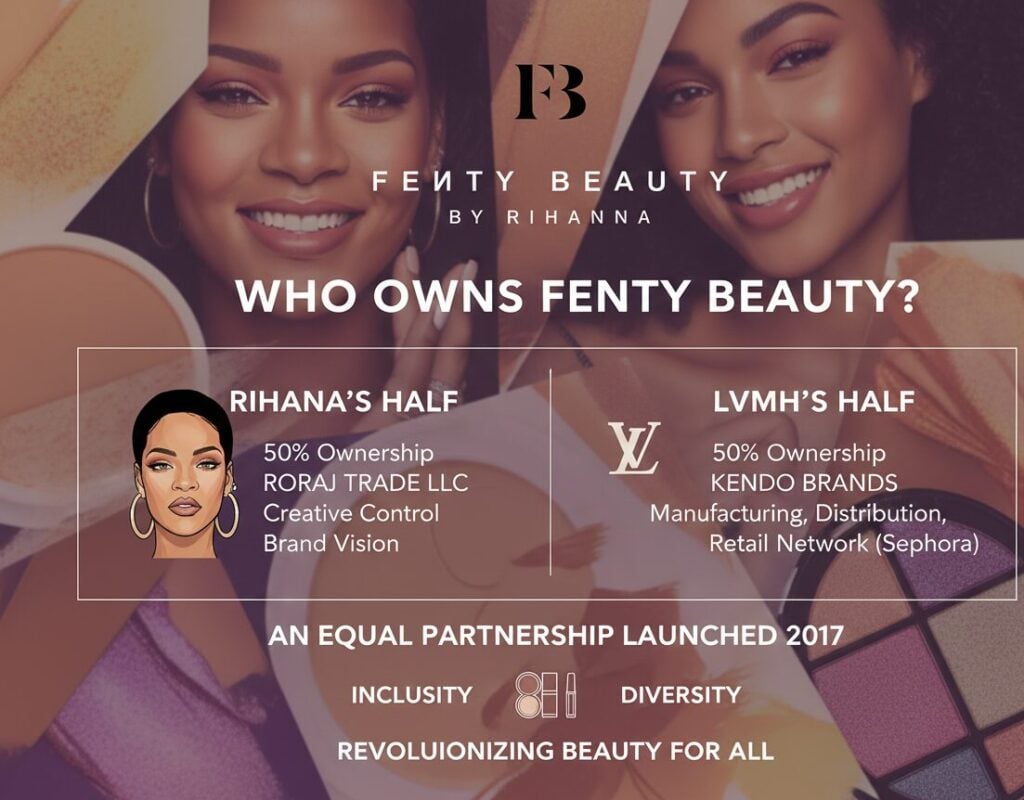
Fenty Beauty is owned jointly by Robyn Rihanna Fenty, who holds 50% ownership, and LVMH’s Kendo Brands, which controls the remaining 50%. This equal partnership launched in September 2017 has revolutionized the beauty industry through its inclusive approach to cosmetics.
The brand recently signed GloRilla as its first joint ambassador across all four Fenty brands in January 2026. Fenty Beauty products launched in India during 2024 and expanded distribution through Ulta Beauty partnerships. The company maintains its position as the top-earning celebrity beauty brand globally, reaching consumers in 17 countries through retail and digital channels.
Key Stats
Who Owns Fenty Beauty?
The ownership structure divides equally between Rihanna’s company Roraj Trade LLC and LVMH’s beauty incubator Kendo Brands. Each party maintains 50% equity in the venture.
This partnership arrangement provides Rihanna with creative control while LVMH handles manufacturing, distribution, and retail infrastructure through its Sephora network. The collaboration allows both parties to leverage their respective strengths in celebrity influence and luxury goods expertise.
Corporate Structure
Fenty Beauty operates as a limited liability company headquartered in San Francisco, California. The brand functions under Kendo Holdings’ operational framework while maintaining distinct identity and creative direction. This structure enables rapid product development and market responsiveness.
Recent Ownership Developments
LVMH began exploring potential sale of its 50% stake in October 2025 according to Reuters. Investment bank Evercore was retained to assess strategic alternatives, though no transactions have materialized. The parent company continues evaluating portfolio optimization amid changing luxury market dynamics.
Fenty Beauty Origin, Founders And Early Years
Rihanna launched Fenty Beauty on September 8, 2017 during New York Fashion Week. The debut coincided with her Puma collaboration, creating cultural momentum around the brand launch.
The singer spent years developing the product line with LVMH after signing a deal in 2016. She approached beauty brand creation differently than most celebrity ventures by maintaining hands-on involvement in product development.
Early Development
Rihanna worked directly with Kendo’s research teams to create formulations that performed across all skin tones. She tested products personally and recruited diverse models for product trials. The focus on underserved deeper skin tones shaped product development from the beginning.
Launch Strategy
The initial product release featured 40 foundation shades through Sephora stores and fentybeauty.com. This approach disrupted industry norms where brands typically offered 15-20 shades. The strategy generated $72 million in earned media value during the first month, surpassing established brands.
How Did Fenty Beauty Get Its Name?
The brand name derives from Rihanna’s legal surname. Her full name is Robyn Rihanna Fenty, making the brand a direct extension of her personal identity.
Rihanna trademarked “Fenty” in June 2013 for future business ventures. The trademark covered cosmetics, fragrances, and other beauty products years before launch. This forward planning demonstrated strategic intent beyond music career.
The naming choice reflects authenticity and personal investment in the brand’s success. Unlike generic celebrity beauty lines, Fenty signals family heritage and genuine ownership. Her father Ronald Fenty’s surname connects the brand to Barbadian roots and family history.
The name carries dual meaning as both personal identifier and brand promise. It positions Rihanna as founder rather than mere spokesperson. The trademark now extends across multiple categories including skincare, hair care, and fragrance. This expansion under one name builds cohesive brand architecture, similar to how major beauty conglomerates structure their portfolios.
Largest Shareholders Of Fenty Beauty
Fenty Beauty’s shareholder structure consists of two primary stakeholders given its private company status. The brand does not trade publicly, limiting ownership to the original partners.
Rihanna’s Holdings
Robyn Rihanna Fenty controls 50% through Roraj Trade LLC, her personal holding company. This stake was valued at approximately $1.4 billion based on 2021 brand valuations. Her ownership represents direct equity rather than licensing arrangements common in celebrity beauty deals. The structure provides voting rights and profit participation proportional to ownership percentage.
LVMH Position
Kendo Brands maintains the remaining 50% ownership on behalf of LVMH. The luxury conglomerate’s stake is held through its Perfumes and Cosmetics division. Bernard Arnault’s family controls LVMH through Christian Dior SE, which holds 46% of the parent company. This indirect ownership chain links Fenty Beauty to one of the world’s wealthiest families.
Investment Structure
No venture capital firms or private equity investors hold positions in Fenty Beauty. The partnership remains exclusively between Rihanna and LVMH since inception. This arrangement differs from other celebrity brands that raise external funding. The absence of outside investors simplifies decision-making and preserves brand vision alignment between founding partners.
Mission Statement Of Fenty Beauty
Fenty Beauty’s mission centers on inclusivity and accessibility across all skin tones. The brand commits to serving customers historically underserved by the beauty industry.
This mission emerged from Rihanna’s personal frustration finding suitable makeup products. She experienced the gap between available offerings and actual consumer needs. The mission statement emphasizes “Beauty for All” as its guiding principle.
The company pursues this mission through extensive shade ranges across all complexion products. Foundation offerings span 50 distinct shades covering the full spectrum of skin tones. This commitment extends beyond product development into marketing representation.
Fenty Beauty demonstrates mission alignment by featuring diverse models in campaigns. The brand showcases models with different skin tones, ages, and gender expressions. This representation challenges traditional beauty marketing norms established by legacy brands.
The mission influences product pricing strategy to maintain accessibility. Items are positioned at premium but not ultra-luxury price points. This approach balances quality with broader market reach, making inclusive beauty commercially viable across different consumer segments.
Fenty Beauty Products And Services
The product portfolio spans four main categories developed since 2017. Each category maintains the brand’s commitment to diverse shade ranges and inclusive formulations.
Makeup represents the core offering with foundations, concealers, highlighters, lipsticks, and eye products. The Pro Filt’R foundation launched the brand and remains a bestseller. Gloss Bomb lip gloss and Killawatt highlighters have achieved cult product status. The makeup line now includes over 300 SKUs across complexion, lip, and eye categories.
Fenty Skin launched in 2020 as the brand’s skincare extension. The line features cleansers, toners, serums, and moisturizers formulated for all skin types. Products emphasize clean ingredients and environmental responsibility. The Fat Water pore-refining toner and Hydra Vizor moisturizer SPF exemplify the skincare philosophy, much like established skincare brands.
Fenty Hair debuted in 2024 targeting textured and curly hair types. The collection includes shampoos, conditioners, and styling products. This category addresses another underserved market segment in beauty.
Fenty Fragrance offers signature scents developed with luxury perfume houses. The fragrances maintain premium positioning while ensuring broad appeal. Body care products complement the fragrance offerings with coordinated scents.
Company History Timeline Of Fenty Beauty
Who Is On The Board Of Directors For Fenty Beauty?
Fenty Beauty operates under Kendo Brands’ corporate governance structure rather than maintaining an independent board. Key decision-makers span both the Rihanna organization and LVMH management teams.
Creative Leadership
Robyn Rihanna Fenty serves as Founder, CEO, and Creative Director. She maintains final approval authority on all product development, marketing campaigns, and brand partnerships. Her involvement extends beyond typical celebrity endorsement into daily operational decisions. She participates in product development meetings and personally tests formulations before launch.
LVMH Executive Oversight
Kendo Brands executives provide strategic oversight and operational support. The beauty incubator’s leadership team manages manufacturing relationships, supply chain operations, and retail distribution. These executives report through LVMH’s Perfumes and Cosmetics division to the parent company’s board. Bernard Arnault, LVMH Chairman and CEO, holds ultimate authority over major strategic decisions affecting the brand.
Operational Management
The brand employs dedicated leadership for specific functions. Marketing, product development, and digital teams operate with significant autonomy under Rihanna’s creative direction. This structure balances entrepreneurial flexibility with corporate resources, similar to governance approaches at major technology companies.
Advisory Network
Industry veterans and beauty executives advise on category expansion and market strategy. These advisors bring expertise from luxury cosmetics, retail operations, and celebrity brand management. The advisory structure complements the core management team without formal board authority.
FAQ
What is the net worth of Fenty Beauty?
Fenty Beauty’s valuation ranges between $1 billion and $2.8 billion according to industry estimates. The brand generated approximately $600 million in revenue during 2024, making it the top-earning celebrity beauty brand globally.
Fenty Beauty market cap in 2026
Fenty Beauty operates as a private company without public market capitalization. LVMH reportedly values its 50% stake between $500 million and $1.4 billion. The brand does not trade on stock exchanges.
Is Fenty Beauty still operational?
Yes, Fenty Beauty continues active operations across makeup, skincare, hair care, and fragrance categories. The brand recently expanded into India and signed new brand partnerships in 2025-2026 across multiple markets.
When did Fenty Beauty come out?
Fenty Beauty launched on September 8, 2017 at New York Fashion Week. The debut featured 40 foundation shades through Sephora stores and fentybeauty.com, revolutionizing inclusive beauty standards across the cosmetics industry.
Who owns Fenty Beauty?
Rihanna owns 50% through her company Roraj Trade LLC while LVMH’s Kendo Brands owns the remaining 50%. This equal partnership has remained unchanged since the 2017 launch despite recent reports of potential stake sales.
Is Fenty Beauty an American company?
Fenty Beauty is headquartered in San Francisco, California, making it an American company. However, it operates as a joint venture between American artist Rihanna and French luxury conglomerate LVMH through its Kendo subsidiary.