


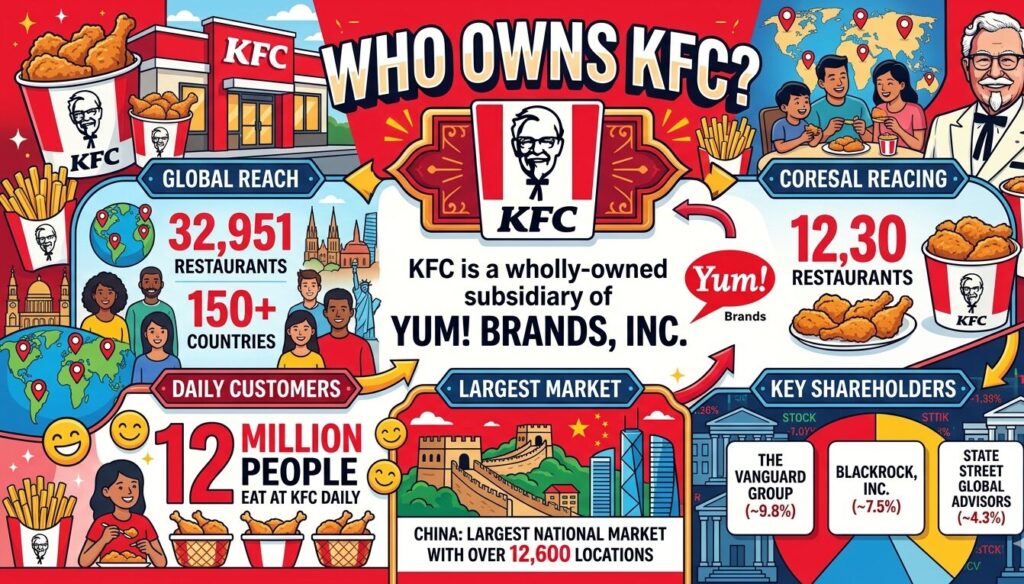
KFC is owned by Yum! Brands, Inc. (NYSE: YUM), a publicly traded restaurant corporation headquartered in Louisville, Kentucky. As of Q3 2025, KFC ran over 32,000 restaurants in more than 150 countries, making it the world’s second-largest restaurant chain by sales after McDonald’s.
- KFC operated more than 32,951 restaurants across 150+ countries as of Q3 2025.
- Yum! Brands recorded a market capitalization of approximately $41.24 billion in December 2025.
- China holds over 12,600 KFC locations, the chain’s largest single national market.
- KFC’s brand value is estimated between $15 billion and $22 billion as of 2025.
- More than 12 million people eat at KFC restaurants every day worldwide.
Who Owns KFC?
Yum! Brands, Inc. owns KFC as a wholly-owned subsidiary. The parent company trades on the New York Stock Exchange under the ticker YUM alongside its other brands, Pizza Hut and Taco Bell.
KFC is not simply a logo in the Yum! portfolio. The division accounts for roughly 50 percent of Yum! Brands’ divisional operating profit. Yum! Brands sets global brand standards, funds marketing programs, and manages franchise agreements in over 150 countries.
Scott Mezvinsky became KFC Division CEO on March 1, 2025, reporting to Yum! Brands CEO Chris Turner, who took the top job on October 1, 2025, succeeding David Gibbs after his 36-year tenure with the company.
KFC’s Origin, Founders and Early Years
KFC traces back to Harland Sanders, who began selling fried chicken at his roadside diner in Corbin, Kentucky in the 1930s. Sanders developed a pressure-cooking method and the 11-herb-and-spice Original Recipe that still defines the brand today.
By 1963, the chain had grown to 600 locations — at the time the largest fast food operation in the United States. In 1964, Sanders sold the company to a group led by John Y. Brown Jr. and Jack C. Massey for $2 million, keeping Sanders on as a lifelong ambassador and quality controller.
Heublein acquired the chain in 1971, followed by R.J. Reynolds in 1982. PepsiCo then purchased KFC in 1986 for $840 million. In 1997, PepsiCo spun off its restaurant holdings — including KFC, Pizza Hut, and Taco Bell — into a separate entity called Tricon Global Restaurants. That company renamed itself Yum! Brands in 2002.
Largest Shareholders of Yum! Brands
Who Is on the Board of Directors for KFC?
KFC operates as a subsidiary under Yum! Brands’ board oversight. The following directors govern Yum! Brands and, by extension, the KFC division.
Brian C. Cornell — Non-Executive Chair
Director since 2015. Former Chairman and CEO of Target Corporation. Chairs the Yum! Brands board and leads overall governance.
Chris Turner — CEO & Director
Director since October 2025. Served as Yum! Brands CFO since 2019 before becoming CEO. Oversees global strategy and franchise operations.
M. Brett Biggs
Director since 2023. Former Executive Vice President and CFO of Walmart Inc. Provides financial oversight and capital allocation guidance.
Keith Barr
Former CEO of IHG Hotels & Resorts. Brings global hospitality operations expertise directly relevant to KFC’s franchise-heavy model.
Tanya L. Domier
CEO of Advantage Solutions. Contributes brand management and consumer marketing experience to the board’s strategic direction.
P. Justin Skala
Former executive at Colgate-Palmolive with deep international consumer goods experience, informing KFC’s global expansion decisions.
Annie Young-Scrivner
CEO of Wella Company. Former Starbucks executive with global brand-building background spanning retail and quick service sectors.
Susan Doniz
Experienced technology executive. Provides digital transformation and data infrastructure counsel as KFC scales its app and delivery platforms.
Mirian M. Graddick-Weir
Director since 2012. Former Executive Vice President of Human Resources at Merck & Co. Oversees talent and culture governance for the company’s global workforce.
KFC Products and Services
Original Recipe Chicken
The flagship product. Pressure-fried on-the-bone chicken seasoned with Colonel Sanders’ blend of 11 herbs and spices, hand-breaded at each restaurant.
Zinger & Chicken Sandwiches
The Zinger spicy chicken fillet burger — launched internationally in 1993 — remains one of KFC’s top-selling items across European and Asian markets.
Family Buckets & Meals
Shareable bucket meals are central to KFC’s identity and revenue. Bucket sizes typically range from 6 to 16 pieces and drive the largest average ticket sizes.
Sides & Accompaniments
Mashed potatoes with gravy, coleslaw, corn on the cob, mac and cheese, and biscuits make up the core sides menu, varying by country.
Digital Ordering & Delivery
KFC operates its own app and partners with third-party delivery platforms globally. The Byte by Yum! digital division supports tech infrastructure across the brand.
Regional & Local Menu Items
KFC adapts menus by market — rice congee in China, rice meals in the Philippines, paneer options in India — with an average of 50 items per store in major markets.
How Did KFC Get Its Name?
KFC stands for Kentucky Fried Chicken, a name tied directly to the state where Harland Sanders developed and refined his original recipe in Corbin, Kentucky during the 1930s. The chain operated under the full name Kentucky Fried Chicken for more than four decades.
In the early 1990s, the company shortened the trading name to “KFC.” Kyle Craig, then president of KFC US, acknowledged the change was partly an attempt to move away from the word “fried” amid rising consumer health awareness. The abbreviation also gave the brand more flexibility as it expanded its menu beyond fried items in several international markets.
Today, KFC is the registered trademark used in all 150+ countries and territories where the chain operates, though the full name Kentucky Fried Chicken still appears in some legal and historical contexts.
The KFC Mission Statement
KFC’s stated purpose centers on serving freshly prepared, great-tasting food that communities around the world can count on. The brand aims to deliver a consistent experience across its franchise network while allowing local operators enough flexibility to serve regional tastes.
Yum! Brands, which governs KFC, frames its broader purpose around building brands that people trust — a goal that leans heavily on the franchise system. Rather than owning every restaurant outright, the company empowers franchisees to run restaurants that meet global quality and safety standards while staying connected to their local communities.
KFC also positions food accessibility as part of its mission. In many emerging markets — across Africa, Southeast Asia, and Latin America — KFC represents an affordable, reliable meal option, which shapes its pricing strategy and menu architecture in those regions.
FAQs
Who owns KFC?
KFC is owned by Yum! Brands, Inc. (NYSE: YUM), a publicly traded restaurant company headquartered in Louisville, Kentucky. Yum! Brands also owns Taco Bell, Pizza Hut, and Habit Burger & Grill.
What is the net worth of KFC?
KFC’s brand value is estimated between $15 billion and $22 billion as of 2025, based on its global franchise system and revenue contribution. As a Yum! Brands subsidiary, KFC does not publish standalone financials.
What is the KFC market cap in 2026?
KFC itself is not publicly traded. Its parent company, Yum! Brands, recorded a market capitalization of approximately $41.24 billion as of December 2025. That figure fluctuates daily with the NYSE-listed YUM stock price.
When was KFC founded?
Harland Sanders began selling fried chicken in the 1930s in Corbin, Kentucky. The first official KFC franchise opened in 1952 in Salt Lake City, Utah. Sanders sold the company in 1964 to investors led by John Y. Brown Jr.
Is KFC still operational in 2026?
Yes. KFC operates more than 32,000 restaurants across 150+ countries as of early 2026. The chain opened a new restaurant roughly every 3.5 hours during 2025 and remains one of the world’s largest quick-service restaurant brands.