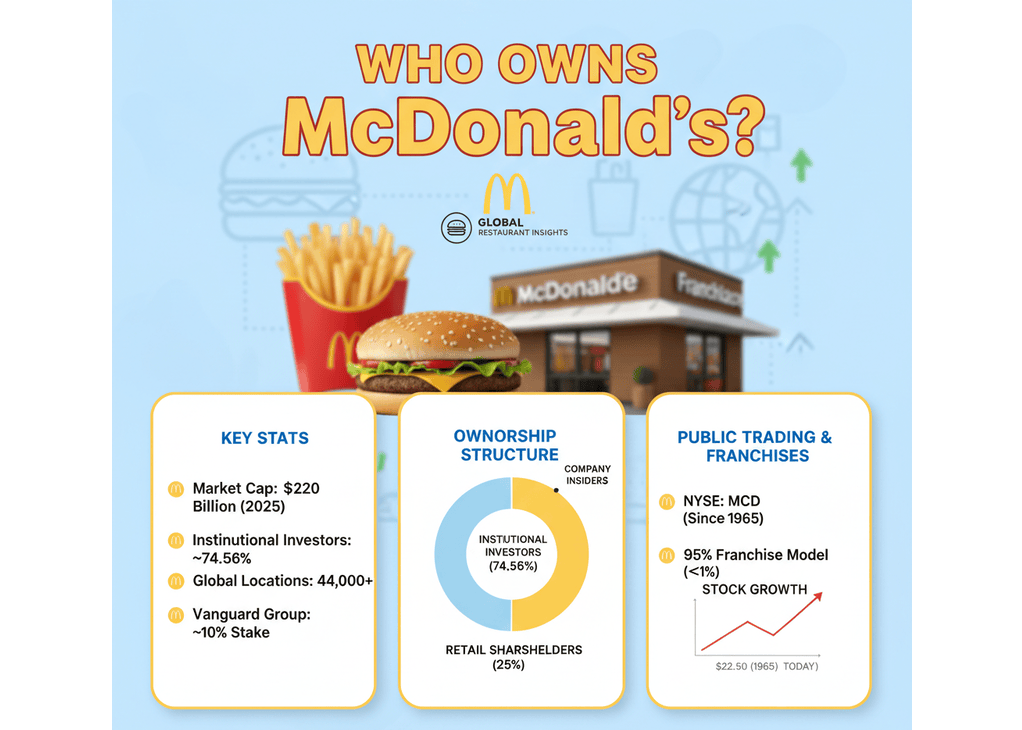
McDonald’s market capitalization stands at approximately $220 billion as of October 2025
Institutional investors control roughly 74.56% of McDonald’s outstanding shares
The company operates over 44,000 locations across more than 100 countries worldwide
Vanguard Group holds the largest stake with approximately 10% ownership worth $21 billion
McDonald’s Corporation operates as a publicly traded company on the New York Stock Exchange under ticker symbol MCD, with no single owner controlling the Golden Arches empire. Instead, institutional investors like Vanguard Group and BlackRock hold substantial stakes alongside millions of individual shareholders who collectively own this global restaurant powerhouse worth over $220 billion.
The company’s massive operations span six continents with approximately 95% of McDonald’s restaurants functioning under franchise agreements with independent business owners. Chris Kempczinski serves as both CEO and Chairman since 2024, guiding strategic decisions from the Chicago headquarters while the board of directors provides oversight and major institutional shareholders influence corporate governance through their voting power.
Who Owns McDonald’s?
McDonald’s operates as a publicly traded corporation where ownership divides between institutional investors, retail shareholders, and company insiders. The institutional investors dominate the shareholder landscape, with these massive investment firms purchasing shares through mutual funds, pension plans, and exchange-traded funds.
Ownership Structure Breakdown
Institutional investors collectively control approximately 74.56% of all outstanding McDonald’s stock. Individual retail investors own roughly 25% through personal brokerage accounts and retirement portfolios. Company insiders, including executives and board members, hold less than 1% of total shares.
Public Trading Since 1965
The company went public in 1965 at $22.50 per share, and today those same shares trade above $300 each, representing phenomenal growth over six decades. Shareholders benefit from consistent dividend payments and capital appreciation as the business expands globally through its franchise model.
Largest Shareholders of McDonald’s
Vanguard Group Leads Institutional Ownership
Vanguard Group holds the largest position with approximately 10% of outstanding shares, translating to roughly 71.33 million shares valued over $21 billion. This global asset manager manages trillions across various industries through index funds and mutual funds.
The firm exercises significant voting power during shareholder meetings but typically follows passive investment strategies. They rarely intervene in daily management decisions but vote on major issues affecting company direction.
BlackRock’s Substantial Stake
BlackRock commands the second-largest position at 7.31% ownership, holding approximately 52.4 million shares worth over $15 billion. Similar to their approach with other major holdings, they use voting rights to advocate for long-term financial stability and sustainability initiatives.
The company invests through various exchange-traded funds and mutual funds. BlackRock consistently pushes for environmental responsibility within major corporations, extending their influence beyond financial returns to corporate governance practices.
State Street Global Advisors
State Street controls 4.95% of McDonald’s stock through approximately 35.5 million shares valued at roughly $10 billion. This major asset manager focuses on shareholder value and corporate responsibility. While not directly managing operations, their substantial stake allows influence through voting power on board decisions.
Additional Major Institutional Holders
JP Morgan Asset Management owns 3.57% with 25.6 million shares. Geode Capital Management maintains 2.24% through 16.1 million shares. Wellington Management, Capital Research, and other institutional investors collectively hold significant positions.
These firms typically invest client funds from pension plans, retirement accounts, and endowments. Their diversified portfolios include McDonald’s alongside thousands of other companies, with investment decisions following research-based strategies aimed at generating consistent returns for fund participants.
McDonald’s Business Model and Franchise Operations
Franchise System Dominance
McDonald’s derives most revenue from franchise fees and royalties rather than operating restaurants directly. Franchisees pay initial fees ranging from $45,000 to $1 million depending on location size and market conditions. They also contribute monthly royalties calculated as a percentage of gross sales.
This model differs significantly from company-operated restaurants. Franchisees assume equipment costs, real estate expenses, and staffing responsibilities while McDonald’s provides training, marketing support, and supply chain access.
Global Market Presence
The United States hosts over 13,436 McDonald’s locations, making it the largest market. China operates approximately 4,978 restaurants while Japan maintains 2,968 outlets. France, Canada, and Germany each host more than 1,400 locations.
International markets adapt menus to local tastes. Indian locations exclude beef products respecting religious customs. Middle Eastern restaurants offer halal-certified meat. This flexibility helps McDonald’s compete against regional chains worldwide.
Historical Brand Investments
McDonald’s previously owned stakes in Chipotle Mexican Grill from 1998 to 2006. The company invested approximately $360 million and received $1.5 billion upon divesting its position, helping Chipotle expand from 16 to over 500 locations.
The company also acquired Boston Market in 2000 targeting the fast-casual dining segment but sold this rotisserie chicken chain in 2007. Similar divestitures included Pret A Manger and Donato’s Pizza as leadership concentrated resources on the main McDonald’s business.
History of McDonald’s Co-founders
The McDonald Brothers’ Innovation
Richard and Maurice McDonald opened their first restaurant in San Bernardino, California in 1940. They operated a traditional carhop service where customers parked and waited for food delivery. The menu included barbecue, hot dogs, and various items beyond their famous burgers.
Everything changed in 1948 when the brothers revolutionized their operation. They eliminated carhop service and created the “Speedee Service System.” This assembly-line approach emphasized quick preparation, limited menu options, and efficient workflows that delivered hot food in minutes.
Ray Kroc’s Transformation
Ray Kroc discovered McDonald’s in 1954 while selling milkshake machines. He noticed the restaurant used eight of his machines simultaneously and visited to investigate. The efficient operation impressed him greatly, leading Kroc to propose franchising the concept nationwide.
He founded McDonald’s Corporation in 1955 and opened the first franchised location in Des Plaines, Illinois. By 1961, Kroc had purchased complete ownership from the McDonald brothers for $2.7 million, gaining total control over the company’s future direction.
Under Kroc’s leadership, expansion accelerated dramatically. The company introduced iconic menu items including the Big Mac in 1968 and competed against rivals like Yum! Brands’ KFC and Pizza Hut. International markets opened throughout the 1970s and 1980s as former restaurant owner PepsiCo divested its fast food holdings.
Who Is on the Board of Directors for McDonald’s?
Executive Leadership
Chris Kempczinski chairs the board while serving as Chief Executive Officer. He assumed the combined chairman and CEO role in 2024 following distinguished service since joining McDonald’s in 2015. His background includes executive positions at Kraft Heinz Company and strategic roles at PepsiCo.
Kempczinski oversees global operations spanning 44,000 restaurants. His leadership navigates challenges including economic uncertainty, supply chain disruptions, and evolving consumer preferences. The CEO’s compensation package totals approximately $18.20 million annually.
Independent Directors – Operations and Finance
Miles White serves as Lead Independent Director, previously leading Abbott Laboratories as Chairman and CEO from 1999 to 2020. Mike Hsu joined the board bringing over 30 years of consumer products experience as Chairman and CEO of Kimberly-Clark Corporation.
Lloyd Dean leads CommonSpirit Health as CEO, bringing governance experience with large organizations to guide board oversight of McDonald’s sprawling franchise network.
Independent Directors – Technology and Innovation
Amy Weaver contributes technology and financial expertise gained as former President and CFO of Salesforce. She currently serves as CEO of Direct Relief, helping McDonald’s navigate digital transformation and online ordering expansion.
Catherine Engelbert brings professional sports management experience from her role as WNBA Commissioner. Her leadership in sports marketing aligns with McDonald’s sponsorship strategies and brand positioning efforts.
Independent Directors – Retail and Consumer Products
Tony Capuano serves as President and CEO of Marriott International. His hospitality industry expertise informs discussions about customer service, franchising, and international expansion.
Paul Walsh previously served as CEO of Diageo plc from 2000 to 2013, bringing extensive consumer goods experience to board discussions about brand management and global market strategies.
FAQs
Who is the biggest shareholder of McDonald’s?
Vanguard Group holds the largest stake at approximately 10% ownership, representing over 71 million shares valued at $21 billion as of October 2025.
Does McDonald’s have a single owner?
No, McDonald’s operates as a publicly traded corporation owned by institutional investors, individual shareholders, and company insiders collectively without single ownership control.
Who controls McDonald’s operations?
The board of directors provides oversight while CEO Chris Kempczinski manages daily operations and strategic initiatives from the Chicago headquarters.
What is McDonald’s current market value?
McDonald’s market capitalization approximates $220 billion as of October 2025, making it among the world’s most valuable restaurant companies.
When did McDonald’s become publicly traded?
McDonald’s completed its initial public offering in 1965 at $22.50 per share and trades on the New York Stock Exchange under ticker MCD.