


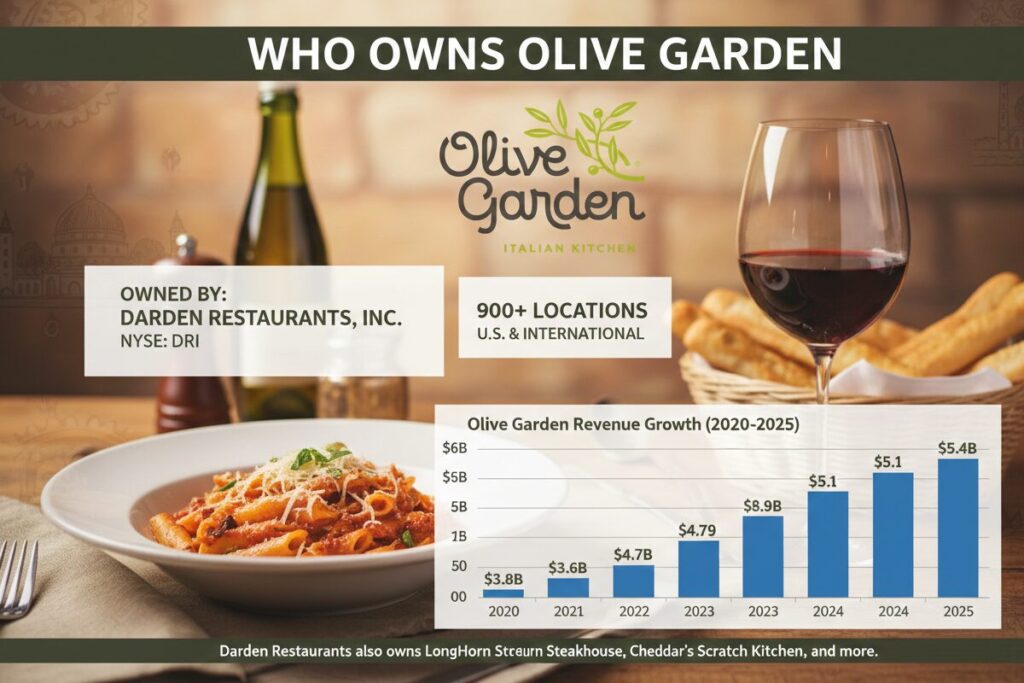
Key Stats
Parent company: Darden Restaurants, Inc. (NYSE: DRI)
Olive Garden locations: 900+ across the U.S. and select international markets
Darden Restaurants fiscal 2025 total revenue: $12.1 billion
CEO of Darden Restaurants: Rick Cardenas (since May 2022)
Olive Garden is owned by Darden Restaurants, Inc., the largest full-service restaurant company in the United States. Darden trades publicly on the New York Stock Exchange under the ticker DRI and controls all of Olive Garden’s operations, menu decisions, and corporate strategy.
As of fiscal year 2025, Darden reported total sales of $12.1 billion, with Olive Garden contributing roughly 45% of that figure. Darden also completed a $605 million acquisition of the Chuy’s Tex-Mex chain in late 2024, adding over 100 locations to its portfolio. The company now operates more than 2,100 restaurants across 11 brands, including well-known casual dining competitors to fast-food giants like McDonald’s. Olive Garden remains Darden’s top earner and continues to grow through digital ordering expansion and suburban market development.
Who Owns Olive Garden?
Olive Garden does not operate as an independent company. It is a wholly owned brand within Darden Restaurants, Inc., headquartered in Orlando, Florida. There is no separate Olive Garden stock, no franchise model in the U.S., and no private ownership group behind the brand. Every domestic Olive Garden restaurant is company-owned and managed directly by Darden.
How Darden Controls Olive Garden
Darden handles all corporate-level functions for the Olive Garden brand, from marketing and real estate to supply chain management and menu development. A brand president within Darden’s executive structure reports directly to the CEO and oversees day-to-day Olive Garden operations. Internationally, a small number of Olive Garden locations operate through licensing agreements in countries like Mexico, Kuwait, Brazil, and the UAE, but Darden retains full control over intellectual property and brand standards.
Who Is on the Board of Directors for Olive Garden?
Since Olive Garden falls under Darden Restaurants, its governance runs through Darden’s board. As of 2025, Darden’s board consists of nine members with backgrounds spanning retail, finance, consumer brands, and food service.
Board Chair and CEO
Cynthia T. Jamison chairs the board. She spent her career as a turnaround CFO across multiple companies, bringing financial restructuring experience to Darden’s governance. Rick Cardenas, Darden’s president and CEO, also sits on the board. He started with the company in 1984 as a busser at Red Lobster and worked through finance and operations roles before his appointment as CEO in May 2022.
Directors with Consumer and Retail Expertise
Juliana Chugg previously held the role of global chief brands officer at Mattel. She chairs the nominating and governance committee. William S. Simon, former president and CEO of Walmart U.S., contributes retail and supply chain perspective. James P. Fogarty runs FULLBEAUTY Brands and chairs the finance committee. Charles M. Sonsteby, retired vice chairman of The Michaels Companies, brings financial oversight as an audit committee expert.
Directors with Operations and Industry Background
Margaret Shân Atkins, formerly managing director of Chetrum Capital, chairs the audit committee. Timothy J. Wilmott, retired CEO of Penn National Gaming, leads the compensation committee. Nana Mensah, chairman and CEO of ‘XPORTS Inc., serves on both the compensation and finance committees, contributing international food industry experience.
History of Olive Garden and Its Co-founders
Olive Garden was not started by an individual entrepreneur. It was created in-house by General Mills, the packaged food conglomerate, as a way to expand its restaurant division in the early 1980s.
The First Olive Garden Restaurant
The first location opened in Orlando, Florida, in 1982. General Mills designed the concept to compete in the growing Italian-American casual dining market, complementing its existing Red Lobster chain. By 1989, Olive Garden had grown to over 145 restaurants, making it the fastest-growing brand in General Mills’ restaurant portfolio.
Spin-Off to Darden Restaurants
In 1995, General Mills spun off its restaurant operations into a new independent company. The entity was named Darden Restaurants after William “Bill” Darden, who had founded Red Lobster in 1968. Since the spin-off, Olive Garden has remained under Darden’s ownership, growing from a domestic chain to an international brand with licensed locations in Latin America and the Middle East.
Largest Shareholders of Olive Garden’s Parent Company
Because Olive Garden is a subsidiary of a publicly traded company, its ownership traces back to the shareholders of Darden Restaurants. No individual or private entity owns Olive Garden directly. Instead, ownership is distributed across institutional investors, mutual funds, pension plans, and retail shareholders who hold DRI stock.
Capital World Investors
Capital World Investors holds the largest stake at approximately 12.7% of Darden shares, or about 14.84 million shares. This Los Angeles-based investment management arm of Capital Group takes long-term positions in established consumer companies. Their holding in Darden reflects confidence in the casual dining sector’s stability, similar to their positions in other major restaurant and food service companies.
The Vanguard Group
Vanguard ranks second with around 12% ownership, holding roughly 14 million shares. As the world’s largest mutual fund provider, Vanguard’s stake comes primarily through index funds and ETFs that track broad market benchmarks. Vanguard holds similar positions in other retail and restaurant companies.
BlackRock
BlackRock, the world’s largest asset manager, owns about 8.5% of Darden through roughly 9.92 million shares. Like Vanguard, BlackRock’s position is spread across various index funds and actively managed strategies.
Other Institutional and Retail Investors
Beyond the top three, institutional investors collectively hold about 28% of Darden shares, while retail investors account for roughly 71% of total ownership. Company insiders own less than 1%. This dispersed ownership structure means no single entity exercises majority control over Olive Garden’s parent company.
Olive Garden Revenue Growth (2020–2025)
FAQs
Who is Olive Garden owned by?
Olive Garden is owned by Darden Restaurants, Inc., a publicly traded company on the NYSE (ticker: DRI). Darden fully operates and controls the brand across all U.S. locations.
Is Olive Garden a franchise?
No. All U.S. Olive Garden locations are company-owned by Darden Restaurants. Some international locations operate under licensing agreements with local partners.
Does General Mills still own Olive Garden?
No. General Mills created Olive Garden in 1982 but spun off its restaurant operations in 1995 to form Darden Restaurants, which has owned the brand since.
Are Olive Garden and Red Lobster owned by the same company?
Not anymore. Both were once under Darden, but Darden sold Red Lobster in 2014. Olive Garden remains with Darden while Red Lobster operates under separate ownership.
How many Olive Garden restaurants are there?
As of 2025, Olive Garden operates over 900 restaurants across the United States and a small number of licensed international locations.