

Key Stats
- Annual Revenue: $91.85 billion (2024)
- Market Capitalization: Approximately $210 billion
- Total Employees: 319,000 (2024)
- Institutional Ownership: 75.33%
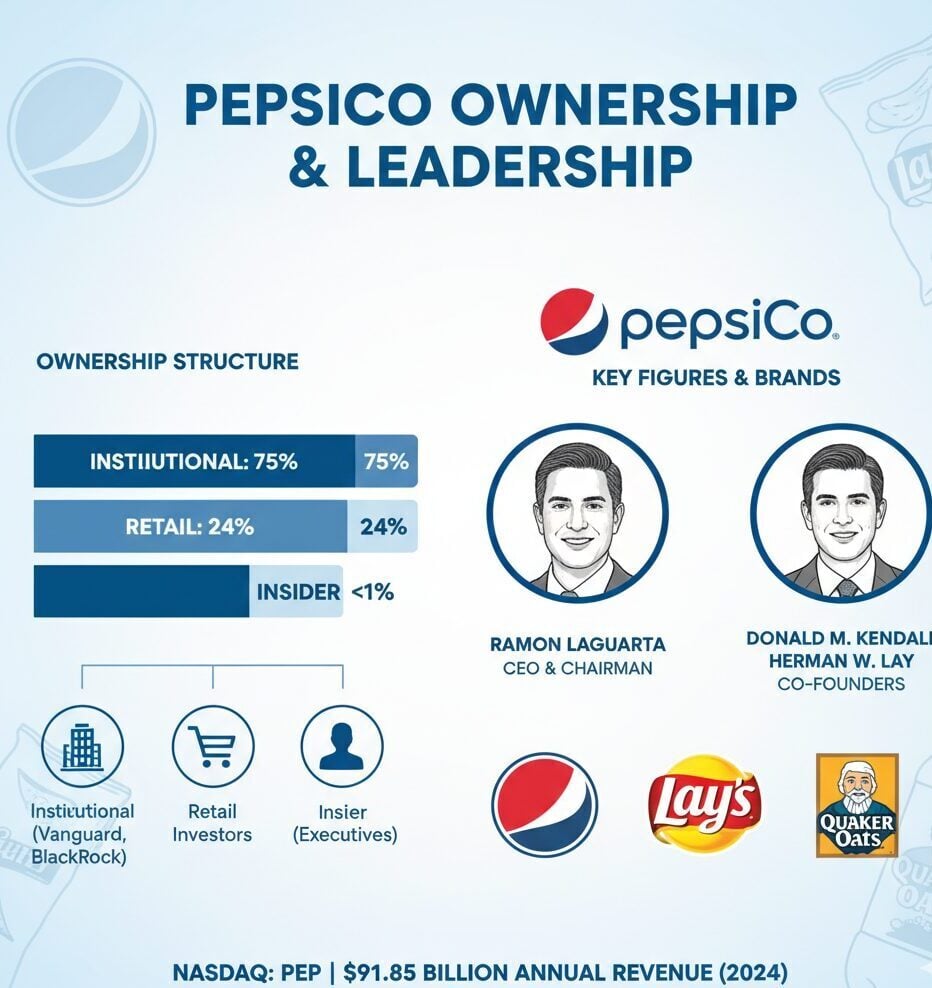
PepsiCo is owned by a diverse group of shareholders, with institutional investors holding the majority stake at approximately 75.33% of total shares. The Vanguard Group is the largest individual shareholder, owning around 10% of the company. Insider ownership stands at about 0.64%, while retail investors own approximately 24% of shares. As a publicly traded corporation listed on NASDAQ under the ticker symbol PEP, PepsiCo operates without a single controlling owner.
The beverage and snacks giant generated nearly $92 billion in net revenue during 2024, maintaining its position as one of the world’s leading food and beverage companies. The company continues to expand its portfolio through strategic acquisitions, including the recent purchases of Poppi for $1.65 billion and Siete Foods for $1.2 billion in 2024-2025. PepsiCo operates globally with products enjoyed by consumers more than one billion times daily across over 200 countries and territories.
Who owns PepsiCo?
PepsiCo operates as a publicly traded company, meaning ownership is distributed among thousands of shareholders rather than concentrated in the hands of a single individual or entity. The company’s shares trade on the NASDAQ stock exchange, allowing investors worldwide to purchase ownership stakes.
Institutional investors dominate the ownership landscape, collectively controlling more than three-quarters of all outstanding shares. These institutions include mutual funds, pension funds, and investment management companies that hold PepsiCo stock on behalf of their clients. The company’s history dates back to the 1965 merger that created the modern corporation, and its broad shareholder base reflects its status as a blue-chip investment.
Individual retail investors own nearly one-quarter of the company, demonstrating significant public interest in PepsiCo stock. Meanwhile, company insiders including executives and board members hold less than 1% of shares, which is typical for large multinational corporations. This ownership structure ensures that no single party can unilaterally control corporate decisions, with power instead distributed across the diverse shareholder base.
PepsiCo Ownership Distribution
Who is on the board of directors for PepsiCo?
PepsiCo’s board of directors consists of 15 members who provide strategic oversight and governance for the global corporation. The board represents diverse professional backgrounds spanning finance, technology, healthcare, retail, and consumer goods industries. These directors guide the company’s long-term strategy while ensuring accountability to shareholders.
Chairman and Chief Executive Officer
Ramon Laguarta serves as both Chairman of the Board and Chief Executive Officer of PepsiCo. A Barcelona native and 25-year company veteran, Laguarta assumed the CEO role in October 2018 and became Chairman in February 2019. He is the sixth CEO in PepsiCo’s history and the first Spanish national to lead a major American multinational corporation.
Laguarta holds an MBA from ESADE Business School in Spain and a master’s degree in international management from Thunderbird School of Global Management. Before becoming CEO, he served in various leadership positions including CEO of the Europe and Sub-Saharan Africa sector, where he led the $5.4 billion acquisition of Russian dairy company Wimm-Bill-Dann.
Independent Directors with Financial Expertise
The board includes several members with extensive financial backgrounds who serve on key committees. These directors bring critical expertise in corporate finance, accounting oversight, and strategic financial planning. Their experience helps guide PepsiCo’s capital allocation decisions and financial reporting processes.
Susan Diamond previously served as Chief Financial Officer of Humana Inc. from 2021 to January 2025. Her background in healthcare finance and operational leadership provides valuable perspective on complex organizational structures. Other financially-oriented directors contribute expertise from banking, investment management, and corporate treasury functions.
Technology and Innovation Leaders
Several board members bring technology and digital transformation expertise essential for PepsiCo’s modernization efforts. These directors understand e-commerce, data analytics, and digital marketing strategies that help the company compete in evolving consumer markets. Their guidance supports PepsiCo’s investments in automation, supply chain technology, and direct-to-consumer platforms.
Consumer and Retail Specialists
Directors with consumer goods and retail experience provide insights into changing shopping behaviors and brand management. Their understanding of customer preferences, distribution channels, and merchandising strategies informs PepsiCo’s approach to product development and market positioning. This expertise proves particularly valuable as the company navigates shifts toward health-conscious products and sustainable packaging.
The board structure includes four standing committees: Audit, Compensation, Nominating and Corporate Governance, and Public Policy and Sustainability. Each committee focuses on specific oversight responsibilities while reporting to the full board. This governance framework ensures comprehensive attention to financial integrity, executive compensation alignment, director nominations, and environmental commitments.
Largest shareholders of PepsiCo
The shareholder composition of PepsiCo reflects the investment priorities of major institutional investors who recognize the company’s market position and stable cash flows. According to recent filings, the top shareholders control significant voting power that influences corporate governance decisions.
The Vanguard Group
The Vanguard Group holds the largest stake in PepsiCo with approximately 136.94 million shares, representing about 10% of total outstanding shares. This position is valued at over $20 billion at current market prices. Vanguard manages these shares primarily through index funds and exchange-traded funds that track major market indices.
As a passive investor, Vanguard typically supports management recommendations while advocating for shareholder-friendly governance practices. The firm’s substantial holdings give it significant influence during proxy votes on director elections, executive compensation, and major corporate actions. Vanguard’s long-term investment approach aligns with PepsiCo’s focus on sustainable growth and consistent dividend payments.
BlackRock Inc.
BlackRock ranks as the second-largest shareholder with approximately 116 million shares, equating to roughly 8.5% ownership. The investment management giant holds PepsiCo shares across numerous funds and separately managed accounts. BlackRock’s position demonstrates institutional confidence in the company’s diversified business model spanning beverages and convenient foods.
The firm actively engages with portfolio companies on environmental, social, and governance matters. BlackRock’s ownership stake provides leverage to encourage sustainability initiatives and transparent reporting practices that benefit all shareholders.
State Street Global Advisors
State Street Global Advisors holds the third-largest position with approximately 4% of outstanding shares. Similar to Vanguard and BlackRock, State Street manages these holdings through index funds and institutional investment products. The three largest shareholders collectively control over 22% of PepsiCo, giving them substantial voting influence.
Other Major Institutional Holders
Beyond the top three, numerous other institutional investors maintain significant PepsiCo positions. These include firms like Capital Research Global Investors, Geode Capital Management, and various pension funds. Each brings different investment time horizons and engagement approaches, creating a diverse institutional shareholder base.
Mutual fund companies offer PepsiCo shares to retail investors through popular funds focused on dividend income, consumer staples, and large-cap stocks. This indirect ownership allows individual investors to participate in PepsiCo’s performance without directly purchasing shares. The distributed institutional ownership structure prevents any single entity from dominating corporate decision-making while providing stable long-term capital.
History of PepsiCo Co-founders
The creation of PepsiCo resulted from the vision of two pioneering entrepreneurs who recognized the potential of combining complementary businesses. The merger strategy that formed PepsiCo would later influence other major corporate combinations in the food industry.
Donald M. Kendall
Donald M. Kendall was born in 1921 in Sequim, Washington, and joined Pepsi-Cola as a fountain syrup salesman in the 1940s. His sales prowess and strategic thinking propelled him through the ranks to become president and CEO of Pepsi-Cola in 1963. Kendall possessed a bold vision for international expansion and understood that diversification beyond soft drinks could strengthen the company’s market position.
After meeting Herman Lay at a grocer’s convention in the early 1960s, Kendall saw the opportunity to create a powerhouse by merging beverage and snack food operations. In 1965, he orchestrated the merger that formed PepsiCo, becoming the new company’s CEO. Kendall served as CEO from 1971 to 1986 and remained chairman until 1991.
Under his leadership, Kendall achieved remarkable firsts including making Pepsi the first U.S. consumer product manufactured and sold in the Soviet Union in 1972. He expanded the company into restaurant franchises, acquiring Pizza Hut, Taco Bell, and KFC during the 1970s and 1980s. Kendall’s combative “Pepsi spirit” helped transform a middling beverage company into a global corporation with nearly $8 billion in revenue by his retirement. He passed away in 2020 at age 99.
Herman W. Lay
Herman W. Lay was born in 1909 in Charlotte, North Carolina. After leaving Furman University without completing his degree, Lay entered the snack food business in Nashville, Tennessee, during 1932. He started as a distributor before purchasing a small Atlanta manufacturer that he renamed H.W. Lay & Company.
Lay revolutionized the snack industry by creating the first national potato chip brand in the United States. His company merged with the Frito Company in 1961 to form Frito-Lay Inc., which quickly became the dominant force in salty snacks. The famous slogan “Betcha Can’t Eat Just One” became synonymous with Lay’s Potato Chips.
When Lay and Kendall sketched out their merger agreement on a napkin in 1965, they created what would become one of the world’s most successful food and beverage corporations. Lay served as chairman of the board for the newly formed PepsiCo before transitioning to chairman of the executive committee. He remained active in the business until his retirement in 1980 and passed away in 1982 at age 73. His entrepreneurial legacy lives on through scholarship programs and the continued success of the brands bearing his name.
FAQs
Who is the CEO of PepsiCo?
Ramon Laguarta serves as Chairman and CEO of PepsiCo. He assumed the CEO position in October 2018 and became Chairman in February 2019, making him the sixth CEO in company history.
Is PepsiCo owned by Coca-Cola?
No, PepsiCo and Coca-Cola are separate, competing publicly traded companies. They operate independently with different shareholders, management teams, and corporate strategies in the global beverage market.
What companies does PepsiCo own?
PepsiCo owns numerous brands including Frito-Lay snacks, Gatorade, Tropicana, Quaker Oats, Mountain Dew, and its namesake Pepsi beverages. Recent acquisitions include Poppi and Siete Foods.
When was PepsiCo founded?
PepsiCo was founded in 1965 through the merger of Pepsi-Cola Company and Frito-Lay Inc. The merger combined Donald Kendall’s beverage business with Herman Lay’s snack food empire.
How much revenue does PepsiCo generate annually?
PepsiCo generated approximately $91.85 billion in annual revenue during 2024. The company operates in over 200 countries with diverse product portfolios spanning beverages and convenient foods.
