


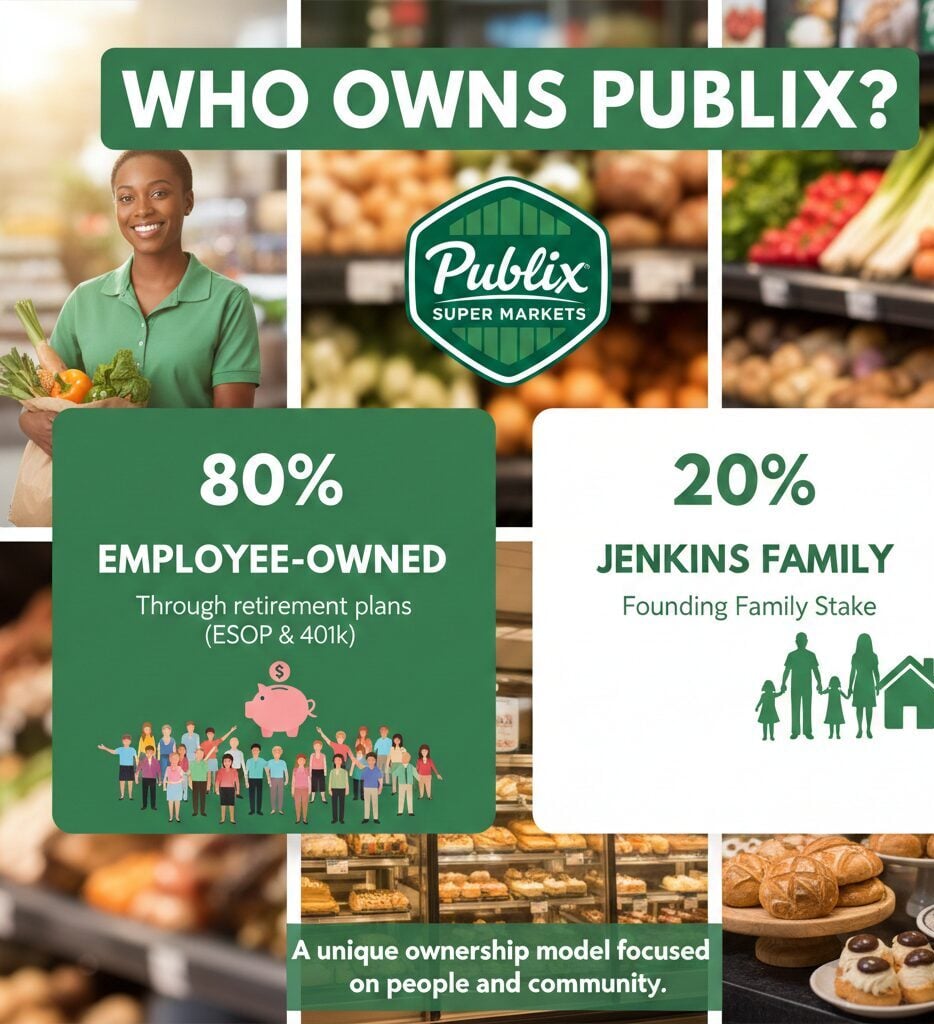
Publix Super Markets operates as an employee-owned corporation, with approximately 80% ownership held by current and former employees through retirement plans. The Jenkins family retains a 20% stake in the privately held grocery chain.
The Florida-based retailer recorded $59.7 billion in annual revenue for 2024, marking consistent growth across its southeastern footprint. The company operates more than 1,350 stores across seven states and maintains a debt-free balance sheet with total assets exceeding $37.6 billion.
Key Stats
- Annual Revenue (2024): $59.7 billion
- Total Store Count: 1,350+ locations in seven U.S. states
- Employee Ownership Percentage: 80% through ESOP and 401(k) plans
- Market Valuation: $62 billion (2025 estimate)
Who Owns Publix?
Publix Super Markets maintains a unique ownership structure among American retailers. The company distributes stock primarily through employee benefit programs rather than public markets.
The Employee Stock Ownership Plan holds the largest single block of shares at 23.1% of outstanding stock. Additional employee ownership flows through the 401(k) retirement program, which accounts for 9.1% of shares. Combined employee holdings reach approximately 80% of total ownership.
The founding Jenkins family maintains control of roughly 20% of shares. This minority stake preserves founding principles while allowing broad employee participation. Family members continue serving in governance roles, ensuring continuity with the company’s original customer service philosophy.
The ownership model differs significantly from competitors like Kroger and other publicly traded chains. Publix stock trades exclusively among employees and board members through internal transactions.
How Did Publix Get Its Name?
George W. Jenkins selected the name “Publix” for its commercial appeal and connection to community service. The founder wanted a name that communicated openness and public accessibility.
Jenkins acquired the name from a struggling New York-based movie theater chain called Publix Theatres. The theater company, which operated during the 1920s, went bankrupt during the Depression era. Jenkins recognized the name’s potential for a retail business and purchased the trademark rights.
The name aligned with Jenkins’ vision of creating stores that served the public interest. He emphasized this connection through company policies that prioritized customer satisfaction and employee welfare. The choice reflected Jenkins’ belief that grocery stores should function as community institutions.
The name distinguished the Florida grocery chain from regional competitors. During the 1930s, most grocery stores used family surnames or geographic identifiers. Publix stood out with its universal appeal and forward-looking branding approach.
Jenkins maintained consistent branding across all locations as the chain expanded. The name recognition became a valuable asset as Publix grew beyond its Winter Haven origins into a regional powerhouse.
Publix Origin, Founders And Early Years
George Washington Jenkins founded Publix Super Markets in 1930. The entrepreneur opened his first store in Winter Haven, Florida, after leaving his position at a Piggly Wiggly location.
Jenkins introduced innovations that shaped modern grocery retail. His stores featured air conditioning, wider aisles, and better lighting than competitors. He implemented employee profit-sharing programs during the company’s early decades.
The founder emphasized customer service and store cleanliness as competitive advantages. These principles guided expansion across Florida during the post-war economic boom. Jenkins remained active in company operations until his death in 1996, leaving a lasting impact on American retail similar to other pioneering retailers.
Publix Company History Timeline
Largest Shareholders of Publix
The Employee Stock Ownership Plan represents the dominant shareholder group. This trust holds approximately 766 million shares, providing voting rights on major corporate decisions.
A committee of trustees manages ESOP operations according to fiduciary standards. Employees participating in the plan gain financial stakes tied directly to company performance. The structure aligns worker incentives with long-term business success.
The 401(k) retirement plan holds an additional 302 million shares. Employees can allocate portions of retirement contributions into Publix stock, creating deeper connections between personal finances and organizational outcomes.
Jenkins family members collectively control approximately 20% of outstanding shares. Jennifer A. Jenkins serves on the board while holding over 1.47 million personal shares. The family maintains influence over strategic direction while supporting the employee ownership model.
Executive officers and directors own roughly 6.9 million shares combined, representing 1.02% of total stock. These holdings ensure leadership teams maintain personal investment in company performance. The structure resembles ownership approaches used by other employee-focused retailers.
Who Is on the Board of Directors for Publix?
Randall T. Jones Sr. serves as Executive Chairman after leading the company as CEO from 2016 through 2023. Jones joined Publix in 1980 and advanced through multiple leadership positions over four decades.
Kevin S. Murphy assumed the CEO role on January 1, 2024. Murphy started his Publix career as a front service clerk in 1984 and progressed through store management, district oversight, and regional director responsibilities.
Financial Leadership
David P. Phillips holds dual roles as Chief Financial Officer and ESOP Committee Trustee. Phillips owns 372,701 shares and oversees both financial operations and employee ownership governance structures.
Technology and Operations
Laurie Z. Douglas serves as Chief Information Officer and Chief Digital Officer. Douglas directs technology initiatives and digital transformation efforts while holding 87,197 personal shares.
Independent Oversight
Jennifer A. Jenkins represents the founding family on the board, maintaining institutional knowledge and preserving company values. Independent directors include Jessica L. Blume, Stephen M. Knopik, and Mark R. Irby, who provide external perspectives on governance and strategic planning.
Publix Mission Statement
Publix operates under a mission centered on customer value and employee development. The company states its purpose as being “passionately focused on customer value” while maintaining “dedication to the dignity, value and employment security” of associates.
The mission emphasizes quality products at competitive prices. Publix commits to offering superior customer service through well-trained, engaged employees. The company views employee ownership as central to achieving service excellence.
Publix prioritizes community involvement across its operating regions. The company contributes to local food banks, educational programs, and charitable organizations. Annual giving programs distribute millions to nonprofits focused on youth development, education, and hunger relief.
The mission includes environmental responsibility commitments. Publix tracks energy consumption, waste reduction, and sustainable sourcing practices. The company invests in refrigeration efficiency, renewable energy, and packaging reduction initiatives.
Publix connects its mission to the founder’s original philosophy. George W. Jenkins believed treating employees well would translate to superior customer experiences. The company maintains this approach through profit-sharing, healthcare benefits, and advancement opportunities.
The mission statement guides strategic decisions about expansion and operations. Publix evaluates new markets based on their ability to support the company’s service standards and community involvement goals. Leadership emphasizes long-term stability over rapid growth, maintaining the founder’s values while adapting to changing retail conditions.
Publix Products And Services
Publix offers full-service grocery operations with extensive fresh food departments. Stores feature bakery, deli, meat, seafood, and produce sections staffed by trained specialists.
The company operates in-store pharmacies providing prescription services, immunizations, and health consultations. Pharmacy operations include medication therapy management and specialty drug programs.
Publix maintains private label brands across multiple categories. The store brand products span groceries, dairy, frozen foods, and household items. The company also operates the GreenWise Market format focused on organic and natural products.
Digital services include online ordering, curbside pickup, and home delivery through Instacart partnership. The Publix app enables shopping list management, digital coupons, and prescription refills. Customers access meal planning tools and recipe collections through digital platforms.
The company provides catering services for events ranging from office meetings to weddings. Prepared food offerings include hot meals, party platters, and custom cakes. The business model mirrors approaches used by other full-service retailers adapting to changing consumer preferences.
FAQ
What is the net worth of Publix?
Publix maintains an estimated market valuation of approximately $62 billion as of 2025, based on internal stock trading prices and company assets.
Is Publix an American company?
Yes, Publix is an American company founded in Winter Haven, Florida, in 1930. The company operates exclusively in the southeastern United States.
Who owns Publix?
Employees own approximately 80% of Publix through ESOP and 401(k) plans. The founding Jenkins family retains the remaining 20% ownership stake.
When did Publix come out?
George W. Jenkins founded Publix Super Markets in 1930, opening the first store in Winter Haven, Florida, during the Great Depression era.
Publix market cap in 2026?
Publix stock reached $19.20 per share in early 2025, suggesting a market capitalization near $64 billion for 2026 based on growth trends.
Is Publix still operational?
Yes, Publix remains operational with over 1,350 stores across seven states. The company recorded $59.7 billion in revenue during 2024.