

Key Stats
- Shopify generated $8.88 billion in revenue during 2024, representing a 26% year-over-year increase.
- The platform powers approximately 5.8 million live stores across 175+ countries worldwide.
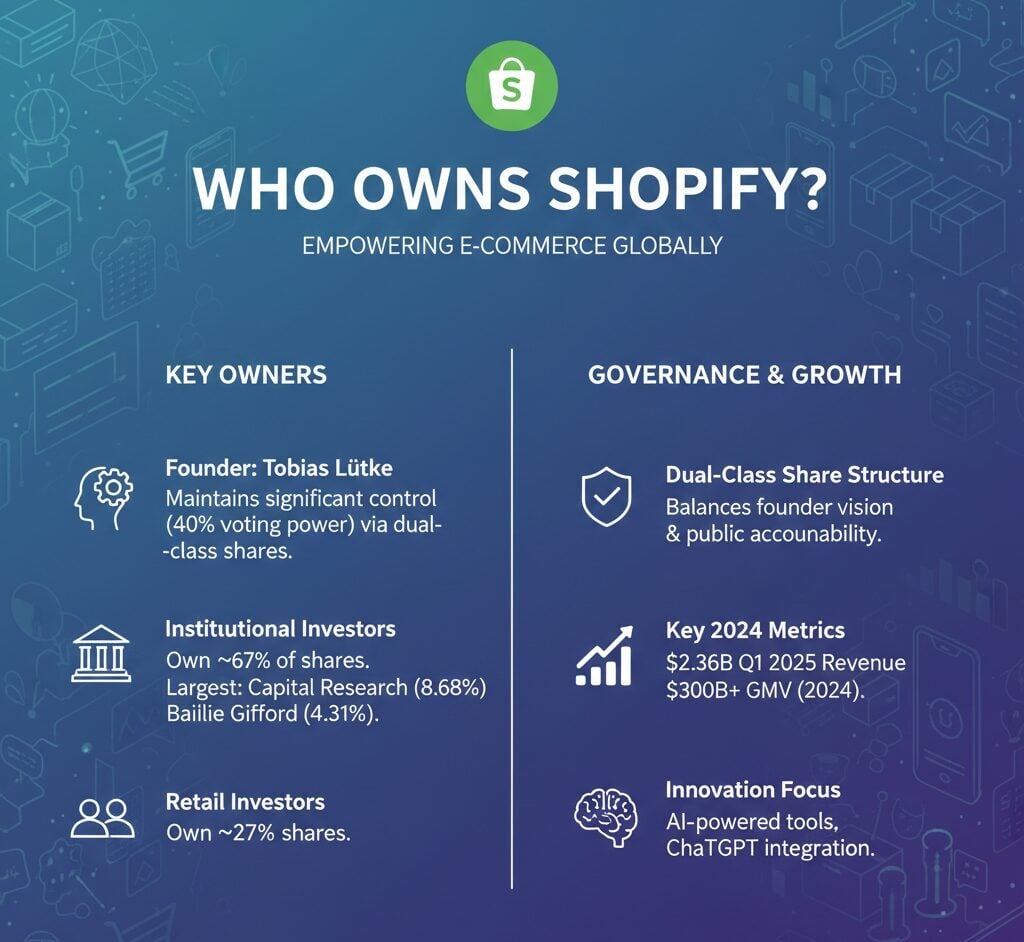
- Institutional investors hold roughly 67% of Shopify shares, with retail investors owning approximately 27%.
- Founder Tobias Lütke controls 40% of voting power through a dual-class share structure and founder share.
Shopify is owned by a combination of institutional investors, retail shareholders, and company insiders, with founder Tobias Lütke maintaining significant control through a unique governance structure. Capital Research and Management Company holds the largest institutional stake at approximately 8.68% of outstanding shares.
The Canadian e-commerce giant has transformed how millions of merchants sell products online since its founding. In Q1 2025, Shopify reported revenue of $2.36 billion, continuing its trajectory as one of the fastest-growing commerce platforms globally. The company processed over $300 billion in gross merchandise volume during 2024, serving approximately 875 million shoppers through its merchant network. Shopify recently announced integration with ChatGPT, bringing conversational commerce capabilities to its platform as part of its ongoing investment in AI-powered tools.
Who Owns Shopify?
Shopify operates as a publicly traded company listed on both the NASDAQ and Toronto Stock Exchange under the ticker symbol SHOP. The ownership structure combines institutional investment with meaningful founder control, creating a governance model that balances public accountability with long-term strategic vision.
Tobias Lütke’s Controlling Interest
While Tobias Lütke owns approximately 6.1% of Shopify’s common shares, his actual influence extends far beyond this economic stake. A dual-class share structure grants Class B shares ten votes per share compared to one vote for Class A shares. Additionally, shareholders approved a non-transferable founder share in June 2022, ensuring Lütke and his affiliates maintain 40% of total voting power as long as he remains an executive officer, board member, or primary consultant.
Institutional and Retail Ownership Distribution
Institutional investors collectively own approximately 67% of Shopify shares, reflecting strong confidence from major asset managers. Retail investors account for roughly 27% of ownership, while insiders hold the remaining portion. This distribution means strategic decisions require balancing institutional expectations with the founder’s long-term vision for the e-commerce platform.
Largest Shareholders of Shopify
Several prominent institutional investors maintain substantial positions in Shopify, each influencing corporate governance through voting rights and shareholder engagement.
Capital Research and Management Company
Capital Research and Management Company stands as Shopify’s largest institutional shareholder with approximately 8.68% of outstanding shares as of March 2025. This Los Angeles-based investment firm manages assets through American Funds, one of the largest mutual fund families in the United States. Their significant position reflects confidence in Shopify’s growth trajectory within the digital commerce sector.
Baillie Gifford & Co.
Scottish investment management firm Baillie Gifford holds approximately 4.31% of Shopify shares. Known for long-term growth investing strategies, Baillie Gifford has maintained positions in technology companies throughout various market cycles. Their investment approach aligns with Shopify’s focus on sustainable growth over short-term profitability.
Other Major Institutional Holders
FMR LLC (Fidelity) owns approximately 3.71% of shares, while The Vanguard Group holds around 3.70%. These asset management giants include Shopify across various index funds and actively managed portfolios, providing broad exposure to retail investors through mutual funds and ETFs. BlackRock and other institutional investors round out the shareholder base.
Shopify Ownership Distribution
Source: Shopify Investor Relations 2025
History of Shopify Co-founders
Shopify emerged from an unlikely beginning when its founders attempted to sell snowboards online and found existing e-commerce solutions inadequate for their needs.
The Snowdevil Origins
In 2004, Tobias Lütke, Daniel Weinand, and Scott Lake launched Snowdevil, an online snowboard store. Lütke, a German-born programmer, became frustrated with available e-commerce platforms and decided to build custom software. This solution eventually became more valuable than the snowboard business itself, leading the team to pivot toward developing a commerce platform.
From Startup to Public Company
Shopify officially launched in 2006, offering merchants an accessible way to create online stores without extensive technical knowledge. The platform attracted early venture capital funding and grew steadily through the late 2000s. In May 2015, Shopify completed its initial public offering on the New York Stock Exchange and Toronto Stock Exchange, raising capital to accelerate growth. The IPO transformed Shopify from a Canadian startup into a globally recognized payments and commerce technology company.
Who Is on the Board of Directors for Shopify?
Shopify’s ten-member board brings together expertise spanning technology, telecommunications, finance, and consumer products. Following the June 2025 annual meeting, all director nominees received shareholder approval.
Executive Leadership on the Board
Tobias Lütke serves as both CEO and Chair of the Board, maintaining direct oversight of corporate strategy. Toby Shannan, who previously served as COO, contributes operational expertise as a director. Their combined understanding of Shopify’s day-to-day operations informs strategic decisions at the board level.
Technology and Product Expertise
Kevin Scott, Chief Technology Officer at Microsoft, brings enterprise technology perspective. David Heinemeier Hansson, creator of the Ruby on Rails framework and co-founder of Basecamp, offers software development insight. These directors help evaluate technical investments and platform architecture decisions.
Finance and Investment Backgrounds
Jeremy Levine, a partner at Bessemer Venture Partners, has extensive experience with high-growth technology companies. Prashanth Mahendra-Rajah previously served as CFO at Analog Devices and brings financial leadership experience. Gail Goodman, former CEO of Constant Contact, understands small business software markets intimately.
Consumer and Communications Expertise
Fidji Simo serves as CEO of Instacart and previously led the Facebook app at Meta, contributing consumer technology experience. Lulu Cheng Meservey, known for communications strategy work, advises on public relations and stakeholder engagement. Joe Natale joined as Lead Independent Director in June 2025, bringing over 30 years of telecommunications leadership experience from his tenure as CEO of Rogers Communications and roles at major technology companies.
Top Institutional Shareholders of Shopify
| Shareholder | Ownership % | Type |
|---|---|---|
| Capital Research and Management | 8.68% | Institutional |
| Tobias Lütke (Founder) | 6.10% | Insider |
| Baillie Gifford & Co. | 4.31% | Institutional |
| FMR LLC (Fidelity) | 3.71% | Institutional |
| The Vanguard Group | 3.70% | Institutional |
FAQs
Is Shopify a publicly traded company?
Yes, Shopify trades on the NASDAQ and Toronto Stock Exchange under the ticker symbol SHOP. The company completed its IPO in May 2015, allowing anyone to purchase shares through brokerage accounts.
Does Tobias Lütke control Shopify?
Tobias Lütke controls approximately 40% of Shopify’s voting power through a dual-class share structure and founder share, despite owning only about 6% of common stock economically.
Who founded Shopify?
Tobias Lütke, Daniel Weinand, and Scott Lake founded Shopify in 2006 after their experience building an online snowboard store revealed the need for better e-commerce software solutions.
What is Shopify’s market capitalization?
Shopify’s market capitalization fluctuates with stock price movements but has ranged around $80-220 billion in recent years, making it one of Canada’s most valuable technology companies.
How many merchants use Shopify?
Approximately 5.8 million live stores operate on Shopify as of 2025, with the platform serving merchants across 175+ countries and supporting over 875 million shoppers annually.
