


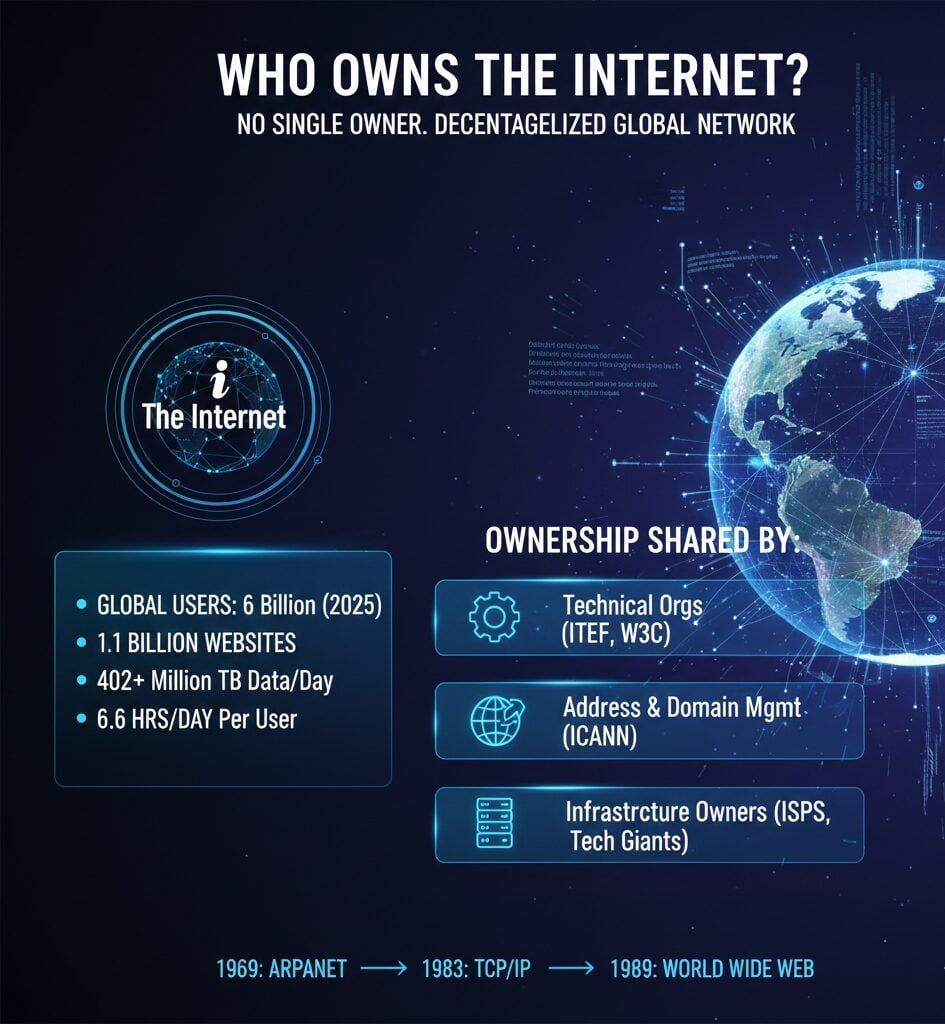
Key Stats
- Global Internet Users: 6 billion people (74% of world population) as of 2025
- Daily Time Online: Average user spends 6 hours and 36 minutes online per day
- Total Websites: Approximately 1.1 billion websites exist worldwide
- Data Created Daily: Over 402 million terabytes of data generated every day
No single person, company, or government owns the internet. Instead, the internet operates as a decentralized network of networks, with different organizations managing specific components of its infrastructure. According to the International Telecommunication Union, approximately 6 billion people now use the internet globally, representing about 74% of the world population.
The internet relies on physical infrastructure including undersea cables, data centers, and routing equipment owned by thousands of different entities. Major telecommunications companies like Verizon Communications and AT&T own substantial portions of this physical backbone. Technology giants including Google, Microsoft, and Amazon operate massive data center networks that handle significant internet traffic. On the user side, connectivity often comes through consumer technologies like mobile SIM cards or an eSIM, which allow devices to authenticate and connect to cellular networks run by these providers. However, ownership of infrastructure components differs from ownership of the internet itself.
Who Owns The Internet?
The internet has no single owner because it was designed as a distributed system without central control. Multiple organizations share responsibility for different aspects of internet operations and governance.
Technical Standards Organizations
The Internet Engineering Task Force (IETF) develops voluntary technical standards that keep the internet functioning. The World Wide Web Consortium (W3C), led by web inventor Tim Berners-Lee, creates web standards and protocols. These bodies publish open specifications that anyone can access and implement.
Address and Domain Management
The Internet Corporation for Assigned Names and Numbers (ICANN) oversees domain names and IP address allocation globally. The Internet Assigned Numbers Authority (IANA) coordinates critical technical identifiers. Five Regional Internet Registries distribute IP addresses within their geographic territories.
Infrastructure Owners
Physical internet infrastructure belongs to various private and public entities. Companies like Cisco Systems manufacture networking equipment. Telecommunications providers maintain fiber optic networks spanning continents. Cloud providers including Amazon Web Services, Microsoft Azure, and Google Cloud operate data centers worldwide. Each controls their portion while connecting to the broader network.
History of The Internet and Its Pioneers
The internet emerged from collaborative efforts by researchers, engineers, and scientists over several decades. No single inventor created the modern internet.
ARPANET Origins (1960s-1970s)
The Advanced Research Projects Agency (ARPA) funded the first computer network in the United States. Leonard Kleinrock developed packet-switching theory in 1961. Lawrence Roberts designed ARPANET, which sent its first message between UCLA and Stanford Research Institute on October 29, 1969.
TCP/IP Development
Vint Cerf and Bob Kahn created the Transmission Control Protocol (TCP) in 1974, allowing different networks to communicate. TCP/IP became the standard protocol on January 1, 1983, a date often called the birth of the modern internet. Computer scientist Peter Kirstein implemented the first TCP/IP outside the United States at University College London.
World Wide Web Creation
Tim Berners-Lee invented the World Wide Web in 1989 while working at CERN. He developed HTML, HTTP, and URLs, making the internet accessible to ordinary users. The web became publicly available in 1991, and Berners-Lee released the technology without patents, enabling rapid adoption. Companies like IBM and Intel later helped expand internet accessibility through hardware development.
Key Organizations Governing The Internet
Several organizations coordinate internet operations without owning the network itself. These bodies manage technical standards, policy development, and resource allocation.
ICANN and Domain Administration
ICANN oversees the domain name system and IP address allocation. Founded in 1998, this nonprofit organization operates through a multistakeholder model involving governments, businesses, and civil society. ICANN’s annual budget exceeds $150 million, with over 450 staff members worldwide managing internet identifiers.
Internet Society and Advocacy
The Internet Society (ISOC), established in 1992, provides leadership on internet standards and policy development. ISOC supports forums discussing internet evolution and promotes the network as a positive platform for global users. The organization works alongside technical bodies to ensure continued internet growth.
Regional Internet Registries
Five Regional Internet Registries manage IP address distribution globally. ARIN covers North America, RIPE NCC handles Europe and the Middle East, APNIC serves the Asia-Pacific region, LACNIC manages Latin America and the Caribbean, and AFRINIC oversees Africa. These registries coordinate through the Number Resource Organization to protect the unallocated IP address pool.
Internet Governance Forum
The IGF brings together stakeholders from governments, businesses, and civil society to discuss internet policy. While the forum does not modify standards directly, it influences those with policy-making authority. Annual meetings address challenges ranging from cybersecurity to digital access and online freedoms.
Who Is On The Board Of Directors For ICANN?
ICANN’s Board of Directors provides strategic oversight for internet identifier management. The board includes 16 voting members and four nonvoting liaison representatives from diverse geographic regions and professional backgrounds.
Current ICANN Leadership
Tripti Sinha serves as Board Chair, having been reappointed in October 2025 for her fourth term. She brings over three decades of experience in internet infrastructure and currently serves as President and CEO of Internet2. Sajid Rahman holds the Vice Chair position, having joined the board in 2022. Kurtis Lindqvist serves as ICANN’s President and CEO.
Technical and Policy Expertise
Board members include experts from telecommunications, law, academia, and technology sectors. Sarah Deutsch brings experience in internet policy and legal issues. Patricio Poblete represents the Country Code Names Supporting Organization. Catherine Adeya contributes digital transformation and governance expertise from over 25 years in technology development.
Regional and Sector Representation
ICANN bylaws require geographic diversity, with at least one director from each region and no more than five from any single region. Members represent North America, Europe, Asia-Pacific, Latin America and the Caribbean, and Africa. Business, nonprofit, and government perspectives all receive representation. Recent additions include Byron Holland from Canada’s CIRA and Raúl Echeberría from Uruguay, both selected in 2025. Social media platforms like Meta (Facebook) and content providers interact with ICANN through its multistakeholder processes.
Global Internet Users Growth (2005-2025)
Source: DataReportal
FAQs
Who invented the internet?
No single person invented the internet. Vint Cerf and Bob Kahn developed TCP/IP in 1974. Tim Berners-Lee created the World Wide Web in 1989. Numerous scientists and engineers contributed to building the modern internet over decades.
Does any company own the internet?
No company owns the internet entirely. Companies like Time Warner Cable and telecommunications providers own infrastructure components, but the internet itself operates as a decentralized network without central ownership.
How many people use the internet worldwide?
Approximately 6 billion people use the internet globally, representing about 74% of the world population as of 2025. China leads with the highest number of users, followed by India and the United States.
What organization manages domain names?
ICANN manages domain names and coordinates IP address allocation worldwide. The nonprofit organization was founded in 1998 and operates through a multistakeholder governance model involving governments, businesses, and civil society groups.
How much electricity does the internet consume?
The internet and its supporting infrastructure use approximately 4% to 6% of global electricity. Data centers, cooling systems, and network equipment account for most consumption. Some estimates suggest this share could reach 20% by 2030.