


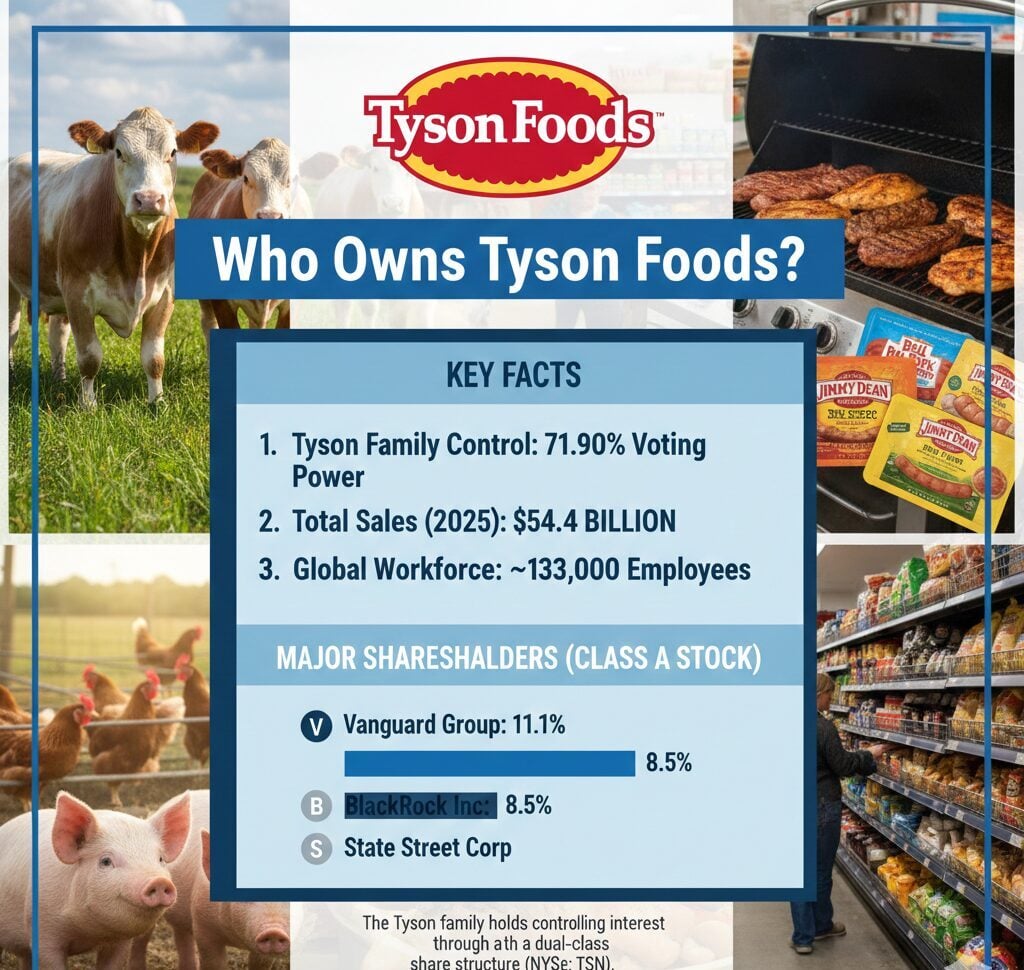
Key Stats
- Total Sales (FY2025): $54.4 billion
- Global Workforce: Approximately 133,000 employees
- Tyson Family Voting Control: 71.90% of total voting power
- Stock Exchange: NYSE (Ticker: TSN)
Tyson Foods is owned and controlled by the Tyson family through a dual-class share structure, with the Tyson Limited Partnership (TLP) holding approximately 99.99% of Class B common stock. This arrangement gives the founding family about 71.90% of total voting power as of December 2025, according to SEC filings.
The company reported $54.4 billion in total sales for fiscal year 2025, operating across four main segments: Beef, Chicken, Prepared Foods, and Pork. Headquartered in Springdale, Arkansas, Tyson processes 42 million chickens, 155,000 cattle, and 451,000 hogs weekly. The business sells products in roughly 140 countries and maintains Walmart as its largest customer, accounting for 18.7% of consolidated sales.
Who Owns Tyson Foods?
The Tyson family maintains effective control over Tyson Foods through a dual-class share structure established when the company reincorporated in Delaware in 1986. Class A shares, traded publicly on the New York Stock Exchange, carry one vote per share. Class B shares carry ten votes per share and remain almost entirely in family hands.
Tyson Limited Partnership Control
The TLP functions as the primary investment vehicle for Tyson family interests. John H. Tyson, the current Chairman, controls 44.445% of the general partner percentage interests in the TLP. Barbara Tyson holds 11.115%, while the Donald J. Tyson Revocable Trust controls 44.44%.
This concentrated ownership means the family can effectively decide major corporate matters regardless of how public shareholders vote. The company qualifies as a “controlled company” under NYSE rules, exempting it from certain governance requirements that apply to other listed corporations.
Largest Shareholders of Tyson Foods
Beyond the Tyson family’s controlling stake, several institutional investors hold substantial positions in the company’s publicly traded Class A shares. These asset management firms collectively own more than 68% of the Class A float.
Major Institutional Shareholders
The Vanguard Group
Vanguard holds the largest institutional position at roughly 11.1% of Class A shares. The firm acquired most of these shares through its index funds that track broad market benchmarks. Similar to its holdings in food industry peers like Conagra Brands, Vanguard maintains a passive investment strategy with Tyson.
BlackRock Inc.
BlackRock owns approximately 8.5% of Class A stock, making it the second-largest institutional holder. The asset manager holds these shares across various funds serving institutional and retail clients. BlackRock also maintains positions in competing protein companies including JBS and Hormel Foods.
State Street Corporation
State Street Global Advisors rounds out the top three with about 4.2% ownership. Like its peers, State Street holds Tyson shares primarily through index-tracking vehicles. These three firms together control more than 23% of the publicly traded stock, providing a foundation of long-term institutional support.
History of Tyson Foods Co-Founders
John W. Tyson started the company in 1935 during the Great Depression. He moved his family from Kansas to Springdale, Arkansas, four years earlier and began hauling chickens to Midwest markets. The business grew from transporting birds to processing and eventually to full vertical integration.
John W. Tyson’s Early Operations
Tyson purchased a truck on credit to transport Arkansas chickens to larger cities where they commanded better prices. By 1947, the business had grown enough to incorporate formally as Tyson Feed and Hatchery, Inc. The company went public in 1963, raising $17 million through its initial offering.
Don Tyson’s Expansion Era
Don Tyson, son of the founder, became CEO in 1967 and transformed the regional poultry firm into a diversified protein producer. Under his leadership, Tyson acquired Holly Farms in 1989, becoming the largest U.S. poultry company. The 2001 purchase of IBP, Inc. for $3.2 billion added beef and pork processing, establishing the multi-protein model. The Tyson Foods corporate timeline shows the Hillshire Brands acquisition in 2014 brought consumer brands like Jimmy Dean and Ball Park into the portfolio. Four generations of family leadership have guided operations since that Arkansas trucking operation began nine decades ago.
Who Is on the Board of Directors for Tyson Foods?
The Tyson Foods board consists of 13 members following the February 2025 annual meeting. Nine directors qualify as independent under NYSE standards. The board oversees company strategy while committees handle audit, compensation, governance, and acquisition matters.
Executive Leadership on the Board
John H. Tyson serves as Chairman, continuing the family’s governance presence into a fourth generation. Grandson of founder John W. Tyson, he has held various leadership positions throughout his career with the company.
Donnie King holds the President and CEO position, bringing operational experience from decades in the protein industry. Noel White serves as Executive Vice Chairman, having previously led the company as CEO from 2018 to 2020.
Independent Directors with Industry Experience
David J. Bronczek brings logistics expertise from his career at FedEx, relevant experience given Tyson’s extensive distribution network that competes with foodservice distributors like Sysco.
Mike Beebe, former Governor of Arkansas, provides public policy perspective valuable for a company facing regulatory oversight across food safety, environmental protection, and labor practices.
Finance and Operations Specialists
Kate B. Quinn chairs the Audit Committee, overseeing financial reporting and internal controls. Maria N. Martinez contributes technology and digital transformation expertise. Kevin M. McNamara and Les R. Baledge add corporate governance experience from their respective business backgrounds.
Maria Claudia Borras provides operations insight, while Cheryl S. Miller and Jeffrey K. Schomburger round out the independent members. Barbara A. Tyson represents additional family presence alongside the Chairman. This board composition balances family control with independent oversight from directors experienced in areas from agriculture and food processing to consumer products and corporate finance.
FAQs
Is Tyson Foods a publicly traded company?
Yes, Tyson Foods trades on the New York Stock Exchange under ticker symbol TSN. Class A common shares are available to public investors, while Class B shares remain privately held by the Tyson family.
What percentage of Tyson Foods does the Tyson family own?
The Tyson family controls approximately 71.90% of total voting power through ownership of nearly all Class B shares, which carry ten votes per share compared to one vote for Class A shares.
Who founded Tyson Foods and when?
John W. Tyson founded the company in 1935 in Springdale, Arkansas. He began by transporting chickens from Arkansas to Midwest markets during the Great Depression.
Who is the current CEO of Tyson Foods?
Donnie King serves as President and Chief Executive Officer of Tyson Foods. John H. Tyson, grandson of the founder, holds the position of Chairman of the Board.
What are Tyson Foods’ main business segments?
Tyson operates four primary segments: Beef (39.7% of revenue), Chicken (30.9%), Prepared Foods (18.2%), and Pork (10.6%). The company also maintains international operations in several countries.