

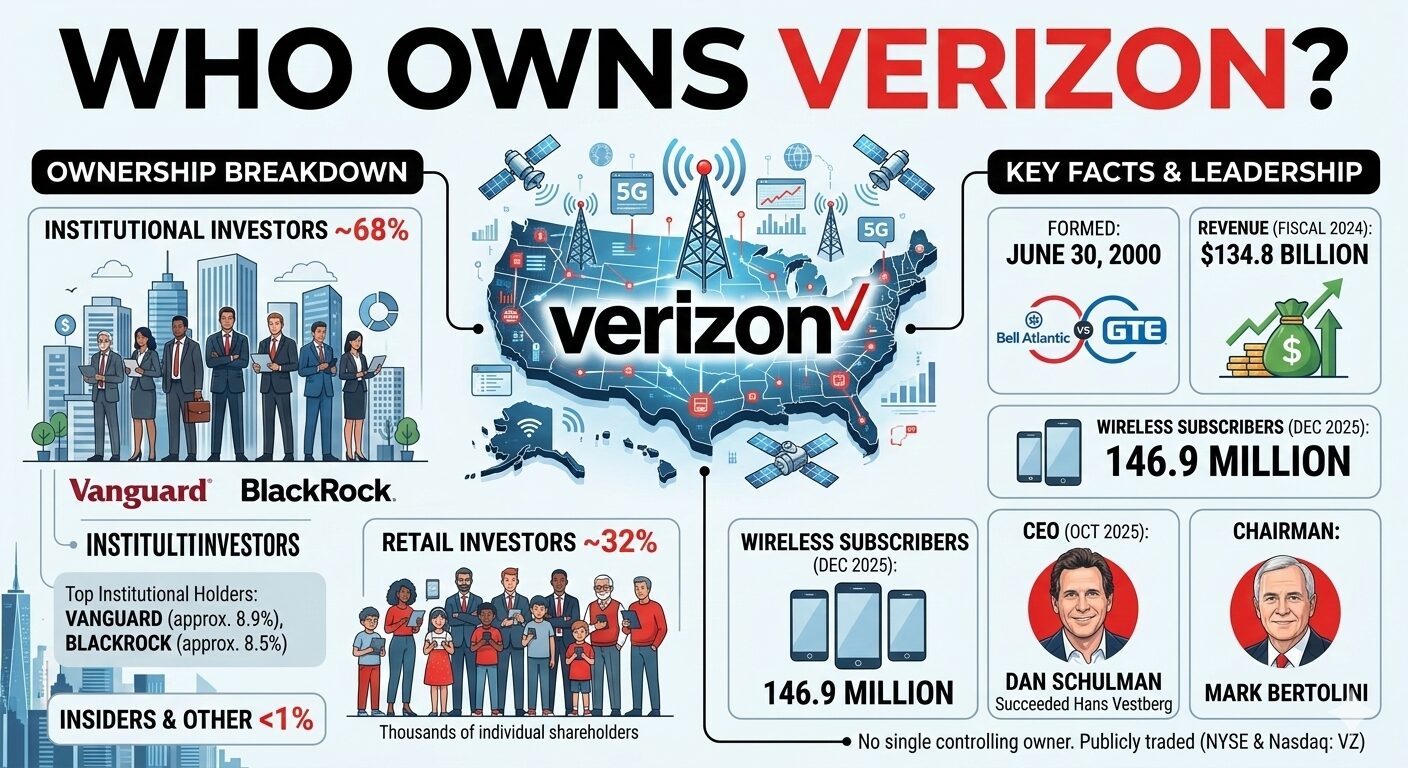
Formed on June 30, 2000 through the merger of Bell Atlantic Corp. and GTE Corp., valued at over $52 billion.
No controlling shareholder. Institutional investors hold approximately 67–68% of outstanding shares; retail investors hold about 32–33% (Simply Wall St).
Total revenue of $134.8 billion in fiscal 2024 with approximately 146.9 million wireless subscribers as of December 2025 (Verizon).
Trades on the NYSE and Nasdaq under ticker VZ. Market capitalization of approximately $178 billion.
Verizon Communications Inc. has no single controlling owner. It is one of the most widely held stocks in the United States, with shares distributed across thousands of institutional and retail investors. The Vanguard Group holds the largest individual stake at roughly 8.7–8.9% of outstanding shares. No insider or founding family retains meaningful voting control, which sets Verizon apart from telecom peers with concentrated ownership structures.
Headquartered in New York City, Verizon is the country’s largest wireless carrier by subscribers. It provides wireless, broadband, and enterprise services across two main segments: Verizon Consumer and Verizon Business. The company operates a nationwide 5G and 4G LTE network covering about 99% of the U.S. population and employs roughly 100,000 people.
History of Verizon and Its Founders
The AT&T breakup and the Baby Bells
Verizon’s roots trace to the 1984 breakup of AT&T, when a court-ordered consent decree split the Bell System into seven Regional Bell Operating Companies. One of them, Bell Atlantic, was formed from telephone companies serving the mid-Atlantic states from New Jersey to Virginia. GTE, separately, was already the largest independent telephone company in the U.S., serving 35 million access lines across 29 states.
Bell Atlantic, NYNEX, and GTE come together
In 1997, Bell Atlantic acquired NYNEX, which operated New York Telephone and New England Telephone, for $23 billion. That deal created a carrier stretching from Maine to Virginia and moved corporate headquarters from Philadelphia to New York. A year later, in July 1998, Bell Atlantic and GTE signed a definitive merger agreement. After two years of regulatory review across 27 state commissions, the FCC, and the Department of Justice, the merger closed on June 30, 2000. The combined company took the name Verizon — a blend of veritas (Latin for “truth”) and horizon.
Founding leadership
GTE’s Charles R. “Chuck” Lee became Verizon’s first Chairman and co-CEO. Bell Atlantic’s Ivan Seidenberg became President and co-CEO. Lee retired in 2002; Seidenberg served as Chairman and CEO until 2011. Lowell McAdam succeeded him and ran the company until Hans Vestberg took over as CEO in August 2018.
Who Owns Verizon?
Verizon Communications (NYSE: VZ) is publicly traded with no dominant shareholder. Institutional investors collectively own about 67–68% of the stock, retail investors hold approximately 32–33%, and insiders own under 1%. The top 25 shareholders together control less than half the company’s shares, making Verizon’s ownership among the most dispersed of any major U.S. corporation.
How Verizon’s shareholder base works
Unlike some telecom companies that use dual-class shares or family trusts to concentrate voting power, Verizon operates on a one-share-one-vote basis. Board elections, executive pay, and major corporate decisions are decided by straightforward shareholder votes. The breadth of the institutional base — including passive index funds, pension funds, and mutual funds — means that no single entity can dictate company policy.
Largest Shareholders of Verizon
Verizon Communications ownership breakdown (as of early 2026)
Top institutional holders
The Vanguard Group is Verizon’s largest shareholder, holding around 374 million shares — roughly 8.9% of the company. BlackRock ranks second at approximately 8.5–8.6%. State Street Corporation holds the third-largest position at around 4.8–5.1%. These three firms together account for just over 22% of outstanding shares, mostly through index funds and ETFs that track the S&P 500 and other broad market benchmarks.
Verizon as a dividend stock
Verizon’s broad retail ownership reflects its appeal as an income investment. The company has raised its dividend for 19 consecutive years and paid a quarterly dividend of $0.6775 per share in late 2025, for an annual yield in the 6–7% range. Warren Buffett’s Berkshire Hathaway held a large position until 2022 but has since fully exited.
Competitive context
Verizon competes directly with AT&T and T-Mobile in U.S. wireless. Cable operators like Comcast and Charter Communications also compete through bundled broadband and mobile offerings. In broadband specifically, the pending Frontier Communications acquisition would add millions of fiber-optic connections to Verizon’s network.
Who Is on the Board of Directors for Verizon?
Verizon’s board underwent a major leadership change in October 2025 when Dan Schulman replaced Hans Vestberg as CEO and Mark Bertolini was elected Chairman.
The CEO transition
Schulman had been on Verizon’s board since 2018 and was elected Lead Independent Director in December 2024. Before joining the board, he spent nine years as CEO of PayPal, where he grew revenue from $8 billion to $30 billion. Earlier in his career he held senior roles at AT&T, Priceline, Virgin Mobile, and American Express. Vestberg, who had led Verizon since 2018 and oversaw its 5G network buildout, remains as Special Advisor through October 2026 and sits on the board until the 2026 Annual Meeting.
Chairman and other directors
Mark Bertolini, the new Chairman, previously served as CEO of Aetna from 2010 to 2018 and has been a Verizon director since 2019. The board has 11 members. Jennifer K. Mann, EVP and President of Coca-Cola’s North America Operating Unit, was the most recent addition, joining in August 2025. Other directors include Melanie Healey (former Group President at Procter & Gamble), Laxman Narasimhan (former CEO of Reckitt and Starbucks), and Clarence Otis Jr. (former CEO of Darden Restaurants). Tony West, who served as General Counsel at Vodafone competitor Uber, is also on the board.
Key executives
Tony Skiadas serves as CFO. Vandana Venkatesh is EVP and Chief Legal Officer. Kyle Malady leads Verizon Business, while Sowmyanarayan Sampath oversees Verizon Consumer.
FAQs
Who owns Verizon Communications?
No single entity owns Verizon. The company is publicly traded on the NYSE under ticker VZ, with roughly 68% of shares held by institutional investors and 32% by individual retail investors.
Who is the largest shareholder of Verizon?
The Vanguard Group, holding about 8.9% of outstanding shares, is Verizon’s largest individual shareholder. BlackRock is second at approximately 8.5%.
Who founded Verizon?
Verizon was created through the June 2000 merger of Bell Atlantic and GTE. Bell Atlantic traces to the 1984 AT&T breakup. GTE was founded in 1918 as a small Wisconsin telephone company.
Who is the CEO of Verizon?
Dan Schulman became CEO in October 2025, succeeding Hans Vestberg. Schulman previously ran PayPal and had been on Verizon’s board since 2018.
Is Verizon acquiring Frontier Communications?
Yes. The FCC approved the deal in May 2025, and Verizon expects to close the acquisition in the first quarter of 2026. The $20 billion transaction would add Frontier’s fiber-optic network.
