

Key Stats
- WhatsApp serves 2.95 billion monthly active users worldwide
- Meta acquired WhatsApp for $19 billion in 2014
- Current valuation ranges from $50-70 billion
- Business messaging revenue expected to hit $7.3 billion by 2030
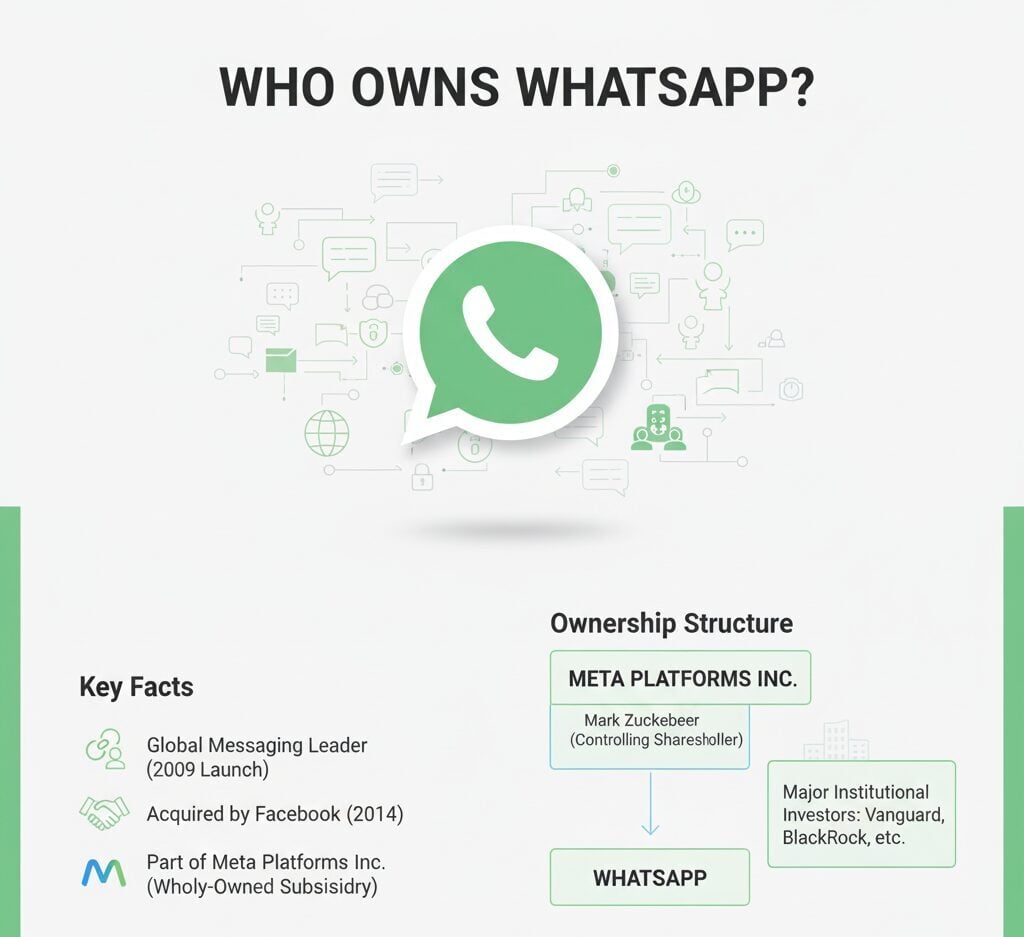
Meta Platforms, Inc. owns WhatsApp entirely as a wholly-owned subsidiary. The messaging giant revolutionized global communication since its 2009 launch, transforming from a simple status-sharing app into the world’s most popular messaging platform.
Recent developments show WhatsApp expanding its business ecosystem significantly. The company introduced advanced payment features across India and Brazil, enhanced its Business API capabilities for enterprise clients, and integrated deeper into Meta’s advertising infrastructure. These strategic moves position WhatsApp as a crucial component in Meta’s vision for unified communication services.
Who owns WhatsApp?
WhatsApp operates under complete ownership by Meta Platforms, Inc., formerly known as Facebook. This ownership structure means that Meta exercises full control over WhatsApp’s operations, strategic decisions, and future development plans.
The ownership technically flows through Meta’s publicly traded shares, making thousands of shareholders indirect owners of WhatsApp. However, Mark Zuckerberg maintains decisive control through his dual-class share structure, which grants him over 50% voting power despite owning just 13% of total equity.
Corporate Control Structure
The messaging platform functions as a subsidiary within Meta’s corporate framework. All major decisions regarding WhatsApp flow through Meta’s executive leadership, with no independent board or separate shareholder votes.
History of WhatsApp Co-founders
Jan Koum and Brian Acton created WhatsApp in 2009 after leaving Yahoo, where they had worked together for nearly a decade. Their shared frustration with intrusive advertising and complex communication apps drove them to build something radically different.
Founding Vision and Growth
Koum, who immigrated from Ukraine, understood the importance of private communication firsthand. He insisted on building WhatsApp without ads, believing that advertising compromised user trust and experience.
The app gained traction rapidly. Within two years, WhatsApp became a top-20 app in the U.S. App Store. By 2013, it processed 27 billion messages daily, surpassing global SMS volume.
The Facebook Acquisition
Facebook announced its acquisition of WhatsApp in February 2014 for $19 billion, shocking the tech industry. The deal included $4 billion in cash, $12 billion in Facebook shares, and $3 billion in restricted stock units for WhatsApp employees.
Both founders initially stayed with the social media giant, but tensions emerged over data sharing and monetization strategies. Acton departed in 2017, later revealing he left $850 million in unvested shares on the table. Koum followed in 2018, citing irreconcilable differences about user privacy.
Who is on the board of directors for WhatsApp?
WhatsApp doesn’t maintain an independent board of directors. Instead, Meta’s board oversees all strategic decisions affecting the messaging platform, while operational leadership reports through Meta’s executive hierarchy.
Technology Leadership
Will Cathcart serves as WhatsApp’s Head since 2019, succeeding Chris Daniels. Cathcart previously managed the Facebook app and brings extensive product development experience. He reports directly to Meta’s leadership team and oversees all WhatsApp operations globally.
Under Cathcart’s leadership, WhatsApp expanded its business tools significantly. He champions end-to-end encryption while navigating regulatory challenges across different markets. His team manages product development, engineering, security, and business development functions.
Finance and Operations
Meta’s CFO Susan Li oversees WhatsApp’s financial performance within the broader Family of Apps segment. She tracks revenue growth from business messaging and evaluates investment priorities for the platform’s expansion.
Andrew Bosworth, Meta’s CTO, influences WhatsApp’s technical infrastructure decisions. His teams ensure WhatsApp’s systems integrate smoothly with Meta’s broader technology stack while maintaining the platform’s encryption standards.
Executive Oversight
Mark Zuckerberg maintains ultimate authority over WhatsApp’s strategic direction as Meta’s CEO and controlling shareholder. His vision for interconnected messaging platforms shapes WhatsApp’s product roadmap and monetization strategies.
Sheryl Sandberg previously influenced WhatsApp’s business development before her 2022 departure. Her replacement in Meta’s leadership continues overseeing commercial strategy, including the expansion of WhatsApp Business tools that generate increasing revenue.
Meta Board Members’ Influence
Meta’s board includes technology veterans like Marc Andreessen and governance experts who review major WhatsApp initiatives. Their oversight ensures the messaging platform aligns with Meta’s regulatory compliance and risk management frameworks.
Board committees evaluate WhatsApp’s privacy policies, audit financial performance, and assess competitive positioning. These directors influence resource allocation decisions that affect WhatsApp’s development priorities and market expansion plans.
Largest shareholders of WhatsApp
Since WhatsApp exists as Meta’s subsidiary, its ownership mirrors Meta’s shareholder structure. Understanding who owns Meta reveals who ultimately controls WhatsApp.
Mark Zuckerberg – Controlling Shareholder
Zuckerberg’s 13% equity stake translates into overwhelming control through Meta’s dual-class share structure. His Class B shares carry ten votes each, while regular Class A shares get one vote. This arrangement ensures his vision prevails in all strategic decisions affecting WhatsApp.
His influence extends beyond voting power. As CEO, Zuckerberg shapes WhatsApp’s integration with other Meta properties, determines privacy policies, and guides monetization efforts. Every major WhatsApp initiative requires his approval.
Vanguard Group – 8.2% Ownership
The investment management company holds approximately 8.2% of Meta’s Class A shares through various index funds and actively managed portfolios. Vanguard’s stake represents millions of individual investors who indirectly own portions of WhatsApp.
While Vanguard maintains passive investment strategies, its voting participation influences governance matters. The firm typically supports management proposals but occasionally challenges executive compensation or board composition decisions.
BlackRock Inc. – 7.3% Stake
BlackRock controls around 7.3% of Meta shares across its iShares ETFs and institutional portfolios. This stake makes BlackRock among the largest economic beneficiaries of WhatsApp’s success.
The asset manager exercises voting rights on governance issues affecting Meta’s direction. BlackRock’s environmental and social governance priorities sometimes influence its voting decisions on matters impacting WhatsApp’s operations.
Other Institutional Investors
Fidelity Investments manages 1.5-2% of Meta shares through mutual funds and retirement accounts. T. Rowe Price holds approximately 1.2%, while Capital Group controls 1.1-1.3% through its American Funds family.
State Street Corporation, another major index fund provider, owns roughly 4% of Meta shares. These institutional investors collectively influence Meta’s governance while maintaining hands-off approaches to operational decisions.
FAQs
Who currently owns WhatsApp?
Meta Platforms, Inc. owns WhatsApp completely as a wholly-owned subsidiary, with Mark Zuckerberg maintaining controlling interest through his dual-class share structure.
How much did Facebook pay for WhatsApp?
Facebook (now Meta) acquired WhatsApp for $19 billion in 2014, including cash, stock, and restricted stock units for employees.
Do WhatsApp founders still own any shares?
No, both co-founders Jan Koum and Brian Acton left Meta and no longer hold ownership stakes in WhatsApp or Meta.
Can WhatsApp be sold separately from Meta?
Any sale would require Meta’s board approval and Mark Zuckerberg’s consent, given his majority voting control over the company.
What percentage of Meta’s value does WhatsApp represent?
Analysts estimate WhatsApp represents $50-70 billion of Meta’s value, roughly 5-7% of Meta’s total market capitalization in 2025.
