

There is only one team in Formula 1 that genuinely needs no introduction. No other constructor carries the same weight of history, passion, and obsession that surrounds Scuderia Ferrari.
Founded by a man who refused to let go of his dream, Ferrari has spent nearly a century threading itself into the very identity of motorsport.
But beyond the red cars and the roaring engines, there is a fascinating story of ownership, legacy, and one of sport’s most recognisable symbols. So who exactly owns Ferrari, and what made it the immortal institution it is today?
Who Owns Ferrari in 2026?
Ferrari N.V. is a publicly listed company, trading on both the New York Stock Exchange and Euronext Milan under the ticker symbol RACE.
That makes it unique among F1 teams, as this means Scuderia Ferrari is the only F1 constructor where ordinary investors can buy a direct stake.
Scuderia Ferrari is a wholly owned subsidiary of Ferrari N.V., with Exor N.V., the Agnelli family holding company, controlling approximately 22.9% of shares and 33.8% of voting rights.
Piero Ferrari, son of the legendary Enzo, holds approximately 10% of the company and serves as Vice Chairman, maintaining the founding family’s direct connection to the brand. The remaining shares float publicly, meaning institutional investors like BlackRock also hold positions.
However, through a dual-class voting structure, the Agnelli family and Piero Ferrari together command near-majority voting power, giving them effective strategic control.
In January 2026, Exor and the Ferrari family extended their shareholders’ agreement until January 2029, confirming their alignment and long-term commitment to the brand.
The Agnelli family’s connection to Ferrari runs through Fiat, which first acquired a stake in 1969. When Ferrari went public in 2015, the family structured the IPO deliberately to preserve their grip on the company’s direction.
This is considered a classic move by a dynasty that treats Ferrari not merely as an asset, but as a crown jewel.
The Birth of Scuderia Ferrari and Enzo’s Vision
Enzo Ferrari founded Scuderia Ferrari as a racing team in 1929, initially running Alfa Romeo cars. It was not until 1947 that he established Ferrari S.p.A. as an independent car manufacturer in Maranello, Italy. From the beginning, Enzo was obsessive about racing above everything else.
The road cars were, by his own admission, a necessary tool to fund the motorsport programme. That hierarchy, which puts racing first, always, became the soul of the organisation and has never truly left it.
Ferrari entered Formula 1 as a constructor in 1950, the very first season of the World Championship, and has competed in every single season since. No other team can claim that record. It is the foundation of everything that makes Ferrari the F1 team.
Why The Prancing Horse?
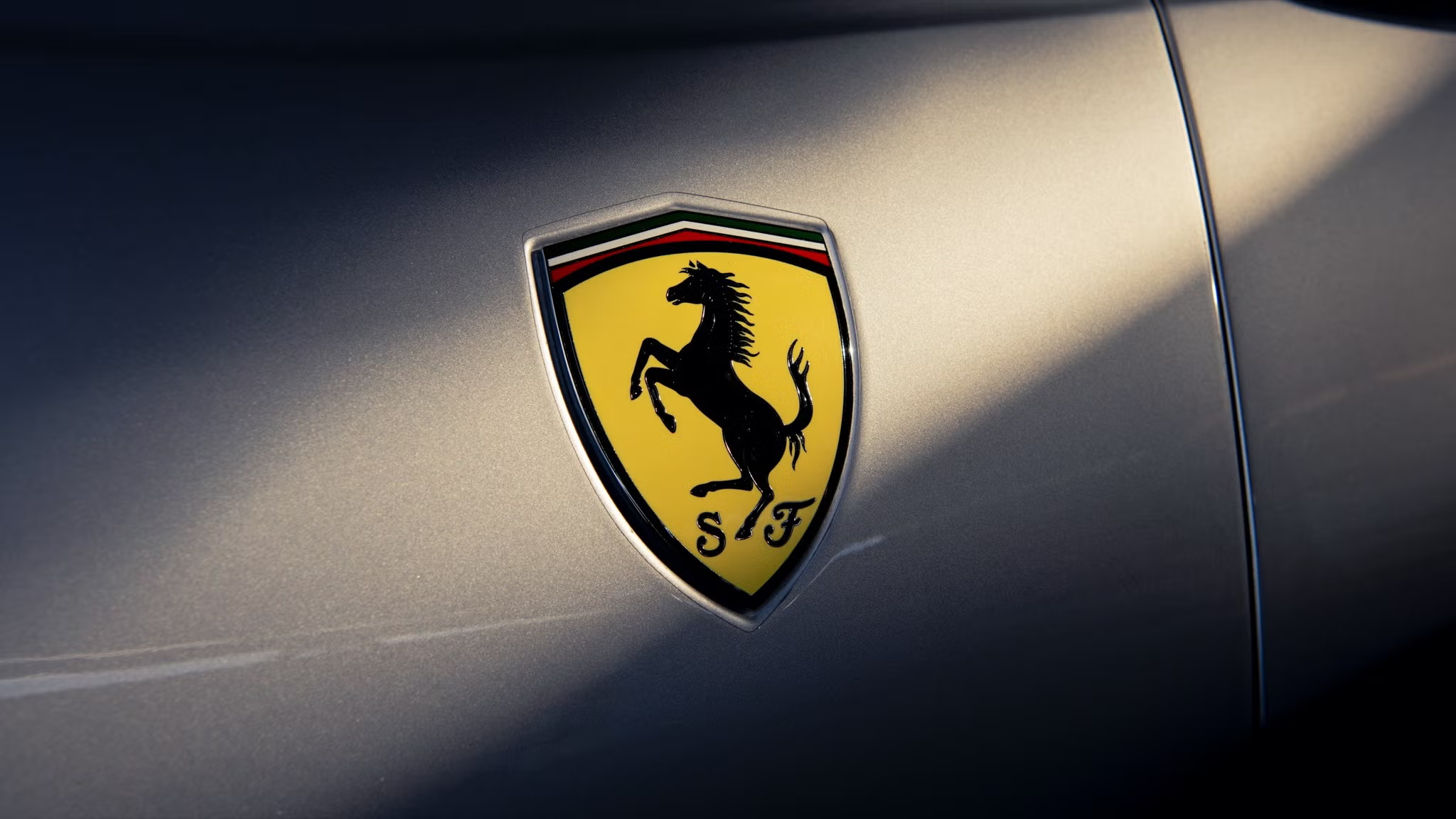
Il Cavallino Rampante, known in English as the Prancing Horse, is one of the most recognised logos on the planet. Its origins are far more human and poignant than most people realise.
The story begins at the 1923 Circuito del Savio race in northern Italy, where Countess Paolina Biancoli urged the victorious Enzo Ferrari to adopt the rearing black stallion that had adorned the biplane of her late son, Italian war hero Francesco Baracca. She believed the emblem would bring him good luck in his racing endeavours.
Baracca had begun using the Prancing Horse in 1917, paying tribute to his old cavalry regiment by using the horse from its coat of arms, altered from silver to black so it could be seen more easily on the fuselage. He died in combat in 1918, and the symbol became a tribute to his memory.
Enzo accepted the gift and added one personal touch: the yellow background, chosen in honour of Modena, his hometown.
The first production car to bear the emblem was the Ferrari 125 S in 1947, with the Prancing Horse appearing on a rectangular shield with a yellow background. A wartime symbol of courage became motorsport’s most enduring icon.
A Dominant Dynasty
If any era defines Ferrari’s greatness in the modern age, it is the stretch from 2000 to 2008. With Michael Schumacher at the wheel and the technical partnership of Ross Brawn and Rory Byrne behind him, Ferrari constructed arguably the most dominant force F1 has ever seen.
Schumacher won five consecutive Drivers’ Championships from 2000 to 2004, and Ferrari claimed the Constructors’ Championship in every one of those years, plus 2007 and 2008, bringing the total to seven constructors’ titles across that era alongside six drivers’ crowns.
The 2004 season was the apex of the machine. Ferrari won 15 of 18 races. Schumacher was in a class entirely his own. It was a period so dominant that rival teams essentially redesigned their technical regulations lobbying efforts around breaking Ferrari’s stranglehold.
Kimi Räikkönen then claimed the 2007 Drivers’ title for the team in the most dramatic season finale in F1 history, famously and unexpectedly edging Lewis Hamilton and Fernando Alonso by a single point on the final lap of the final race in Brazil.
What made it remarkable was not the way they were winning, but the way they operated. Ferrari had built an institution, a structure where every department fed into victory. That blueprint still influences how top F1 teams are organised today.
For fans who want to follow the action closely and back their judgement on race outcomes, bettingtop10 is a trusted resource for finding the best betting options across all the major F1 markets.
Ferrari’s Place in F1 Today
The Scuderia remains one of the sport’s two or three genuine title contenders heading into the second half of the 2020s.
Charles Leclerc and Lewis Hamilton, who made a seismic move to Maranello ahead of the 2025 season, represent Ferrari’s boldest investment in reclaiming that 2000s-era dominance.
The arrival of Hamilton, the only one who has equalled Schumacher’s seven championships and surpassed his claim as the most decorated driver in the sport’s history, signals that Ferrari’s ambition has not dimmed.
Ferrari is not simply a racing team. It is an idea, fueled by passion, precision, and the relentless pursuit of speed. That idea is now almost a century old, and shows no signs of slowing down.
