

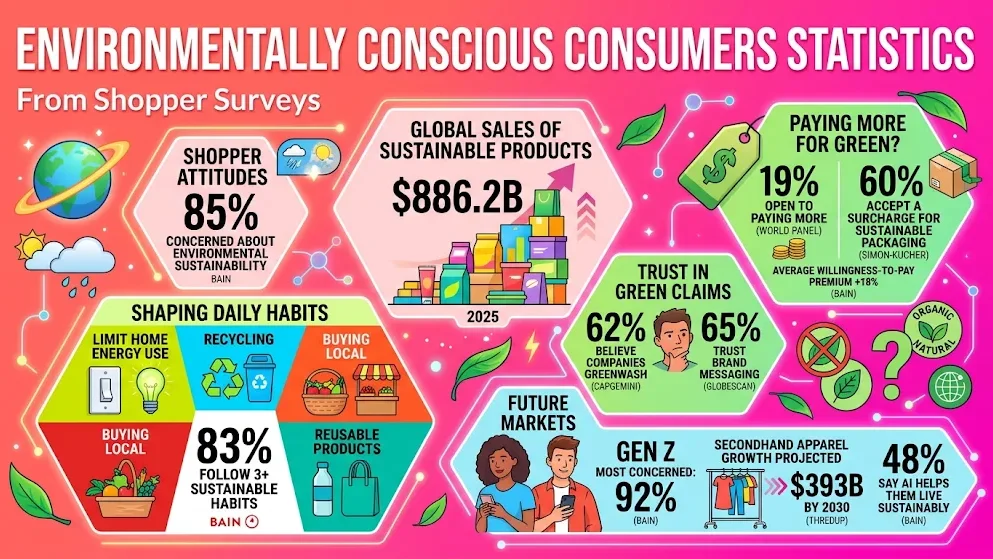
Bain’s September 2026 survey found 85% of consumers concerned about environmental sustainability. Worldpanel’s 2025 study counted 23% of shoppers as Eco-Actives who act on that concern in daily buying.
This page covers the environmentally conscious consumer statistics between those two numbers: concern by country and age, habits, price premiums, trust in green claims, AI use and resale, using 2025 and 2026 releases.
Environmentally Conscious Consumers Statistics
What Percentage of Consumers Are Environmentally Conscious?
It depends on whether a survey measures concern, intent or repeated action.
Bain’s Consumer Lab ESG Survey 2026 found 85% of 7,499 respondents somewhat, very or extremely concerned about environmental sustainability, up from 79% in 2025. The 2026 sample covered five markets. The 2025 sample covered eight.
Source: Bain & Company, Consumer Lab ESG Survey 2026 (report published September 2026)
Euromonitor puts climate concern at around 60% globally and says that level has held for two years. It also finds 45% of consumers still try to make a difference through their actions.
Source: Euromonitor International, From Planet to People, July 2026
Worldpanel by Numerator segments shoppers by everyday actions rather than intention, a filter similar to tracking the drop-off from interest to purchase.
Its 2025 edition put Eco-Actives at 23%, down from 24%. Eco-Considerers held at 40% and Eco-Dismissers rose to 38%. Worldpanel rounds these shares.
Source: Worldpanel by Numerator, Who Cares? Who Does? 2025, November 2025
Environmentally Conscious Consumers by Country: Bain’s Five 2026 Markets
Indonesia posted the highest concern in Bain’s 2026 survey at 99%, followed by Brazil at 90%. Italy matched the 85% overall reading, up from 81% in 2025.
The US and UK came in at 77% and 74%. Bain puts fast-growing markets at 95% and developed markets at 79%. It names extreme weather as the main cause of rising concern.
Source: Bain & Company, Consumer Lab ESG Survey 2026; Bain Italy press release, September 2026
The table shows the share of respondents citing each reason for higher concern.
| Reason for higher concern | Developed markets | Fast-growing markets |
|---|---|---|
| Extreme weather worldwide | 53% | 61% |
| Negative environmental events in own country | 26% | 49% |
| Extreme weather in own country | 32% | 47% |
Source: Bain & Company, Consumer Lab ESG Survey 2026 (developed: US, UK, Italy; fast-growing: Brazil, Indonesia; up to three answers allowed)
Climate Disruption Worry in Capgemini’s 2026 Consumer Survey
Capgemini’s June-July 2026 survey of 6,500 consumers found 68% worried about heat, flooding, drought and wildfires affecting their daily life. France posted the highest country reading.
| Market | Concerned about climate disruption to daily life |
|---|---|
| Global | 68% |
| France | 78% |
| Germany | 74% |
| Australia | 74% |
| United Kingdom | 73% |
| Spain | 72% |
Source: Capgemini Research Institute, A world in balance 2026, survey June-July 2026
Which Generation Is the Most Environmentally Conscious?
Gen Z, on Bain’s 2026 data. 92% of Gen Z respondents reported concern, against 77% of Boomers. In Italy, Bain puts Gen Z at 92% and Boomers at 85%.
Source: Bain & Company, Consumer Lab ESG Survey 2026; Bain Italy press release, September 2026
The age split is wider on payment. In Simon-Kucher’s German study, 83% of under-25s accepted a sustainable packaging surcharge, versus 51% of over-54s. That gap widened by 12 percentage points since 2025.
Source: Simon-Kucher with YouGov, Sustainable Product Packaging study, May 2026
Capgemini found Gen Z and millennials most supportive of companies continuing sustainability efforts despite economic and geopolitical pressure. GlobeScan’s 2025 research reported Gen Z as particularly disengaged from sustainability messaging and concern overall.
Source: Capgemini Research Institute, June-July 2026; GlobeScan, Healthy & Sustainable Living 2025
59% Now Limit Home Energy Use: Everyday Habits of Eco-Conscious Shoppers
Limiting home energy use topped Bain’s 2026 habit list at 59%, up from 49%. Recycling rose to 56% from 46%.
Respondents could pick several habits, and the two years used different market samples. 83% now report three or more habits, up from 73% in 2023.
Nearly half of people who say they do not care about sustainability report three or more habits, up from 35% in 2023. In half the cases, the main motive is something other than the environment, such as cost, health or convenience.
Source: Bain & Company, Consumer Lab ESG Surveys 2025 and 2026
Health Is Steering Many Green Purchases
Health remains the top purchase criterion for most Bain respondents. 72% say they change what they buy because of PFAS, BPA or microplastics. In Italy the share is 76%.
Bain notes that Walmart committed to removing artificial dyes and 30 other additives by 2027, after the Yuka app flagged it and its own customer research pointed the same way.
Source: Bain & Company, Consumer Lab ESG Survey 2026; Bain Italy press release, September 2026
Price Premiums and Spending: Environmentally Conscious Consumers Statistics for 2026
Global sustainable product sales reached USD886.2 billion in 2025, Euromonitor reports, after 6.7% compound annual growth since 2020. That pace beat non-sustainable products by 1.3 percentage points.
Source: Euromonitor International, July 2026
Bain’s 2026 respondents say they would pay 18% more for sustainability benefits. That rises to 24% for products that add health benefits.
Worldpanel’s 2025 study shows tighter limits. Only 19% said they were open to paying more for a product they trusted was better for the environment, and 52% preferred simpler packaging.
Source: Bain & Company, Consumer Lab ESG Survey 2026; Worldpanel by Numerator, Who Cares? Who Does? 2025
of German consumers accept a surcharge for more sustainable packaging (May 2026)
That German share is six points higher than a year earlier. Most buyers still cap the extra cost.
| Measure | Share of German consumers |
|---|---|
| Accept a surcharge for more sustainable packaging | 60% |
| Would pay at most 5% more on the total product price | 30% |
| Say sustainable packaging is at least as important as before | 71% |
| Recognize sustainable packaging mainly by minimal material use | 49% |
| Cannot reliably identify sustainable packaging | 12% |
Source: Simon-Kucher with YouGov, Sustainable Product Packaging study, May 2026 (2,108 respondents)
Most Trusted Eco Claims and Shelf Premiums
Recyclable packaging and locally sourced claims each earn trust from 57% of global consumers. Organic, a core pitch for grocers such as Whole Foods, sits at 53%.
| Product claim | Share of global consumers who trust it |
|---|---|
| Recyclable packaging | 57% |
| Locally sourced | 57% |
| Natural | 55% |
| Organic | 53% |
| Environmentally friendly | 52% |
| Sustainably sourced | 48% |
Source: Euromonitor International, From Planet to People, July 2026
Euromonitor measures shelf price premiums of 46% for organic juice, 36% for cruelty-free hair care and 30% for B-Corp plant-based dairy. These are product price gaps, not stated willingness to pay.
Source: Euromonitor International, Key Trends Shaping Sustainability Communication in 2026, May 2026
Do Shoppers Still Trust Green Claims?
Belief that companies greenwash reached 62% in Capgemini’s 2025 survey of 6,566 consumers. It was 52% in 2024 and 33% in 2023.
Source: Capgemini Research Institute, A world in balance 2025 and 2024
Brands are also saying less. GlobeScan found 36% of consumers saw at least “some” brand sustainability messaging in 2025, down from 49% in 2023, across 31 markets.
Among consumers reached, 65% trust that messaging at least somewhat. The share was 74% in 2023 and 79% in 2022.
Source: GlobeScan, Healthy & Sustainable Living survey 2025 (30,000+ consumers)
Consumers still want disclosure. In Capgemini’s 2026 survey, 71% said companies should keep communicating sustainability efforts despite the risk of criticism. 51% of executives said scrutiny had made their organization more cautious.
These numbers can be read next to wider brand reputation trends covering reviews and AI search.
Source: Capgemini Research Institute, A world in balance 2026, survey June-July 2026
AI and Product Apps in Environmentally Conscious Shopping
48% of Bain respondents who use AI say it helped them live more sustainably in the past 12 months. 38% of AI users ask it for eco-friendly product suggestions, up from 32% in 2025.
Bain links this to a knowledge gap. On average, 68% did not know or chose wrong when asked to pick the lower-carbon option in a product pair.
Correct answers ranged from 67% for local versus imported fruit to 13% for plastic versus glass jars.
Source: Bain & Company, Consumer Lab ESG Survey 2026
Product information apps such as Yuka reach 41% of Bain’s respondents. 79% of users say the apps changed their purchases, and 42% use them to check a product’s environmental footprint.
Source: Bain & Company, Consumer Lab ESG Survey 2026
Euromonitor found more than half of consumers use GenAI tools for information and recommendations. Broader AI adoption figures show how far these tools reach beyond shopping.
Source: Euromonitor International, Voice of the Consumer: Lifestyles Survey, January-February 2026
$393 Billion by 2030: Secondhand Apparel’s Projected Size
| Measure | Value |
|---|---|
| Global secondhand apparel market, 2030 projection | $393 billion |
| US secondhand apparel market, 2030 projection | $78.8 billion |
| US online resale, 2025 | $29.7 billion |
| US online resale, 2030 projection | $48.3 billion |
Source: ThredUp 2026 Resale Report with GlobalData, April 2026
US secondhand apparel grew 13% in 2025, nearly four times the 3.6% pace of broader clothing retail. Globally, secondhand makes up roughly 10% of apparel spend.
ThredUp projects that Gen Z and millennials will drive 71% of market growth through 2030. Nearly 50% of shoppers find secondhand items through social media, creators and influencer feeds.
Source: ThredUp 2026 Resale Report, survey of 3,268 US adults, January-February 2026
FAQs
What percentage of consumers are environmentally conscious?
It depends on the measure. Bain’s 2026 survey found 85% concerned about environmental sustainability, while Worldpanel’s 2025 study classed 23% of shoppers as Eco-Actives who act on that concern consistently.
Are consumers willing to pay more for sustainable products?
Many say so. Bain’s 2026 respondents named an 18% premium for sustainability benefits, or 24% with added health benefits. Worldpanel’s 2025 study found only 19% open to paying more for greener products.
Which generation is the most environmentally conscious?
Gen Z, based on Bain’s 2026 survey: 92% are concerned about environmental sustainability, against 77% of Boomers. In Germany, 83% of under-25s accept a sustainable packaging surcharge versus 51% of over-54s.
Do consumers trust brands’ green claims?
Trust is falling. Capgemini found 62% of consumers believed companies were greenwashing in 2025, up from 52% in 2024. GlobeScan measured 65% trust in 2025 among consumers reached by brand messaging, down from 79% in 2022.
Are environmentally conscious consumer statistics shared on Reddit reliable?
Check each figure against its original publisher first. Primary releases include Bain’s 2026 survey, which found 85% concerned about sustainability, and Euromonitor’s estimate of USD886.2 billion in 2025 sustainable product sales.
References
https://www.capgemini.com/insights/research-library/sustainability-trends-2026/
https://www.euromonitor.com/article/from-planet-to-people-consumers-still-care-about-sustainability
https://market.worldpanelbynumerator.com/id/News/Who-care-who-does-2025
