

Statista sizes the 2026 metaverse market at US150.1billion,whileFortuneBusinessInsightsputsitatUS2,114.25 billion. The two models count different things.
This metaverse market statistics guide sets those forecasts beside reported operating data: Meta’s Reality Labs results, Roblox’s Q2 2026 users and bookings, IDC’s Q2 2026 XR shipment shares, and creator payouts.
Metaverse Market Statistics
How Big Is the Metaverse Market in 2026?
Three research firms published 2026 metaverse market sizes ranging from US150.1billiontoUS2,114.25 billion. Each counts a different set of segments, so the rows below are separate models, not competing measurements of one market.
| Research firm | 2026 estimate | Long-range forecast | Stated CAGR | Segments in scope |
|---|---|---|---|---|
| Statista Market Insights | US150.1B | US507.8B by 2030 | 35.63% (2026–2030) | eCommerce, gaming, education |
| Precedence Research | US263.75B | US3,100.56B by 2035 | 32.70% (2026–2035) | Software, hardware, platforms, offerings, VR/AR, blockchain |
| Fortune Business Insights | US2,114.25B | US10,808.57B by 2034 | 22.60% (2026–2034) | Hardware, software/platform, services |
Source: Statista Market Insights, Metaverse Worldwide outlook, 2026 estimate; Precedence Research, Metaverse Market report, 2026–2035 edition; Fortune Business Insights, Metaverse Market report, updated June 8, 2026
What Each Forecast Counts
Statista’s model covers consumer spending on eCommerce, gaming, and education inside metaverse environments. Fortune Business Insights builds its figure from hardware, software/platform, and services components.
Precedence Research lists blockchain, a technology tracked in separate blockchain market statistics, as its own segment beside virtual and augmented reality.
Fortune Business Insights expects desktop to hold the largest platform share in 2026, at 45.70%.
Metaverse Market Share by Region
Fortune Business Insights gives North America 70.70% of the 2025 market, worth US$900.13 billion. Precedence Research also ranks North America first and projects Asia Pacific to grow fastest, at a 52.0% CAGR from 2026 to 2035.
Statista ranks the United States first by value, with a projected US$46.5 billion in 2026.
Source: Fortune Business Insights, 2025 regional share; Precedence Research, 2026–2035 forecast; Statista Market Insights, 2026 estimate
Reality Labs and the Metaverse Market: US$4,619 Million Lost in Q2 2026
Meta’s Reality Labs segment booked US431millioninrevenueinQ22026againstaUS4,619 million operating loss. Revenue rose from US370millionayearearlier,andthelosswidenedfromUS4,530 million.
Meta tied the 16% revenue rise to AI glasses, with lower Quest headset sales as an offset, according to GamesBeat’s account of the earnings call.
| Period | Revenue (US$ millions) | Operating loss (US$ millions) |
|---|---|---|
| Q2 2025 | 370 | 4,530 |
| Q1 2026 | 402 | 4,028 |
| Q2 2026 | 431 | 4,619 |
| H1 2025 | 782 | 8,739 |
| H1 2026 | 833 | 8,647 |
Source: Meta Platforms, Q1 and Q2 2026 earnings releases and Form 10-Q, quarters ended March 31 and June 30, 2026
Meta Platforms funds those losses from its Family of Apps segment, which earned US$23,394 million in Q2 2026 operating income.
TechSpot reported that Meta cut hundreds of Reality Labs jobs and moved Horizon Worlds into maintenance mode after a US$6 billion loss for Q4 2025.
Cumulative tallies differ. TechSpot puts losses since the end of 2020 at about US88billion,whileEWIntelligence,citedbyYahooFinance,countsUS83.6 billion.
Source: TechSpot, August 2026; Yahoo Finance citing EW Intelligence, July 30, 2026
Who Leads Metaverse Market Hardware? IDC’s Q2 2026 Shipment Data
IDC counted XR headset and glasses shipments up 35.3% year over year in Q2 2026, down from 130.2% growth in Q1. Audio glasses without displays took 70.3% of units, up from 61.9% a year earlier.
Display glasses held 14.3% of Q2 2026 shipments, up from 11%. Headsets held the remaining 15.4%.
Source: IDC Worldwide Quarterly Wearable Device Tracker and AR/VR Headset Tracker, Q2 2026
| Vendor | Q2 2026 share | Q1 2026 share |
|---|---|---|
| Meta | 68.7% | 69.2% |
| RayNeo | 3.6% | 3.4% |
| Alibaba Group | 2.6% | Not in top five |
| XREAL | 2.5% | 2.0% |
| Xiaomi | 2.3% | 3.1% |
| Viture | Not in top five | 2.5% |
Source: IDC, XR headset and glasses unit shipment shares, Q1 2026 and Q2 2026 (top five vendors per quarter)
IDC credits Meta’s lead to distribution scale, brand recognition, and AI features rather than a single device. Meta’s competitive field includes Google and Snap, which IDC names as glasses challengers.
VR Headsets Shrink as AI Glasses Grow
IDC data shows passthrough-VR shipments, the category holding Quest and Vision Pro, peaked in 2024, fell 44% in 2025, and fell a further 27% in 2026.
Quest-based headsets took the majority of that category’s units each year since 2024, while Apple’s visionOS stayed under 7%, according to IDC.
EssilorLuxottica said it sold more than 7 million Meta AI glasses in 2025. CNBC reported that the figure compares with about 2 million across 2023 and 2024 combined.
Source: IDC, September 2026; EssilorLuxottica full-year 2025 results, February 2026
IDC’s XR Shipment Forecast, 2026–2028
IDC projects total XR headset and glasses unit shipments to grow 26.3% in 2026, 40.5% in 2027, and 26.4% in 2028.
For display-less glasses alone, IDC forecasts 13.6 million units in 2026 and 27.3 million by 2030, an 18.9% CAGR.
Source: IDC, forecasts published June and September 2026
Roblox Daily Users Slid From 151.5 Million to 123 Million in Three Quarters
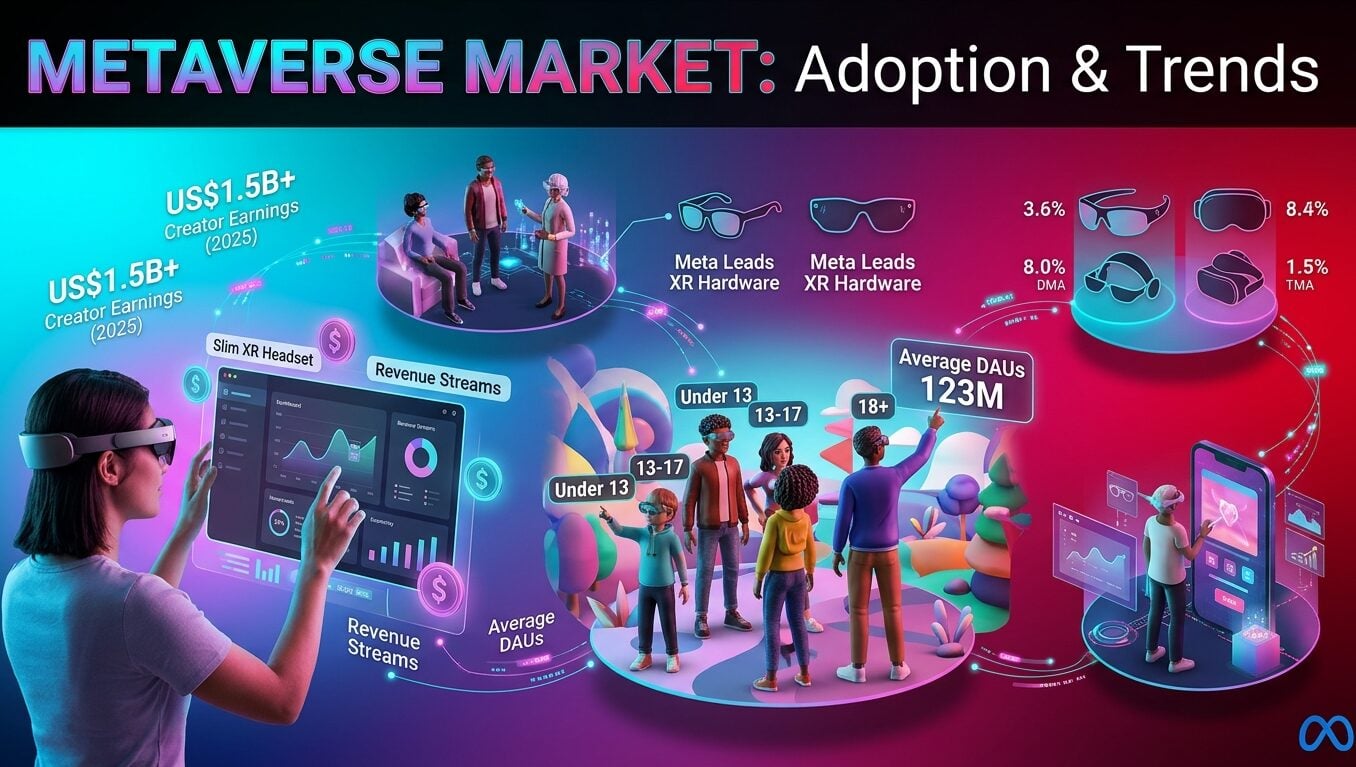
Roblox averaged 123 million daily active users in Q2 2026, up 10% year over year but below the 151.5 million recorded in Q3 2025. Hours engaged reached 29 billion, up 5%.
Growth came from outside North America. DAUs rose 67% in Japan and 64% in India, against 6% in the US and Canada.
Source: Roblox shareholder letters, Q3 2025 through Q2 2026
| Metric | Q2 2026 (US$ millions) | Q2 2025 (US$ millions) |
|---|---|---|
| Revenue | 1,469 | 1,081 |
| Bookings | 1,557 | 1,438 |
| Operating cash flow | 318 | 199 |
Source: Roblox Q2 2026 shareholder letter, quarter ended June 30, 2026
Revenue grew 36% while bookings grew 8%, because Roblox recognizes most bookings as revenue over a 27-month estimated paying-user lifetime. The company tied the bookings shortfall to lower per-hour monetization, led by younger US and Canada cohorts.
For Q3 2026, Roblox guided bookings down 14% to 18% year over year and revenue up 4% to 10%.
Roblox says close to 4% of global gaming revenue now runs through its platform, a market it shares with console makers such as Sony.
Infrastructure and trust-and-safety expenses rose 54% to US$236 million in Q2 2026. Roblox plans to move AI inference from third-party clouds to its own GPU-equipped data centers during 2026.
How Many People Use the Metaverse?
No organization publishes a single metaverse headcount. Statista Market Insights models user penetration at 21.2% in 2026 and 39.7% by 2030, when it projects 2.6 billion users.
Source: Statista Market Insights, Metaverse Worldwide outlook, 2026–2030 projections
Platform data is narrower. Roblox reports the age split of users who completed its age check, which covered 57% of global DAUs by the end of Q2 2026.
In the seven days ended June 30, 2026, 35% of age-checked users were under 13, 38% were 13 to 17, and 27% were 18 or older. Roblox notes the age-checked group may not represent its full user base.
US users aged 18 and over made up about one-third of age-checked US DAUs. US DAUs aged 18 to 34 grew 42% year over year.
Source: Roblox Q2 2026 shareholder letter, seven days ended June 30, 2026
Creator Payouts in the Metaverse Market Topped US$1.5 Billion in 2025
| Period | Roblox developer exchange fees (US$ millions) |
|---|---|
| FY2024 | 922.8 |
| FY2025 | 1,503.1 |
| Q2 2025 | 316 |
| Q2 2026 | 363 |
Source: Roblox Q4 2025 and Q2 2026 shareholder letters
Roblox creators earned over US$1.5 billion in 2025, the first year above that mark, according to the company’s 2026 proxy statement.
The top 1,000 Roblox creators earned an average of US$1.3 million in 2025, up over 50% from 2024. Roblox raised its DevEx rate by 8.5% in September 2025.
A second, targeted increase began in June 2026 for spending by age-checked US users over 18. Q2 2026 developer exchange fees rose 15% to US$363 million, against 70% growth in Q4 2025.
Source: Roblox 2026 proxy statement; Roblox Q4 2025 and Q2 2026 shareholder letters
FAQs
How big is the metaverse market in 2026?
Published 2026 estimates range from US150.1billion(StatistaMarketInsights)toUS2,114.25 billion (Fortune Business Insights). Precedence Research sits at US$263.75 billion. Each firm counts different segments, so the figures are not interchangeable.
How much money has Meta lost on the metaverse?
Reality Labs lost US4,619millioninQ22026andUS8,647 million in the first half. Cumulative tallies since late 2020 differ: about US88billionperTechSpot,US83.6 billion per EW Intelligence.
Is the metaverse dead, as Reddit threads often ask?
The numbers are mixed. Horizon Worlds sits in maintenance mode, per TechSpot, while Roblox averaged 123 million daily users in Q2 2026 and IDC counted XR headset and glasses shipments up 35.3% year over year.
Which company leads the metaverse hardware market?
Meta held 68.7% of XR headset and glasses shipments in Q2 2026, according to IDC. RayNeo ranked second at 3.6%, followed by Alibaba Group at 2.6%.
How many people use the metaverse?
No single headcount exists. Statista Market Insights projects 2.6 billion metaverse users by 2030. Roblox, one of the few platforms reporting daily figures, averaged 123 million daily active users in Q2 2026.
References
https://www.sec.gov/Archives/edgar/data/1315098/000162828026051059/ex991-robloxq22026earnin.htm
https://www.sec.gov/Archives/edgar/data/1315098/000131509826000009/ex991-q42025shareholder.htm
https://s21.q4cdn.com/399680738/files/doc_financials/2026/q2/Meta-06-30-2026-Exhibit-99-1-FINAL.pdf
