

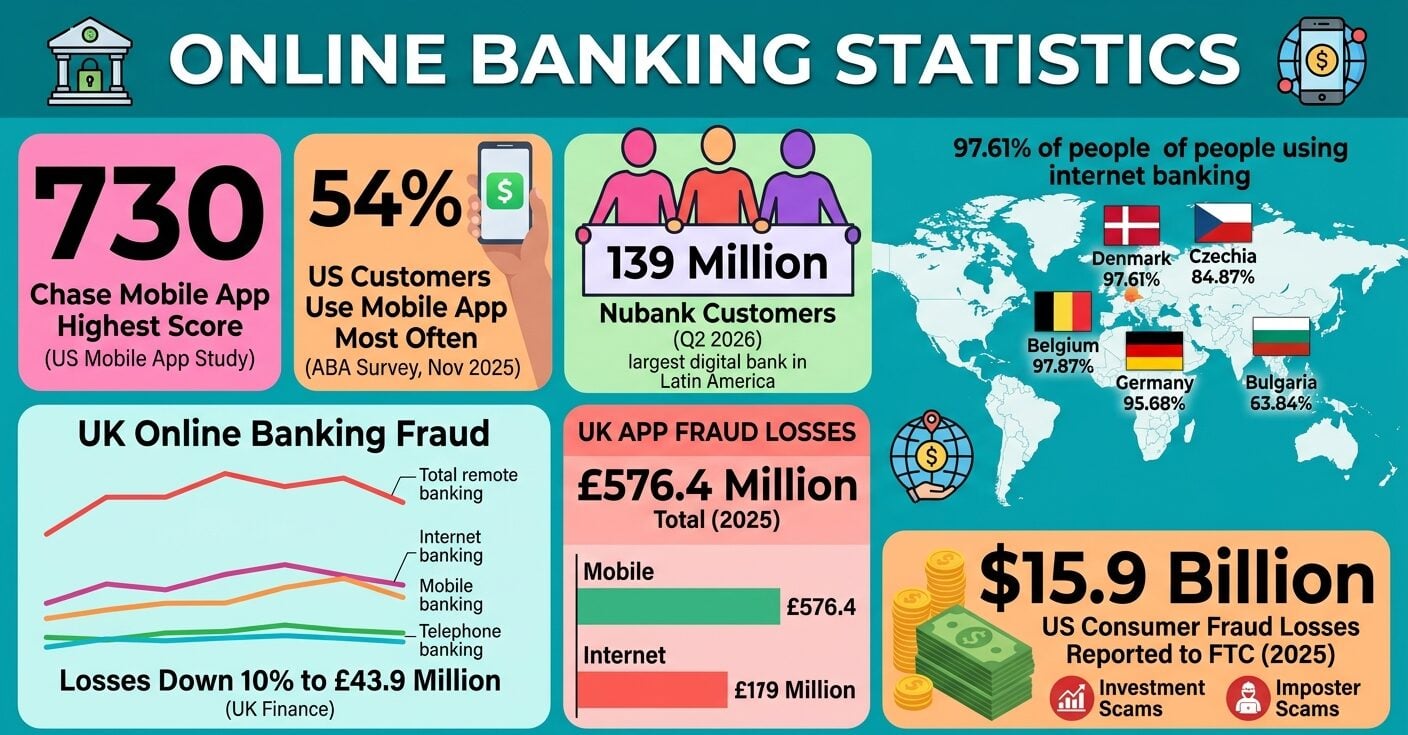
Chase’s app scored 730 out of 1,000 in J.D. Power’s 2026 rankings, while UK mobile banking fraud losses fell year on year for the first time UK Finance has reported. These online banking statistics draw on 2025 and 2026 releases from J.D. Power, the American Bankers Association, Eurostat, the FTC, UK Finance, Nubank, Revolut and Chime. They cover satisfaction scores, customer counts, channel use, country adoption and fraud losses.
Online Banking Statistics 2026
Which Banks Lead Online Banking Satisfaction in 2026?
Capital One ranks highest among national banks in J.D. Power’s 2026 U.S. Online Banking Satisfaction Study, with 725 points on a 1,000-point scale. It is the bank’s second straight year in first place.
Wells Fargo follows at 711 and Truist at 707. Among regional banks, Huntington and Regions Bank tie for first at 724 each.
| Segment | Bank | 2026 score (1,000-point scale) |
|---|---|---|
| National | Capital One | 725 |
| National | Wells Fargo | 711 |
| National | Truist | 707 |
| Regional (tie) | Huntington | 724 |
| Regional (tie) | Regions Bank | 724 |
Source: J.D. Power, 2026 U.S. Online Banking Satisfaction Study, released May 28, 2026
Mobile App Rankings: Chase Moves to First
Chase ranks highest among national bank apps with 730. Overall satisfaction with national banking apps stands at 723.
Close to 63 million active mobile users rely on the app, the bank says in its May 28, 2026 release.
Huntington leads regional bank apps at 719. For credit card apps, American Express ranks first for a third straight year at 746, against an overall score of 713.
J.D. Power redesigned all four digital studies for 2026, so scores do not line up with earlier editions. The 2025 edition had Bank of America first among national bank apps at 678, with PNC at 675 and Chase at 673.
Source: J.D. Power, 2026 and 2025 U.S. Banking Mobile App Satisfaction Studies (May 2026 and May 2025); Chase Media Center, May 28, 2026
139 Million Customers: Where Digital-Only Banks Stand in 2026
Nubank, Revolut and Chime count customers in different ways. Nubank and Revolut report total customers, while Chime reports active members, so the three totals should not be compared as equals.
Nubank Reaches 139 Million in Q2 2026
Nu Holdings added about 4 million customers in the second quarter of 2026, reaching 139 million. Brazil accounts for almost 118 million, Mexico 15.8 million and Colombia more than 5 million.
Quarterly net income passed $1 billion for the first time, at $1.1 billion. Nu calls itself the largest digital bank in Latin America.
Source: Nu Holdings, Q2 2026 earnings release, quarter ended June 30, 2026
Revolut Ends 2025 at 68.3 Million Retail Customers
Revolut closed 2025 with 68.3 million retail customers, up 30%, after 16 million joined during the year. More than 63% of new retail customers arrived through word of mouth or referrals.
Its annual report page listed more than 80 million retail customers when checked on October 19, 2026. Revolut’s stated target is 100 million customers by mid-2027.
Source: Revolut, Annual Report 2025 (year ended December 31, 2025); revolut.com annual report page, accessed October 19, 2026
Chime Grows to 10.4 Million Active Members
Chime’s active members grew 20% year over year to 10.4 million in Q2 2026. Its 1.7 million net additions over the prior 12 months were the most for any 12-month period in company history.
Average revenue per active member rose 6% to $260.
Source: Chime Financial, Form 8-K exhibit 99.1, quarter ended June 30, 2026
UK Online Banking Fraud Statistics 2026: Losses by Channel
Unauthorised remote banking fraud losses fell 27% to £104.4 million in 2025, the lowest total since 2014, according to UK Finance’s Annual Fraud Report 2026. Case numbers rose 11% to 37,646.
Mobile banking logged its highest case count on record, 25,180, up 21%. Losses on the channel still fell 10% to £43.9 million, the first annual drop UK Finance has reported for mobile banking.
Internet banking losses dropped 32% to £52.6 million, the lowest since 2011. Telephone banking losses fell 53% to £7.9 million, the lowest UK Finance has ever reported.
Banks prevented 70% of attempted remote banking fraud in 2025, up from 65% a year earlier.
| Channel | 2024 losses | 2025 losses | Change |
|---|---|---|---|
| Internet banking | £77.8m | £52.6m | -32% |
| Mobile banking | £49.0m | £43.9m | -10% |
| Telephone banking | £16.7m | £7.9m | -53% |
| Total remote banking | £143.5m | £104.4m | -27% |
Source: UK Finance, Annual Fraud Report 2026, gross losses for calendar years 2024 and 2025
Where Authorised Push Payment Scams Are Sent From
Authorised push payment (APP) fraud, where customers are tricked into sending money themselves, rose 19% to £576.4 million in 2025. Cases rose 7% to 248,070.
Mobile banking carried £301.8 million of APP losses in 2025 and internet banking £218.5 million. Mobile overtook internet banking in 2024, at £236.0 million against £186.9 million, for the first time in data going back to 2020.
In a subset of case data, UK Finance found 66% of APP cases started online and 17% through telecoms. Banks returned £354.3 million to APP victims in 2025.
Source: UK Finance, Annual Fraud Report 2026, APP data for 2020 to 2025
How Much Did US Consumers Report Losing to Fraud in 2025?
US consumers filed 3 million fraud reports with the FTC’s Consumer Sentinel Network in 2025 and reported $15.9 billion in losses. In 2024, they filed 2.6 million reports.
The totals cover all fraud reported to the FTC, not online banking alone. By payment method, bank payments carried the highest reported losses in 2025, followed by cryptocurrency.
Investment scams made up over $7.9 billion, about half of 2025 losses. Imposter scams were the most reported type, with over 1 million reports and over $3.5 billion lost.
Credit cards were the payment method named most often in reports. The FTC says reported losses have risen close to 430% since 2020 and capture a fraction of actual losses.
| Year | Reported fraud losses (FTC wording) |
|---|---|
| 2025 | $15.9 billion |
| 2024 | Over $12 billion |
| 2023 | Over $10 billion |
| 2022 | Nearly $9 billion |
| 2021 | More than $6 billion |
Source: Federal Trade Commission, testimony before the Joint Economic Committee, March 25, 2026 (calendar years 2021 to 2025)
54% of US Bank Customers Use an App as Their Top Banking Method
The ABA’s national survey, run by Morning Consult and published November 18, 2025, found 54% of bank customers use apps on phones or other mobile devices most often to manage their accounts. Online banking on a laptop or PC came second at 22%.
Apps led every other method for the sixth year running. The app share has more than doubled since the first ABA and Morning Consult survey in 2017, when it stood at 26%.
Ninety-five percent of respondents rated their bank’s online and mobile app experience as excellent, very good or good.
Source: American Bankers Association and Morning Consult, national survey released November 2025
Mobile Banking Statistics by Generation
Baby boomers named apps as their top method for the first time in the survey. Their use of laptops or PCs as a main channel fell from 41% in 2024 to 35% in 2025.
Branches remain the most-used method for 12% of boomers and 3% of Gen Z.
| Generation | Use a mobile app most often (2025) |
|---|---|
| Millennials | 67% |
| Gen Z | 63% |
| Gen X | 56% |
| Baby boomers | 38% |
Source: American Bankers Association and Morning Consult, national survey released November 2025
Online Banking Use by EU Country: Eurostat 2025
| Country (selected) | Share of people aged 16–74 using internet banking (2025) |
|---|---|
| Denmark | 97.61% |
| Czechia | 84.87% |
| Belgium | 79.30% |
| Austria | 79.04% |
| Cyprus | 78.10% |
| Germany | 70.71% |
| Bulgaria | 31.08% |
Source: Eurostat, dataset tin00099 (all individuals aged 16–74), 2025 survey, updated December 16, 2025
The table shows the share of all people aged 16 to 74 who used internet banking, not the share of internet users. Eurostat’s survey reference period is usually the first quarter of each year.
Denmark recorded 97.61% in 2025 and Bulgaria 31.08%. Belgium’s 79.30% sits below its series peak of 83.34%.
On a different base, Eurostat reports 72% of EU internet users banked online in 2024, up from 56% in 2014.
Source: Eurostat, Digitalisation in Europe 2025 edition (data year 2024)
FAQs
What percentage of Americans bank online?
Fifty-four percent of US bank customers use a mobile app most often to manage accounts, and 22% use online banking on a laptop or PC most, per the ABA’s November 2025 survey with Morning Consult.
Which bank has the best banking app in 2026?
Chase, the consumer and commercial banking arm of JPMorgan Chase, ranks highest among national banks in J.D. Power’s 2026 mobile app study with 730 points. Huntington leads regional banks at 719.
How many customers does Nubank have?
At the end of Q2 2026, Nubank had 139 million customers after adding about 4 million in the quarter. Almost 118 million of them are in Brazil, according to Nu Holdings.
How much money is lost to online banking fraud?
Unauthorised remote banking fraud losses in the UK totalled £104.4 million in 2025, per UK Finance. US consumers reported $15.9 billion in fraud losses to the FTC in 2025, a figure covering all fraud types.
Is online banking safe, according to data rather than Reddit threads?
UK losses from unauthorised account access fell in 2025 while scam losses rose. Remote banking fraud dropped 27% to £104.4 million, and authorised push payment scams climbed 19% to £576.4 million, per UK Finance.
