

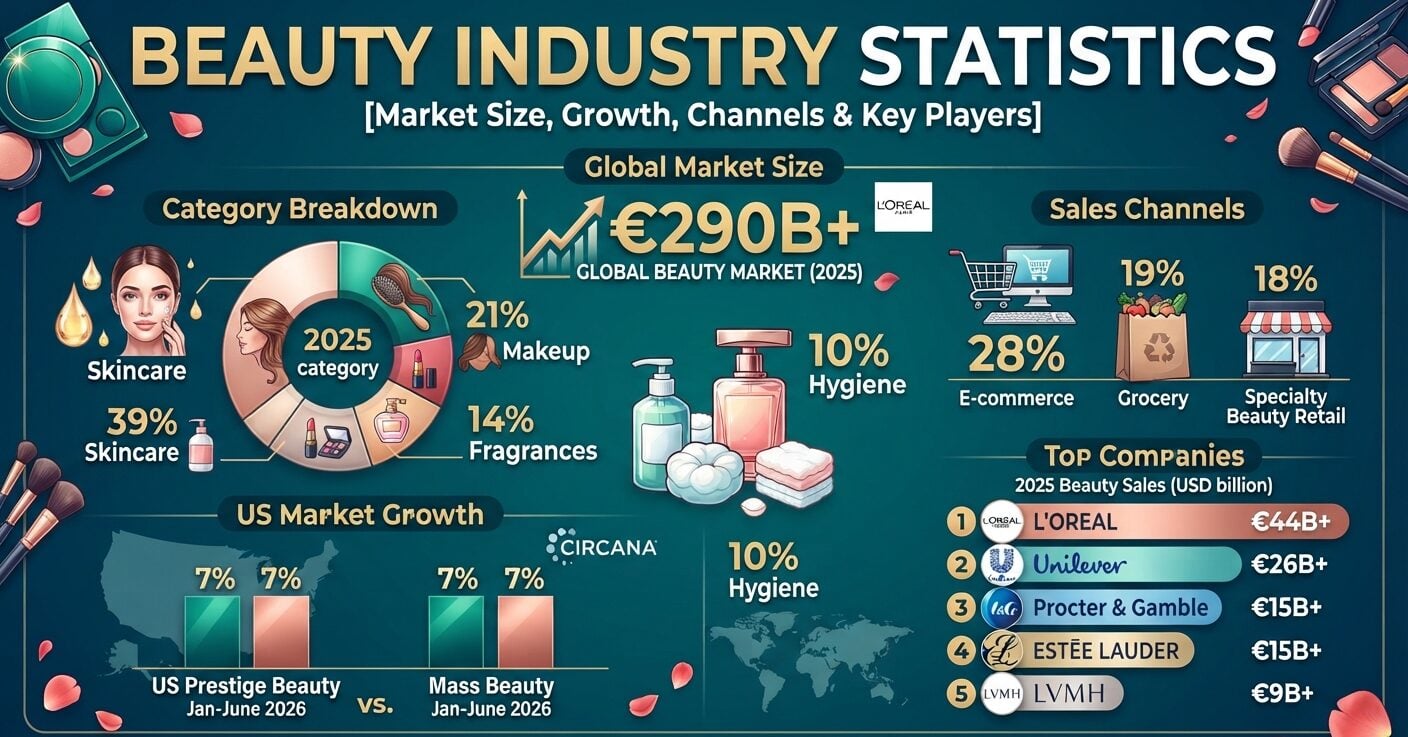
Global beauty sales grew about 3.5% in 2025, based on L’Oréal’s market estimate, while US prestige and mass beauty retail each rose 7% in the first half of 2026, according to Circana. This page collects verified beauty industry statistics on market size, categories, sales channels, US retail, China, K-beauty exports and the largest companies.
Beauty Industry Statistics
How Big Is the Beauty Industry in 2026?
L’Oréal values the global beauty market at more than €290 billion for 2025, with growth of about 3.5%. Its estimate includes hygiene products.
Growth has slowed for two years in a row. L’Oréal puts it at 8% in 2023 and 4.5% in 2024.
Source: L’Oréal 2025 Annual Report, market estimates for 2021–2025
McKinsey projects 5% annual growth through 2030, taking the market to $590 billion. That model covers only skin care, hair care, color cosmetics and fragrance, at current prices with exchange rates fixed to 2025 levels.
The L’Oréal and McKinsey figures use different scopes and currencies. They are not interchangeable.
Source: McKinsey & Company, State of Beauty report, June 18, 2026
Skincare Takes 39% of the Global Beauty Market
Skincare held 39% of the global beauty market in 2025, per L’Oréal’s category split. Hair followed at 21%, makeup at 16%, fragrances at 14% and hygiene at 10%.
Source: L’Oréal 2025 Annual Report, 2025 breakdown by category
Is fragrance bigger than makeup?
It depends on the source. McKinsey’s 2026 report says fragrance has passed color cosmetics to become the third-largest of its four core categories.
L’Oréal’s 2025 split still places makeup ahead, at 16% against 14% for fragrances. The two firms define the market differently.
Source: McKinsey & Company, State of Beauty report, June 2026
Company results point the same way as McKinsey. Estée Lauder reported fragrance sales up 12% to $2.78 billion in fiscal 2026, or 10% on an organic basis.
Source: The Estée Lauder Companies, fiscal year ended June 30, 2026
Global Beauty Industry Statistics by Sales Channel
E-commerce is the largest beauty channel worldwide, with 28% of sales, according to McKinsey’s June 2026 report. Grocery follows at 19% and specialty beauty stores at 18%.
| Channel | Share of global beauty sales |
|---|---|
| E-commerce | 28% |
| Grocery | 19% |
| Specialty beauty retail stores | 18% |
Source: McKinsey & Company, State of Beauty report, June 2026
McKinsey’s e-commerce figure covers retailer websites, brand sites, marketplaces, and social and agentic commerce. Department store beauty sales have declined 2% a year since 2019.
How much beauty sells on TikTok?
TikTok holds about 2% of US beauty sales, yet its beauty sales have risen roughly 260% a year since 2023. McKinsey says the platform is on track for $4 billion in beauty sales in 2026.
Shoppable video accounts for 66% of TikTok beauty sales. Live streaming represents about 22% of US sales on the platform.
Amazon, Ulta Beauty, Sephora and TikTok together make up just under half of the US beauty market. Sephora is owned by LVMH.
Source: McKinsey & Company, State of Beauty report, June 2026 (TikTok data from Charm.io)
Beauty live shopping by country
China leads, with 41% of surveyed consumers watching a beauty shopping live stream in the past year. Europe sits at 8%.
McKinsey surveyed 1,500 consumers per market in February 2025. Roughly one in five live stream viewers report buying in every or nearly every session.
Source: McKinsey Global Beauty Consumer Survey, February 2025
How Did US Prestige and Mass Beauty Perform?
US prestige beauty dollar sales rose 4% to $36 billion in 2025, with units also up 4%, according to Circana. Mass beauty grew 5% to $72.7 billion on 2% unit growth.
Makeup remained the largest prestige category, up 4%. Hair grew fastest by dollar sales and is the only prestige category where online accounts for most retail sales.
Source: Circana, US prestige and mass beauty retail, full year 2025
US beauty sales in the first half of 2026
Prestige sales rose 7% to $17.1 billion in January–June 2026. Mass sales also rose 7%, to $39.2 billion.
Prestige fragrance growth came from price. Average prices rose 5% while units stayed flat.
| Category | Prestige dollar growth | Mass dollar growth |
|---|---|---|
| Fragrance | +6% | +15% |
| Skincare | +9% | Not published |
| Makeup | +3% | +5% |
| Hair | +11% | +7% |
Source: Circana, US beauty retail, January–June 2026 vs. same period 2025
Beauty Industry Statistics by Region
North America held 28% of global beauty sales in 2025, the largest regional share in L’Oréal’s breakdown. North Asia followed at 27% and Europe at 24%.
| Region | Share of global beauty market (2025) |
|---|---|
| North America | 28% |
| North Asia | 27% |
| Europe | 24% |
| SAPMENA – SSA | 12% |
| Latin America | 9% |
Source: L’Oréal 2025 Annual Report, 2025 breakdown by region
L’Oréal expects more than 600 million additional potential consumers worldwide by 2030. SAPMENA (South Asia Pacific, Middle East, North Africa) accounts for the largest increase.
| Region | Additional potential consumers by 2030 |
|---|---|
| SAPMENA | +380 million |
| North Asia | +110 million |
| Sub-Saharan Africa (SSA) | +65 million |
| Latin America | +33 million |
| Europe | +19 million |
| North America | +9 million |
Source: L’Oréal 2025 Annual Report, 2025–2030 consumer projection
China cosmetics retail sales
China’s cosmetics retail sales reached RMB 465.3 billion in 2025, up 5.1%, based on National Bureau of Statistics data for enterprises above designated size. Jing Daily described the total as a record.
| Period (2026, cumulative) | Retail sales (RMB billion) | Year-over-year change |
|---|---|---|
| January–February | 75.3 | +4.5% |
| January–March | 122.0 | +5.9% |
| January–June | 244.5 | +6.3% |
| January–July | 272.3 | +6.3% |
Source: National Bureau of Statistics of China, enterprises above designated size, January–July 2026
Total consumer goods retail sales in China grew 1.2% over January–July 2026. June cosmetics sales rose 12.6% to RMB 45.6 billion.
Source: National Bureau of Statistics of China, June and January–July 2026
K-Beauty Exports Reached $11.43 Billion in 2025
South Korea’s cosmetics exports rose 12.3% to a record $11.43 billion in 2025, according to the Ministry of Food and Drug Safety.
The US became the top destination for the first time, at $2.19 billion. Shipments to China fell 19.2% to $2.01 billion.
Skincare made up $8.54 billion of exports, up 11.6%. Buyer countries rose from 172 in 2024 to 202 in 2025.
| Destination | 2025 exports | Year-over-year change |
|---|---|---|
| United States | $2.19 billion | +15.1% |
| China | $2.01 billion | -19.2% |
| Japan | $1.09 billion | +5.0% |
| Hong Kong | $705 million | +21.6% |
Source: Ministry of Food and Drug Safety (Korea), calendar year 2025
Which Companies Lead the Beauty Industry?
L’Oréal tops the beauty sales ranking published in its 2025 annual report, at $47.0 billion. Unilever ranks second at $26.0 billion.
| Rank | Company | Beauty sales (USD billion) |
|---|---|---|
| 1 | L’Oréal | 47.0 |
| 2 | Unilever | 26.0 |
| 3 | Procter & Gamble | 15.4 |
| 4 | Estée Lauder | 14.7 |
| 5 | LVMH | 9.2 |
Source: L’Oréal 2025 Annual Report, main global players by sales
Procter & Gamble and Estée Lauder follow at $15.4 billion and $14.7 billion. LVMH rounds out the top five.
L’Oréal’s own 2025 sales reached €44.05 billion, up 4.0% like-for-like and 1.3% as reported. E-commerce made up more than 30% of the total.
| L’Oréal division | 2025 sales | Like-for-like growth |
|---|---|---|
| Consumer Products | €16.1 billion | +3.5% |
| Luxe | €15.6 billion | +2.8% |
| Dermatological Beauty | €7.2 billion | +5.5% |
| Professional Products | €5.2 billion | +7.5% |
Source: L’Oréal 2025 Annual Report, fiscal year 2025
The Estée Lauder Companies posted fiscal 2026 net sales of $15,049 million, up 5%, with organic sales up 3%. Its fiscal 2027 outlook calls for 3% to 5% organic growth.
Source: The Estée Lauder Companies, fiscal 2026 results, August 19, 2026
FAQs
How big is the beauty industry?
L’Oréal estimates the global beauty market at more than €290 billion in 2025. McKinsey projects its four core categories will reach $590 billion by 2030, growing 5% a year.
Is the beauty industry still growing?
Yes. Global beauty sales grew about 3.5% in 2025, per L’Oréal, down from 4.5% in 2024. US prestige and mass retail sales each rose 7% in January–June 2026, per Circana.
What is the largest beauty category?
Skincare. It held 39% of the global beauty market in 2025, according to L’Oréal, ahead of hair at 21% and makeup at 16%.
What percentage of beauty sales happen online?
E-commerce accounts for 28% of global beauty sales, the largest single channel, according to McKinsey’s June 2026 report. Grocery follows at 19% and specialty beauty stores at 18%.
Is beauty spending recession-proof, as many Reddit threads claim?
The data does not prove that. L’Oréal shows global growth slowing from 8% in 2023 to about 3.5% in 2025. US beauty retail still grew 7% in the first half of 2026, per Circana.
Sources
https://www.loreal-finance.com/en/annual-report-2025/beauty-market/
https://www.mckinsey.com/industries/consumer-packaged-goods/our-insights/state-of-beauty
https://www.elcompanies.com/en/news-and-media/newsroom/press-releases/2026/08-19-2026-110037466
