

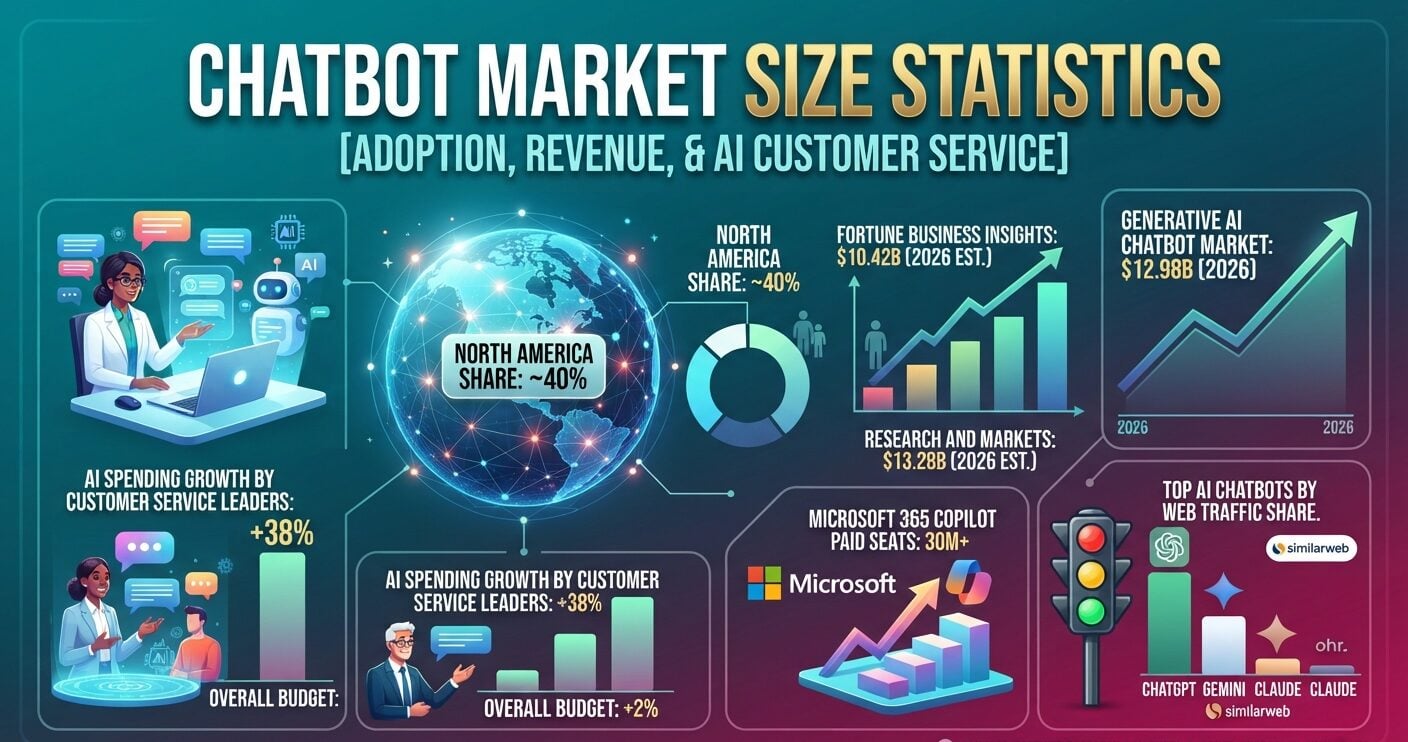
Fortune Business Insights values the global chatbot market at $10.42 billion for 2026. Research and Markets puts the same year at $13.28 billion.
This chatbot market size guide sets each firm’s estimate beside its forecast horizon, then covers regional splits, the separately tracked generative AI chatbot segment and demand signals from Gartner, Microsoft and Similarweb.
Chatbot Market Size Statistics
How Big Is the Chatbot Market in 2026?
Five research firms reviewed here publish a 2026 value for the global chatbot market. Four of them land between $10.42 billion and $13.28 billion.
Fortune Business Insights reports $10.42 billion for 2026, up from $8.37 billion in 2025.
Market Data Forecast sits just above that at $10.68 billion, from a 2025 base of $8.25 billion.
Coherent Market Insights estimates $12.01 billion for 2026.
The highest 2026 figure in this set comes from Research and Markets: $13.28 billion, up from $10.25 billion in 2025.
Precedence Research is the outlier, at $1.42 billion in 2025 and $1.70 billion in 2026.
Source: Fortune Business Insights, Market Data Forecast, Coherent Market Insights, Research and Markets and Precedence Research, 2026 report editions
Why do chatbot market size estimates differ?
Each firm sizes vendor revenue under its own definition of the market. None of these reports publishes a reconciliation with the others.
Read the figures as separate estimates. Averaging them would mix different scopes.
The Fortune Business Insights series gives one consistent view from 2025 to 2034.
| Year | Chatbot market value | Status |
|---|---|---|
| 2025 | $8.37 billion | Reported |
| 2026 | $10.42 billion | Estimate |
| 2034 | $60.21 billion | Forecast, 24.51% CAGR (2026–2034) |
Source: Fortune Business Insights, Chatbot Market report, 2026–2034 forecast edition
Chatbot Market Size Forecasts Through 2035
Research and Markets expects the chatbot market to reach $37.53 billion by 2030, a 29.7% CAGR.
Source: Research and Markets, Chatbot Market Report 2026
Fortune Business Insights projects $60.21 billion by 2034. Coherent Market Insights lands on $60.22 billion, but for 2033, at a 25.9% CAGR from 2026.
Market.us forecasts about $68.3 billion by 2035, growing 22.2% a year over 2026–2035 from $9.2 billion in 2025.
Market Data Forecast has the largest long-range number reviewed here: $84.50 billion by 2034, at 29.5% a year.
Starting from a much smaller base, Precedence Research projects $7.96 billion by 2035 at an 18.81% CAGR.
Source: Fortune Business Insights, Coherent Market Insights, Market.us (updated August 3, 2026), Market Data Forecast (July 2026) and Precedence Research (January 2026)
$12.98 Billion: Generative AI Chatbot Market Size in 2026
Fortune Business Insights sizes generative AI chatbots in a separate report. It puts that market at $12.98 billion in 2026, up from $9.9 billion in 2025.
The same report forecasts $113.35 billion by 2034, a 31.11% CAGR over 2026–2034.
That $12.98 billion is higher than Fortune’s $10.42 billion for the overall chatbot market in 2026. The two numbers come from separate reports, each with its own scope.
North America’s generative AI chatbot market stood at $2.20 billion in 2025, per the same report.
Source: Fortune Business Insights, Generative AI Chatbot Market report, 2026–2034 edition
Regional Chatbot Market Size and the North America Share
Five firms name North America as the largest chatbot region. Their share estimates differ by report year and scope.
Fortune Business Insights puts North America at 39.55% of the global chatbot market in 2025.
Source: Fortune Business Insights, Chatbot Market report, 2025 base year
Market.us reports a share above 35.0% for 2025, worth about $3.2 billion in revenue.
Precedence Research estimates around 41% for 2025. Coherent Market Insights projects 29% for 2026.
Research and Markets names North America the largest region in 2025 and Asia Pacific the fastest-growing. Coherent Market Insights also expects Asia Pacific to grow fastest over its forecast period.
Source: Market.us (2025), Precedence Research (2025), Coherent Market Insights (2026) and Research and Markets (2025), 2026 report editions
How big is the US chatbot market?
Precedence Research values the US chatbot market at $407.54 million in 2025. It projects $2,356.46 million by 2035, a 19.18% CAGR over 2026–2035.
Source: Precedence Research, Chatbot Market report, January 2026
How Fast Is Customer Service AI Spending Growing?
Customer service leaders raised AI spending by 38%, while overall service and support budgets grew 2%. Gartner surveyed 199 service and support leaders in April and May 2026.
Gartner analyst Kim Hedlin said leaders are moving money away from labor and overhead toward technology.
Two years out, respondents expect GenAI chatbots to become the most valuable customer service channel, ahead of live chat and GenAI voicebots.
Source: Gartner, survey of 199 service and support leaders, April–May 2026 (published August 26, 2026)
A separate Gartner survey of 1,303 senior leaders, run January to April 2026, found service and support leaders put a median 12% of their 2025 budget into AI. That was the highest of the 10 business functions assessed.
Only 24% of those service and support leaders showed positive financial returns across their AI use cases.
Source: Gartner, survey of 1,303 senior leaders, January–April 2026 (published July 8, 2026)
Do customers actually use company chatbots?
Customers are about three times more likely to use third-party GenAI tools than company-provided chatbots for service issues. Gartner surveyed 3,566 B2B and B2C customers in February and March 2026.
Third-party GenAI use in service interactions nearly doubled over the past year. Company chatbot use has stayed statistically unchanged since 2022.
Third-party tools include assistants such as ChatGPT, which sells into consumer, developer and enterprise segments.
Half of customers (50%) say interactions are easier when companies use GenAI. Yet 87% call an option to reach a human agent essential.
Source: Gartner, survey of 3,566 B2B and B2C customers, February–March 2026 (published July 8 and August 4, 2026)
Microsoft 365 Copilot Paid Seats in Fiscal 2026
Paid seats are not market revenue. They track paid demand for one enterprise AI assistant.
Microsoft reported 15 million paid Microsoft 365 Copilot seats on January 28, 2026, then more than 20 million on April 29, 2026.
By the end of fiscal 2026 on June 30, 2026, Microsoft 365 Copilot had more than 30 million paid seats, per Microsoft’s July 29 earnings release.
Copilot sits inside a wider Microsoft AI portfolio that also includes Azure OpenAI Service.
Developer subscriptions to GitHub Copilot are reported as a separate figure.
Source: Microsoft earnings disclosures, January 28, April 29 and July 29, 2026
Which AI Chatbot Leads Web Traffic Share?
Similarweb’s August 2026 update measures each platform’s share of worldwide visits to generative AI websites. It does not measure revenue or unique users.
| Platform | Share, snapshot 12 months earlier | Share, snapshot 1 month earlier |
|---|---|---|
| ChatGPT | 73.3% | 55.5% |
| Gemini | 12.9% | 25.6% |
| Claude | 1.9% | 9.3% |
| DeepSeek | 4.0% | 3.4% |
| Grok | 2.6% | 2.4% |
| Copilot | 2.0% | 1.6% |
| Perplexity | 2.0% | 0.9% |
Source: Similarweb, Gen AI website traffic share update, August 2026
ChatGPT held 55.5% in the one-month-earlier snapshot, down from 73.3% twelve months earlier. Broader AI market share by company follows a different set of metrics.
Gemini rose from 12.9% to 25.6% across the same two snapshots, a shift that feeds into Google’s competitive position.
Claude moved from 1.9% to 9.3%. Anthropic’s assistant sits among OpenAI’s main rivals with Gemini and Copilot.
FAQs
What is the chatbot market size in 2026?
Four firms place 2026 between $10.42 billion (Fortune Business Insights) and $13.28 billion (Research and Markets). Precedence Research publishes a much lower $1.70 billion, reflecting its own scope definition.
How fast is the chatbot market growing?
Published CAGRs run from 18.81% (Precedence Research, 2026–2035) to 29.7% (Research and Markets, to 2030). Fortune Business Insights projects 24.51% a year through 2034.
Which region has the largest chatbot market?
North America. Fortune Business Insights puts its share at 39.55% in 2025, and Coherent Market Insights at 29% for 2026. Research and Markets names Asia Pacific the fastest-growing region.
Are chatbot market size figures shared on Reddit reliable?
Only as reliable as the report behind them. Before reusing a number seen on Reddit, confirm the publishing firm, report edition and forecast period, since firms size the market under different scopes.
Which AI chatbot has the largest market share?
By web traffic, ChatGPT. Similarweb’s August 2026 update shows it at 55.5% of generative AI site visits in the one-month-earlier snapshot, ahead of Gemini at 25.6%. This is traffic share, not revenue.
Sources
https://www.sec.gov/Archives/edgar/data/0000789019/000119312526323632/msft-ex99_1.htm
https://x.com/Similarweb/status/2096878021378466096
https://www.quantumrun.com/consulting/chatbot-market-size-statistics/
