

In 1965, finding a computer-generated date required considerably more patience than downloading an app. A student filled out a paper questionnaire, mailed it with a $3 fee and waited for a machine the size of a small car to produce a list of names.
There were no profile photographs, instant messages or carefully edited opening lines. If one of the names looked promising, the next step was an actual telephone call—often made to a stranger’s family home.

The service was called Operation Match. Created by a group of Harvard students, it used an IBM 1401 to process answers about personality, habits and romantic preferences. Tens of thousands of students reportedly tried it.
The mechanics now seem wonderfully primitive, but the business idea was remarkably modern: use technology to expand a person’s social circle, charge for access and let the customer decide what happens next.
Six decades later, online dating has become an international industry with its own public companies, specialist platforms and competing revenue models. The questionnaire has survived, but almost everything around it has changed.
Before the Internet, There Was Already a Market
Operation Match was not an isolated experiment. Computer dating services appeared on university campuses and in large cities throughout the 1960s and 1970s.
Most followed a similar process. Customers answered dozens—or sometimes more than 100—questions. Employees transferred the answers to punch cards, and a mainframe compared them with other entries.
The computer was part analytical tool and part marketing attraction. At the time, many consumers had never interacted with one.
Promising that a machine could find compatible partners gave an old business—the introduction service—a futuristic identity.
It did not always produce lasting companies. Early operators struggled with expensive computing, regional databases and the practical difficulty of attracting enough compatible people in the same place.
Still, they discovered a principle that would shape every dating platform that followed: the value of the service depended heavily on the number and variety of people using it.
This is the network effect at its most personal. A dating company can build elegant software, but customers ultimately join because they hope someone interesting is already there.
The Web Removed Geography’s First Barrier
Personal ads continued to thrive in newspapers throughout the 1980s and early 1990s. Some services experimented with telephone recordings and premium-rate lines, allowing people to hear introductions rather than read them. Then the commercial internet arrived.
The launch of web-based dating services in the mid-1990s changed both the speed and economics of matchmaking.
Profiles could be updated without printing anything. Search results appeared immediately. A company could serve customers in several cities from the same technical platform.
Online dating also became more visual. Instead of choosing from a few lines of newspaper copy, users could browse photographs, personal descriptions and lists of interests. Email-style messaging allowed two people to speak privately before exchanging telephone numbers.
The early business model was easy to understand. Browsing was often free, while contacting another member required a subscription.
This created a natural sales funnel: show customers that appealing people were available, then charge for the ability to communicate.
The model worked well enough to turn dating from a fragmented collection of local introduction agencies into a scalable technology business.
The Smartphone Made Dating a Daily Habit
The next major change was not a better compatibility questionnaire. It was the smartphone.
Desktop dating required intention. A person had to sit down, open a website and spend time searching. Mobile apps could be checked on a train, during lunch or while waiting for a friend. Location services also made nearby matches instantly visible.
Tinder’s swipe mechanic, introduced in the early 2010s, simplified the entire experience to one physical gesture. It was fast, visual and easy to learn.
The interface was copied across the industry because it solved a difficult product problem: how to make reviewing a large number of profiles feel effortless.
Bumble later adjusted the social rules of the match by allowing women to initiate conversations in heterosexual pairings. Its founder, Whitney Wolfe Herd, became one of the industry’s most visible executives.
As CompaniesHistory has documented in its account of Wolfe Herd and Bumble, the company reached a valuation of more than $13 billion after its 2021 Nasdaq debut.
That valuation did not last. Bumble’s subsequent market decline illustrated an important fact about the sector: attracting millions of users does not guarantee durable growth.
Dating companies must keep improving their products while managing acquisition costs, customer trust and the awkward reality that successful users may leave after finding a partner.
A Brief Business Timeline of Digital Dating
| Period | Important development | Business significance |
| 1960s | Mainframe services match questionnaires | Proved consumers would pay for computer-assisted introductions |
| 1980s–early 1990s | Newspaper ads and telephone dating expand | Created recurring revenue from listings and paid communication |
| Mid-1990s | Web-based dating services appear | Made large, searchable databases commercially viable |
| 2000s | Subscriptions and specialist sites multiply | Demonstrated demand for dating products built around specific audiences |
| 2010s | Smartphones, location and swiping dominate | Turned dating into a frequent mobile activity |
| Early 2020s | Video communication becomes routine | Helped people assess chemistry before meeting |
| Mid-2020s | Verification, AI and international tools improve | Shifted competition toward trust, relevance and communication quality |
Every stage lowered one kind of friction while introducing another. Websites made it easier to find people but created crowded databases.
Swiping accelerated discovery but made profiles feel disposable. International platforms widened the available pool but had to address language, distance and trust.
The companies that endured were rarely those with a single clever feature. They were the ones that adapted as customers’ expectations changed.
Specialization Became the Industry’s Next Chapter
Once online dating became mainstream, one universal product no longer made sense. A college student looking for casual dates and a 57-year-old widow interested in a committed relationship are technically using the same category, but they do not have the same priorities.
That difference created room for specialist platforms organized around religion, profession, lifestyle, sexuality, relationship goals and age.
Rather than competing for every single adult, these businesses could design a clearer experience for a particular group.
Age-focused dating is especially interesting because the potential audience is growing. People are living longer, remaining professionally active and forming new relationships later in life. Divorce, widowhood and relocation can return someone to dating after 10, 20 or even 30 years away.
These customers are not simply older versions of younger app users. Many want detailed profiles, clear intentions and enough information to decide whether a conversation is worth starting.
They may also value customer support more highly, particularly if they are unfamiliar with current dating conventions or payment models.
DateMyAge and the Rise of Global Mature Dating
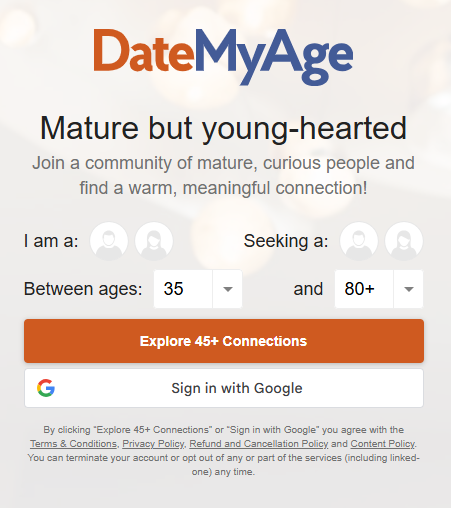
DateMyAge represents this more specialized phase of the industry. According to the company, its roots date back to 1993, placing its launch near the beginning of commercial online dating.
Today, it focuses on connecting mature singles across more than 40 countries, with a presence spanning North America, Latin America, Europe and Asia.
That international emphasis distinguishes the company from services built primarily around nearby matches.
DateMyAge allows members to discover people outside their existing social and geographic circles, then communicate through direct messages, live chat and video features.
The platform’s pay-per-action approach also differs from the familiar unlimited monthly subscription. Customers pay for the communication features they choose to use, giving active members more control over how they engage with the service.
As with any unfamiliar pricing structure, prospective members benefit from understanding it before they begin.
Independent resources offering datemyage reviews can help newcomers examine the platform’s tools, costs and user experience before deciding how they want to participate.
DateMyAge has also made verification and on-platform safety prominent parts of its service. The company says verified users submit government identification and complete biometric checks through a third-party verification provider.
Verification must be renewed after six months. Its anti-scam and moderation systems are designed to detect suspicious behavior, financial requests and potentially harmful content.
No dating platform can eliminate every risk created by conversations between strangers. DateMyAge’s approach is nevertheless a positive example of how a mature international service can combine access with practical safeguards.
The company encourages members to remain on the platform while getting acquainted and advises against sharing financial or identifying information too quickly.
Why Global Dating Has Become More Practical?
International dating once involved expensive telephone calls, unreliable mail and considerable guesswork. Today, two people can exchange messages, photographs and video calls before either books a flight.
That change matters for mature adults. They may travel frequently, work remotely, own homes in different places or plan to relocate after retirement.
Some have families spread across several countries. Others simply find that local dating offers too narrow a social circle.
A global platform does more than increase the number of visible profiles. It exposes users to different languages, traditions and ways of living.
The appeal is not necessarily the promise of an exotic romance. Often, it is the simpler pleasure of meeting someone whose life would never have crossed one’s own offline.
The best platforms support that curiosity without pretending distance is irrelevant. Time zones, travel costs and future living arrangements are real considerations.
Video communication is valuable because it allows a relationship to develop gradually while helping both people make informed decisions.
The Next Competitive Advantage Is Trust
For much of the industry’s history, growth meant building a larger database. That remains important, but size alone has become a weak differentiator. People now expect platforms to help them understand who they are meeting and how the service itself works.
This makes transparency part of the product. Customers should be able to find clear information about pricing, verification, privacy and reporting procedures.
They should understand which features are free and which require payment. When a problem occurs, customer support must feel like a real function rather than a hidden email form.
Artificial intelligence will play a growing role behind the scenes. It can identify repeated images, unusual message patterns and accounts that behave like coordinated fraud. It can also improve translation and recommend profiles based on interests rather than appearance alone.
Yet the most successful dating company will not be the one that claims to automate romance. People do not want software to fall in love for them. They want it to remove distractions, present credible possibilities and make the first conversation easier.
The Technology Changed; the Need Did Not
From an IBM mainframe producing six names on paper to a video chat connecting two people on opposite sides of the world, dating technology has covered extraordinary ground.
Its core promise, however, remains almost identical to the one sold by Harvard students in 1965: there may be someone worth knowing beyond the limits of your current social circle.
Companies such as DateMyAge show where the market is heading. The future is not one enormous app designed for everyone. It is a collection of more thoughtful services built around different stages of life, intentions and ways of communicating.
The industry began by asking whether a computer could introduce two compatible people. Sixty years later, the answer is clearly yes. The more interesting business question is whether a platform can make that introduction feel safe, useful and genuinely personal.
For the companies that manage it, there is still plenty of history left to write.
