

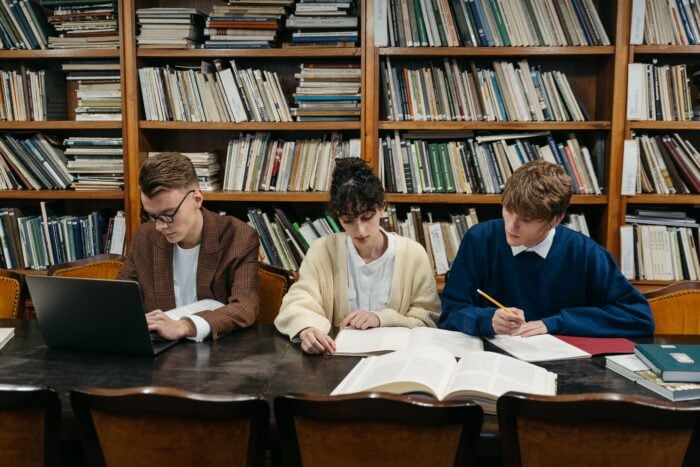
Here’s a thing that hasn’t changed in thousands of years: people help each other learn. That’s it. That’s the constant. What changes is the shape it takes — sometimes a conversation, sometimes a borrowed notebook, now a glowing screen at midnight.
Every civilization worked this out differently. Oral tradition here, written records there, eventually whole school systems.
But trace it back far enough and you notice the same move happening over and over. A new way to share knowledge shows up, and within a generation or two, people have made it communal. Not because anyone planned it that way. It just happens.
Learning Circles of the Ancient World
Education used to live inside relationships, not buildings. You learned by sitting next to someone who already knew the thing you didn’t.
Take ancient Greece. Philosophers pulled small groups around them and traded questions instead of handing down speeches — Socrates built an entire method on this, asking rather than telling. Meanwhile in Egypt and Mesopotamia, scribes spent years training apprentices, symbol by symbol. It was slow. Painfully slow, probably, by modern standards. But it worked.
Confucian scholars in China went a similar route, building whole communities where older students simply looked after newer ones, no one had to assign it.
And in India, the gurukul tradition pushed even further — students actually lived with their teachers, learning by doing rather than by testing. None of this looked like a classroom. It looked like patience. Mostly patience, honestly, and a lot of repeating things until they stuck.
Guidance That Keeps Pace With Every Generation
Some things just don’t change. Modern study still runs on shared resources, same as ancient learning did — the clothes are different, not the instinct underneath.
Today’s students want guidance that fits into a semester that’s already too full, not one more thing to squeeze in. So a lot of them reach for simple, digital resources — something that answers one question and then gets out of the way.
One resource plenty of learners quietly turn to is a professional free plagiarism checker for teachers, and it gives instant clarity on originality before a paper goes anywhere near submission. Its ease of use is probably the whole reason it’s stuck around — barely any learning curve, nothing extra to figure out.
Instructors like it too, for having a shared reference point when they’re reading through student work. Small habit. Bigger effect on confidence than you’d expect, well before graduation.
That impulse — reaching for something dependable when the stakes feel a little heavier than usual — connects right back to how learning communities have worked all along. The format shifts under everyone’s feet, sure. The need for a hand you can trust doesn’t.
The Rise of Formal Education and Peer Support
Once universities started appearing across medieval Europe, learning began organizing itself almost without anyone directing it. Bologna. Oxford. Paris. These places pulled in scholars from wherever they’d come from, often after weeks of travel just to arrive.
And once there, students didn’t just sit through lectures and vanish. They formed nations — loose networks grouped by hometown or language — and leaned on each other while figuring out unfamiliar cities and even more unfamiliar ideas.
Studying was already a group sport by then: shared notes, shared arguments, occasionally a shared meal when someone’s stipend stretched a little further than usual.
Scholars’ guilds even negotiated rent with local landlords. Academic life and ordinary life were tangled together in a way that’s easy to forget now, centuries later.
Medieval Study Groups and Shared Notes
Manuscripts were rare and expensive, so students copied each other’s notes constantly — almost compulsively.
A good notebook was basically currency. Study groups formed around whoever happened to own the cleanest copy of a text, and that person became, briefly, the most popular student on campus.
The Printing Press Changes Everything
Then Gutenberg’s press showed up in the fifteenth century, and things sped up fast. Books got cheaper. Ideas started traveling faster than any teacher could carry them on foot.
For the first time ever, a student in one city could read the exact same page as a student hundreds of miles away and actually compare notes on something close to equal footing.
Give it a couple of generations, and subjects that once belonged to a small circle of scholars opened up to almost anyone who could read.
A handful of milestones worth pulling out of this stretch of history:
- Ancient mentorship built the first teacher-student relationships around trust and back-and-forth dialogue.
- Medieval universities introduced organized peer networks and shared living communities.
- The printing press made written knowledge reachable well beyond a small circle of scholars.
- Public libraries in the eighteenth and nineteenth centuries opened learning to people outside formal institutions.
- Correspondence courses during the industrial era let people study from home for the very first time.
Academic Support in the Digital Age
The twentieth century brought radio lessons, then televised courses, then — eventually — the internet, and each one shrank the distance between a learner and whatever help they actually needed. By the 1990s, students could just email a professor, no appointment required.
By the 2000s, whole universities were posting lecture notes online for free, for anyone curious enough to look.
These days, learning support looks less like one mentor and more like a web of resources working quietly in the background. Online forums connect students across continents who will probably never meet in person.
Digital writing aids catch small mistakes before they turn into embarrassing ones. Video platforms take genuinely complicated topics and turn them into five-minute explanations that click on the first watch — no small feat.
Language apps let curious people pick up new skills on their own schedule, no classroom in sight. Shared documents let classmates edit the same project from opposite ends of the planet, in real time, without stepping on each other’s sentences.
None of this replaces a good teacher. It just means a good teacher isn’t the only source of help left in the room.
What’s a little funny, actually, is how familiar all of it feels once you trace it back far enough. A study group in a Bologna courtyard eight centuries ago and a group chat comparing notes tonight are doing, underneath it all, the exact same human thing: making learning a bit lighter by sharing it around.
Why This History Still Matters?
Every generation seems convinced its own tools are unprecedented. They almost never are, once you actually look. What stays constant is a fairly simple belief — that learning goes better together than it does alone.
Knowing this history is genuinely useful for students right now, not just a nice bit of trivia to file away somewhere.
It’s permission to ask for help without treating it like a shortcut. Scholars in every century before this one reached for whatever their era happened to offer them — a mentor, a borrowed notebook, a freshly printed page.
Reaching for what’s available now is just the newest chapter in a very old story, one built on curiosity, community, and the quiet satisfaction of figuring something out with a little help along the way. That story isn’t finished. Not even close. It’s still being written — one student, one notebook, one shared idea at a time.
