
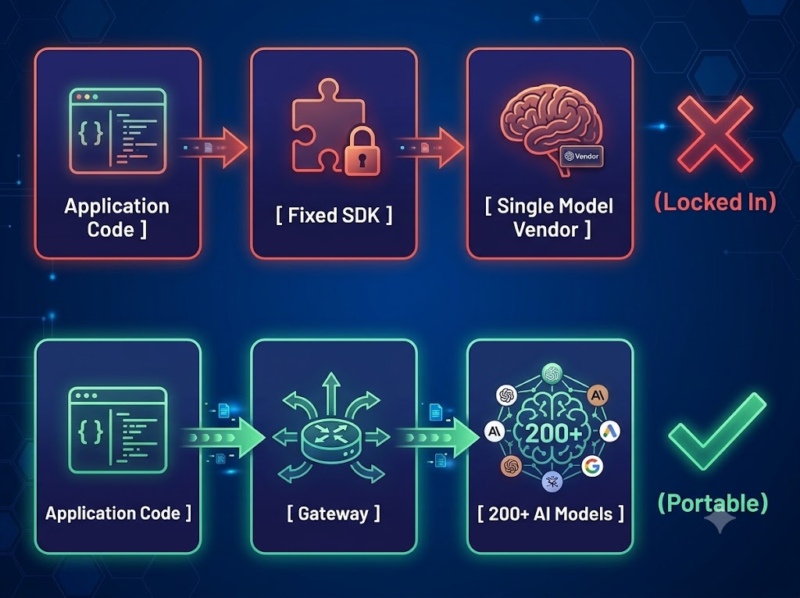

Technology leaders struggle with the same structural challenge in every computing era – vendor lock-in. Whenever enterprise systems become dependent on a single service provider, their flexibility becomes limited, and expenses rise. Breaking free becomes impossible due to costly and risky system re-platforming efforts.
Traditionally, lock-in resided in hardware servers and closed software licenses. Today, lock-in happens in proprietary cloud APIs and integration with single-provider artificial intelligence. Knowing the history helps the technology teams keep their stack vendor-independent.
Using modern LLM orchestration tools provides necessary control over expenses and the ability to migrate technologies without reprogramming the core application logic.
The Legacy Trap: How Mainframe Monopoly Established the Pattern
Back in the 1960s and 1970s, the computing monopoly was held by IBM with its revolutionary System/360 architecture.
Enterprises would spend millions on developing their own assembly code and proprietary storage formats exclusively for the IBM architecture.
When competing hardware manufacturers started developing more affordable and efficient processors, enterprises could not switch because of the prohibitive costs of migration.
There were three major aspects of vendor lock-in in the IBM mainframe era:
- Proprietary Instructions: Code that was directly dependent on the hardware architecture of a vendor.
- Closed Data Format: Databases that were accessible only through the use of certain tools.
- Prohibitive Migration Cost: Technological debt that made vendor changes impossible.
Cloud Hyperscalers: Exchanging Hardware Tethers for Proprietary APIs
The era of cloud computing was all about freedom. Enterprises did not need to spend money on expensive servers and run their own data centers anymore. However, cloud hyperscalers have quickly developed new vendor chains.
Instead of hardware, modern lock-ins are built with proprietary cloud APIs and managed database services. If an application uses certain features of a specific cloud vendor (e.g., AWS DynamoDB, AWS Lambda), it will require complete redevelopment when trying to move it to Azure or Google Cloud.
| Mainframe Era (1970s) ──> Hardware & Assembly Code Lock-InCloud Era (2010s) ──> Proprietary APIs & Managed ServicesAI Era (2020s) ──> Model SDKs, Prompts & Tool Formatting |
Decades of Lock-In: A Quick Comparative Overview
| Computing Era | Dominant Technology | Primary Lock-In Mechanism | Business Impact |
| 1970s–1980s | Mainframes (IBM) | Hardware architecture & proprietary code | Massive capital expenditure, multi-year vendor reliance |
| 2000s–2010s | Enterprise Software (Oracle/SAP) | Closed database schemas & custom ERP code | High recurring licensing costs, rigid workflows |
| 2010s–2020s | Cloud Hyperscalers (AWS/GCP/Azure) | Managed APIs, serverless frameworks, data egress fees | Trapped cloud workloads, unpredictable monthly bills |
| 2020s & Beyond | Artificial Intelligence & LLMs | Provider SDKs, tuned prompts, tool calling conventions | Inability to adopt faster or cheaper AI models instantly |
The AI Era: Why Model Coupling is the Riskiest Lock-In Yet
Generative AI poses the fastest-emerging vendor lock-in risk in computing history. The coupling of application code through a single model API causes provider-specific code proliferation throughout the entire application stack.
Coupling happens across three major AI layers:
- Model SDK Coupling: Application code invoking provider-specific endpoints.
- Prompt Engineering: Prompt engineering tuned specifically for one model behavior.
- Tool & Agent Formats: Agentic workflow tied to proprietary execution formats.
How Modern Infrastructure Brings Back the Enterprise Autonomy?
In order not to repeat history, the forward-thinking engineering team ensures that the application code is decoupled from the model providers underneath it.
Leveraging full-fledged LLM orchestration tools frameworks enables dynamic routing of requests between hundreds of models through a single standardized interface.
Some of the best network-level orchestration frameworks offer unique enterprise value propositions:
- Smart Multi-Model Routing: Route simple queries to light models and reasoning tasks to advanced models.
- Automated Failover & Resilience: Immediate provider switching in the case of an outage with no downtime.
- Centralized Spend Management: Monitor token consumption, budget enforcement, and sharing caches for all teams.
- Unified Governance: Ensure secure policies, audit trails, and data privacy across the entire stack regardless of providers.
AI Portability Strategy: Building a Future-Proofed AI Infrastructure
Avoiding vendor lock-in will necessitate strategic design considerations. Experience suggests that neglecting the problem of vendor dependency results in expensive migration problems down the line.
Follow these to ensure portability of your AI infrastructure:
- API Interface Standardization: Standardize all external interactions using a single proxy layer.
- Logic vs. Provider Independence: Ensure that business logic is not tied to any specific AI model.
- Monitor Usage Everywhere: Ensure visibility of latency, cost, and output quality at each provider.
Through abstraction of the interfaces of providers, companies will have total freedom regarding the evolution of their technology stack for years to come.
