
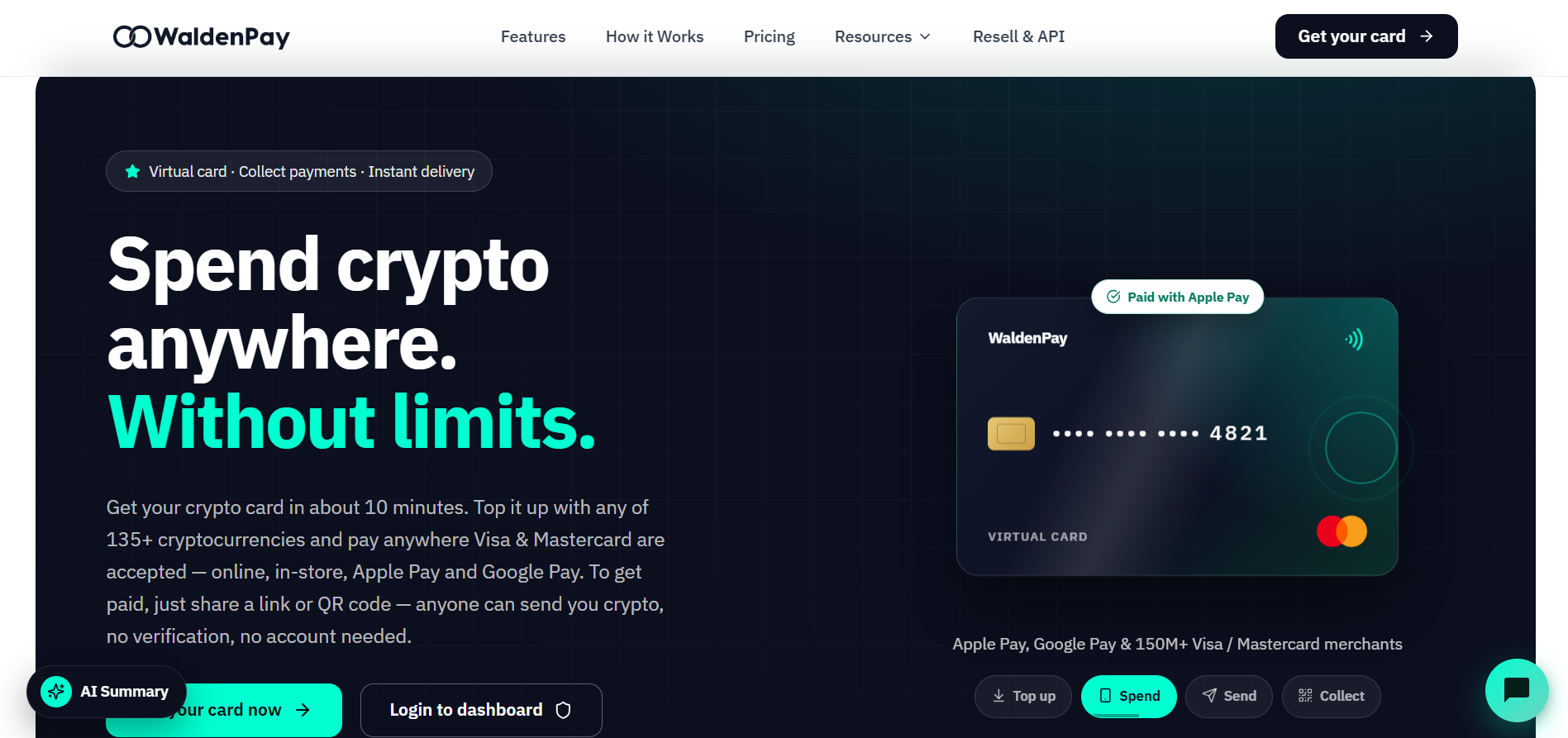

A checkout form asks for a card number, expiration date, and security code. The customer’s money sits in a crypto wallet instead of a checking account.
That gap is the practical starting point for WaldenPay: a virtual card platform converts cryptocurrency into a balance that can be spent through established card networks.
But paying a merchant, transferring money to another user, and collecting a customer’s payment are separate services, with different costs.
Everyday spending options for crypto holders
The first decision concerns the route from digital assets to a purchase. A standalone virtual card platform accepts cryptocurrency funding and provides card details.
An exchange-linked card connects spending to an exchange relationship, with conversion and funding mechanics determined by that provider.
Selling crypto and withdrawing the proceeds to a bank account takes a different route. It separates the crypto sale from subsequent spending through an existing bank card.
None is automatically the best choice. The useful comparison is between the steps, fees, and account relationships each route requires.
| Profile | Likely best fit | What to check |
|---|---|---|
| Holder needing card access | Crypto-funded virtual card | Loading costs and eligibility |
| Active exchange customer | Exchange-linked card | Funding and conversion timing |
| Privacy-conscious spender | Email-signup card option | Documents and transaction records |
| Freelancer collecting crypto | Payment-request platform | Payer fees and receipt amount |
| Business using bank payments | Sale and bank withdrawal | Withdrawal terms and timing |
The platform examined here supports 135+ cryptocurrencies across 35+ networks, converting funds into card balance at loading time. That timing matters: subsequent purchases draw on the loaded balance rather than requiring a new crypto sale at every checkout.
For a holder who already has a suitable exchange account or bank withdrawal route, a separate card needs to justify its additional cost.
If a holder is choosing a platform, then identify the operator first
A useful starting point when assessing a platform is the company behind the interface. Its operator is BlueHouse Software B.V., based in Rotterdam, Netherlands, and it operates through a licensed partner model.
That separates the software operator from the partner arrangements supporting the card service. The operator’s name identifies the business running the platform; the partner model describes how it delivers financial functionality. It doesn’t establish that the software company holds every license involved itself.
Among cryptocurrency payment platforms, WaldenPay’s crypto virtual card illustrates the standalone approach: cryptocurrency enters the service, becomes card balance when loaded, and is spent through Visa/Mastercard rails. Cards are issued instantly after funding, with setup measured in minutes.
The published reach of 150M+ merchants describes card acceptance, not the company’s customer count. Likewise, support for 135+ cryptocurrencies measures funding breadth, not adoption or revenue.
This distinction matters on a company-history site. Product availability, corporate identity, and business growth are different subjects; broad network access doesn’t establish a founding story, transaction volume, or market share.
No KYC crypto cards: signup requirements and privacy
“No KYC crypto card” usually expresses a concrete preference: opening a spending account without uploading identity documents. For standard use, this platform requires an email address at signup and no identity documents.
That can reduce onboarding friction for someone who wants to spend existing crypto holdings. It isn’t the same as anonymous spending.
An email-based account, a funded balance, and card transactions still involve records. The accurate distinction is between avoiding document submission during standard signup and making a payment that cannot be associated with an account.
The Telegram bot offers another practical convenience. It handles card orders, recharges, balance checks, and transaction alerts, reducing the need to manage routine actions through a support inbox.
But a chat interface doesn’t erase the underlying payment trail. Its value lies in account management, not invisibility.
For a U.S. reader, access also deserves a separate check. Acceptance at an American merchant and eligibility to open an account as an American resident are different questions, so residency eligibility should be confirmed before funding.
The strongest reason to consider this model is therefore lighter standard onboarding combined with usable card access, rather than a promise of untraceable purchases.
If a privacy-conscious spender needs checkout access, then follow the funding sequence
The funding sequence hinges on when cryptocurrency stops being the spending asset. Conversion happens when funds load onto the card, not when a merchant submits a purchase.
The account wallet provides unique deposit addresses for each supported network. Selecting the intended network is therefore a distinct step before funding, rather than an incidental detail attached to a token’s name.
- Register with an email address and check account eligibility.
- Select the supported cryptocurrency and network for the deposit.
- Review the card creation charge and current top-up fee before loading.
- Use the issued card details online or add the card to Apple Pay or Google Pay for supported checkout use.
The minimum card top-up is $50, and card creation costs $10 once. Those amounts make a small trial meaningfully different from opening a free account and merely checking its balance.
After loading, the balance is available for card spending. A merchant receives a card payment rather than needing to accept the customer’s original cryptocurrency.
That is the product’s central bridge: crypto funding on one side, familiar checkout methods on the other.
If a freelancer needs customer receipts, then use payment requests rather than card funding
For freelancers, the platform’s uses extend beyond spending earnings. Collect Payments creates a request for a fixed USD amount between $1 and $10,000, adds a description, and turns it into a shareable link or QR code.
The customer can pay with any supported cryptocurrency across the supported networks without opening an account. The creator receives the exact requested USD amount in the account wallet, while the payer covers the published 0.2% conversion fee.
Consider an illustrative $800 request for editing services. The freelancer receives $800 in wallet balance, and the stated 0.2% payer-side fee equals $1.60.
That charge belongs to payment collection. It is separate from the card top-up fee that applies if the freelancer subsequently loads funds onto a card.
Underpayments are tracked, with a fresh address generated for the remainder. Incomplete payments are automatically refunded to the payer’s wallet.
These crypto payment links can also suit a market vendor displaying a QR code or a seller requesting payment remotely. Their distinguishing feature is the fixed amount received, rather than making each customer calculate and negotiate a crypto-denominated invoice.
If a freelancer is paying another platform user, then separate transfers from collection
An internal balance transfer serves a different purpose. Send to Friend moves funds between existing users by the recipient’s email address, without requiring a wallet address or a blockchain transaction.
It is an internal ledger transfer that arrives in seconds and carries no transfer fee. The sender sees a recipient-name preview and confirms each transfer with a password.
Limits are $1 minimum, $10,000 per transfer, and $20,000 per rolling 24 hours. Those boundaries belong to this transfer workflow, not to card top-ups or payment requests.
An illustrative freelancer sending $250 to a collaborator who already uses the platform can use this internal route. A customer who has never registered would instead be better served by a payment request.
- If both parties already hold platform accounts, then an email-based balance transfer avoids a blockchain transfer step.
- If a customer needs to pay without registering, then a payment link or QR code fits that collection task.
- If the recipient needs to pay a card-accepting merchant, then card funding is a separate decision with its own fee.
Zero-fee transfers therefore shouldn’t be read as zero-fee card spending. Each service moves money across a different boundary.
If a small business funds recurring spending, then price the actual loading tier
Published crypto card fees begin with a $10 one-time creation charge, no monthly maintenance fee, and a top-up fee starting at 5%. Registration, balance checks, and support are free.
The lowest published top-up rate isn’t the default. Automatic discounts depend on rolling 30-day card spend, rather than the amount deposited into the account wallet.
The starting rate is 5% below $2,000 in qualifying spend. It falls to 4.75% from $2,000, 4.5% from $5,000, 4.25% from $10,000, 4% from $25,000, 3.5% from $50,000, and 3% from $100,000; businesses spending $250,000 or more monthly can obtain individual pricing.
Discounts apply instantly without an application. The dashboard shows the current fee, rolling spend, and progress toward the next level.
For an illustrative $1,000 amount subject to the top-up fee, 5% equals $50, while 4.5% equals $45. The difference is $5, but the lower rate requires the relevant spending threshold.
A business evaluating software subscriptions or advertising purchases can use the virtual card features and fees guide to compare these charges with the tools it actually needs.
Price the spending already expected, rather than spending more simply to qualify for a discount.
If a small business is choosing a long-term provider, then examine the business model
The platform’s published charges distinguish card issuance, card loading, and customer payment collection. Internal user transfers have no fee, while the payment-request conversion charge falls on the payer.
Those terms describe customer-facing costs. They don’t disclose profit margins or the division of revenue between the operator and its partners.
The company also offers a partner API, referral links, and a white-label Telegram bot with a configurable 0-20% markup. Partner commissions are paid in USDT.
These distribution options help explain crypto card business models beyond the consumer-facing app. A platform can distribute its service directly and through other businesses, so a partner offering deserves its own cost comparison rather than an assumption that every interface has identical economics.
For a small company, the appropriate route follows the job. Collecting customer receipts, paying collaborators, and funding merchant purchases should be assessed separately, even when a single platform supports all three.
An existing exchange-linked card may suit an established exchange customer better, while selling crypto and withdrawing to a bank may fit businesses whose obligations are mainly bank payments.
When choosing a provider, a business should check residency eligibility, the operator and partner arrangement, its current loading tier, and who pays the fee at each step.
