

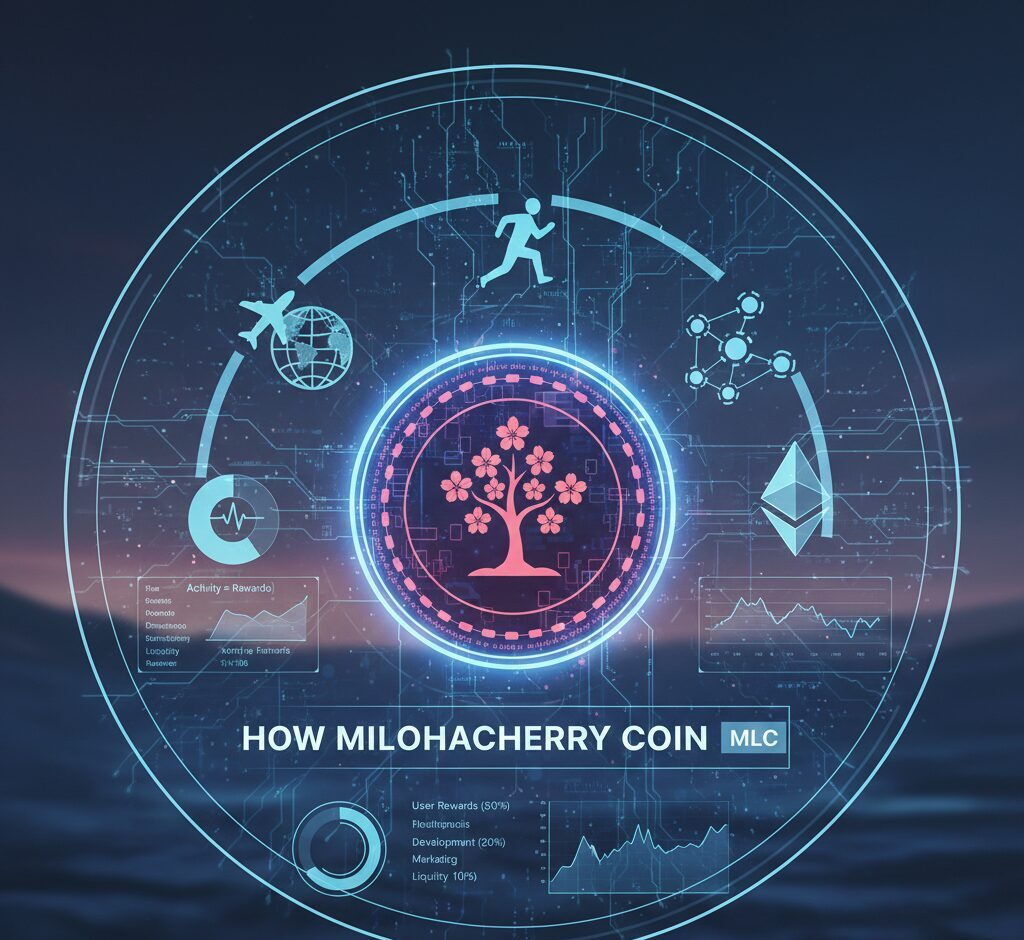
Milohacherry Coin (MLC) is a proof-of-stake cryptocurrency that rewards users for travel and fitness activities. Built on Ethereum-compatible blockchain infrastructure, MLC operates with a capped supply of 100 million tokens distributed across user rewards, development, and liquidity pools. Here is how Milohacherry Coin operates and what investors should evaluate before committing funds.
What Is Milohacherry Coin and How Did It Start
Milohacherry Coin launched as a lifestyle-oriented digital token targeting users who want to earn crypto through real-world activity rather than pure trading. The project was created to address a gap in the token market: most cryptocurrencies at the time had no practical use beyond speculation.
MLC’s founders designed the token around three pillars: travel rewards, fitness tracking, and community governance. Users earn tokens by booking trips through partner services, completing workout milestones, or participating in cultural events verified through mobile apps. For context on how major crypto exchanges have scaled their own token economies, the history of Binance offers a useful comparison point.
How Milohacherry Coin Blockchain Technology Works
Milohacherry Coin runs on an Ethereum-compatible blockchain using a proof-of-stake (PoS) consensus mechanism. Validators lock up MLC tokens as collateral to confirm transactions. If a validator approves fraudulent activity, they lose their staked tokens. This financial penalty keeps the network honest.
Smart contracts handle reward distribution, staking payouts, and governance voting automatically. No manual intervention is required. Each transaction is recorded on a public ledger, and the Ethereum compatibility means developers can build decentralized apps using standard tools.
PoS networks consume roughly 99.5% less energy than proof-of-work systems like Bitcoin. This gives Milohacherry Coin a lower environmental footprint, which matters as regulators scrutinize energy use across the crypto sector.
Milohacherry Coin Token Economics and Supply Distribution
MLC has a fixed supply of 100 million tokens. The allocation is split across five categories, with the largest share reserved for user rewards earned through verified activity.
The 50% user rewards allocation is the largest segment. This portion flows to holders who complete qualifying travel bookings, fitness challenges, or community participation tasks. A 20% share goes toward community and partner development. Marketing receives 15%, liquidity pools get 10%, and 5% stays in reserves.
The capped supply creates scarcity. As participation grows and token demand rises, basic supply-demand dynamics put upward pressure on price. But this remains theoretical until adoption reaches meaningful scale. Traditional payment companies like Visa took decades to build the transaction volumes that sustain their business models.
Milohacherry Coin Use Cases Beyond Trading
MLC was designed for more than exchange-based trading. Reported use cases include payments for partner services, governance voting, staking rewards, and access to members-only platform features.
The travel reward component works through partnerships with hotels, airlines, and tour operators. When a user books a service through a participating partner, they receive MLC tokens. The fitness side follows a similar pattern: users connect fitness trackers or apps and earn tokens based on verified activity like running, cycling, or gym workouts.
These earned tokens can then be used for discounts on future bookings, swapped for other digital assets, or held as investments. The model resembles loyalty programs run by major consumer brands. Companies like Nike and Adidas have experimented with similar blockchain-integrated reward systems in recent years.
Milohacherry Coin Governance and Holder Voting Rights
MLC holders can vote on protocol upgrades, development priorities, and resource allocation decisions. This governance model distributes decision-making power among participants rather than concentrating it in a core team.
Token holders who stake larger amounts typically receive greater voting weight. This structure mirrors shareholder voting at public companies, where equity ownership determines influence over corporate direction.
Milohacherry Coin Security Measures and Audit Status
| Security Layer | Implementation |
|---|---|
| Smart Contract Audits | Third-party review (details not publicly verified) |
| Transaction Ledger | Publicly viewable on-chain records |
| Consensus Method | Proof-of-Stake with validator penalties |
| Wallet Compatibility | MetaMask, Trust Wallet, and other Ethereum-compatible providers |
The project claims third-party smart contract audits, though independent verification of audit reports remains limited. Investors should confirm audit details through official project channels before committing capital. The broader payments industry, including companies like PayPal, has faced its own security challenges when scaling crypto-integrated services.
Milohacherry Coin vs Other Move-to-Earn Tokens
MLC enters a competitive sector. Over 30 move-to-earn projects were listed on major tracking platforms as of 2024, according to CoinGecko data. The combined market cap of the move-to-earn segment ranged between $125 million and $700 million during that period.
STEPN reached a peak market cap above $4 billion in 2022 before dropping more than 90%. Sweatcoin transitioned from a traditional app to blockchain that same year. MLC differentiates by combining both travel and fitness in a single token rather than focusing on one vertical.
Risks of Investing in Milohacherry Coin
Several risks apply to MLC, the same as with any early-stage crypto project. Market swings can erase value quickly. The reward system depends entirely on real partnerships materializing and functioning properly. Many crypto projects announce partnerships that never produce tangible results.
Regulatory shifts present another concern. Governments worldwide continue to develop and revise digital asset laws. These changes could affect how MLC operates or whether it can offer certain services in specific jurisdictions. When analyzing risk profiles for newer tokens, cross-referencing the financial histories of established technology firms can add perspective. The corporate profile of Google’s parent company Alphabet shows how even well-funded tech ventures carry regulatory and market risk.
The founding team behind MLC has not been widely publicized, which raises transparency questions. Investors should treat any commitment as high-risk and allocate only what they can afford to lose.
Milohacherry Coin Roadmap and Future Development
The project’s roadmap includes planned upgrades such as cross-chain compatibility with Solana, Polygon, and Binance Smart Chain. Future phases reportedly cover NFT reward integrations, expanded partner networks, and deeper DeFi protocol access.
Long-term viability depends on whether the team can execute these upgrades on schedule and maintain community trust. Steady progress toward stated goals builds investor confidence, while missed deadlines or scope changes tend to erode it.
FAQs
What is Milohacherry Coin used for?
Milohacherry Coin is used for travel and fitness rewards, governance voting, staking, and payments within its partner network. Users earn MLC tokens through verified real-world activities.
How does Milohacherry Coin operate on the blockchain?
MLC operates on an Ethereum-compatible blockchain using proof-of-stake consensus. Smart contracts automate reward distribution and transaction validation without intermediaries.
What is the total supply of Milohacherry Coin?
Milohacherry Coin has a fixed total supply of 100 million tokens. 50% is allocated to user rewards, with the rest split among development, marketing, liquidity, and reserves.
Is Milohacherry Coin a safe investment?
No cryptocurrency investment is risk-free. MLC carries risks including market volatility, regulatory uncertainty, unverified team identity, and partnership dependency. Research thoroughly before investing.
Where can I buy Milohacherry Coin?
MLC may be available on select cryptocurrency exchanges. Users should verify listings through official project channels and store tokens in compatible wallets like MetaMask or Trust Wallet.
