


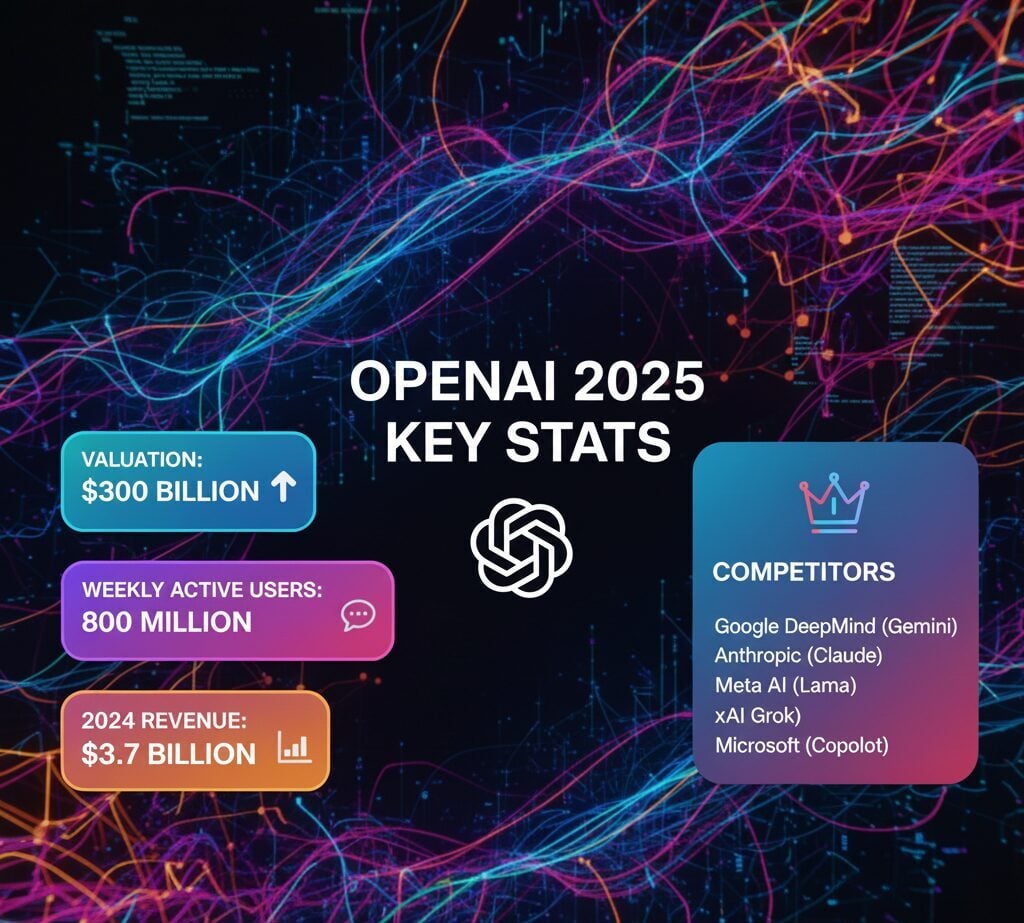
Key Stats
OpenAI stands as the leading artificial intelligence research organization that transformed public perception of AI capabilities. The company develops advanced AI systems including ChatGPT, DALL-E, and GPT models that power applications across industries worldwide.
Founded in 2015 as a nonprofit research lab, the organization evolved into a hybrid structure combining nonprofit governance with a for-profit subsidiary. This transformation enabled massive capital raising while maintaining its mission to ensure artificial general intelligence benefits humanity.
The launch of ChatGPT in November 2022 marked a watershed moment for consumer AI adoption. Within months, the conversational AI tool became the fastest-growing consumer application in history. The company now serves hundreds of millions of users globally through its consumer products and developer APIs, competing with tech giants like Google in the AI race.
OpenAI History
OpenAI was founded in San Francisco by Sam Altman, Elon Musk, Greg Brockman, Ilya Sutskever, and others with $1 billion in pledged funding as a nonprofit research organization.
Elon Musk departed from the board citing potential conflicts of interest with Tesla’s AI development, though later reports suggested internal disagreements over control and direction.
The organization introduced a capped-profit structure called OpenAI LP to raise capital needed for expensive AI research. Sam Altman became CEO to lead this transition.
Microsoft invested $1 billion and became OpenAI’s exclusive cloud computing provider through Azure, establishing a partnership that would define both companies’ AI strategies.
GPT-3 was released with 175 billion parameters, demonstrating unprecedented language generation capabilities and becoming the foundation for numerous AI applications.
ChatGPT launched publicly and reached 1 million users within five days, becoming the fastest-growing consumer application in history and sparking global AI adoption.
GPT-4 was released with multimodal capabilities, accepting both text and images as input and scoring in the top 10% on the bar exam.
Sam Altman was briefly removed as CEO by the board, only to be reinstated five days later after employee backlash and pressure from Microsoft.
OpenAI announced The Stargate Project with Oracle and SoftBank, a $500 billion joint venture to build AI infrastructure systems with the U.S. government.
The company acquired iO, the AI hardware startup founded by Jony Ive, for $6.5 billion to enter the consumer hardware market.
OpenAI completed its restructuring into a public benefit corporation with Microsoft holding 27% stake and the nonprofit foundation retaining 26%.
OpenAI Co-founders
Former president of Y Combinator who became CEO in 2019. He transformed OpenAI from research lab to commercial powerhouse while maintaining focus on beneficial AI development.
Former CTO of Stripe who serves as president and chairman. He leads technical strategy and played a key role in developing GPT models.
Former Google Brain researcher who served as chief scientist until 2024. He pioneered key innovations including reinforcement learning from human feedback.
Tesla and SpaceX CEO who co-founded the organization but departed in 2018. He contributed over $44 million in early funding before leaving the board.
AI researcher who developed key reinforcement learning algorithms. He left in 2024 to join Anthropic, a competitor founded by former OpenAI employees.
OpenAI Revenue
The company experienced explosive revenue growth from its consumer products and enterprise services. ChatGPT subscriptions and API access drive the majority of income.
OpenAI Competitors
The AI landscape features intense competition from tech giants and specialized startups. Each competitor brings unique strengths in research, infrastructure, or market positioning that challenges OpenAI’s dominance.
| Company | Key Product | Backing |
|---|---|---|
| Google DeepMind | Gemini | Alphabet |
| Anthropic | Claude | Amazon, Google |
| Meta AI | Llama | Meta Platforms |
| xAI | Grok | Elon Musk |
| Microsoft | Copilot | Internal |
| Cohere | Command | Independent |
| Mistral AI | Mistral | European VCs |
| AI21 Labs | Jurassic | Independent |
| Hugging Face | Open Source Models | Independent |
| Baidu | ERNIE | Baidu |
OpenAI Acquisitions
The company accelerated its acquisition strategy in 2024 and 2025 to expand capabilities and enter new markets. These purchases signal a shift toward vertical integration and hardware ambitions beyond pure software development.
The largest deal came in May 2025 when the organization acquired iO, the AI hardware startup founded by legendary Apple designer Jony Ive. The $6.5 billion all-stock transaction brought Ive and his team of former Apple designers to lead hardware development. This marked entry into consumer devices after years focused purely on software.
In September 2025, the company purchased Statsig for $1.1 billion to strengthen product development and experimentation capabilities. The acquisition brought advanced A/B testing and feature management tools to accelerate internal development cycles. Similar to how Roper Technologies expanded through strategic software acquisitions, this deal enhanced technical infrastructure.
The Windsurf acquisition for approximately $3 billion in May 2025 added AI-assisted coding capabilities. This purchase positioned the company to compete directly with GitHub Copilot and other developer tools in the rapidly growing AI coding assistant market.
In August 2023, the organization acquired Global Illumination, a New York-based startup deploying AI for digital infrastructure and creative tools. The entire team joined to work on core products including ChatGPT and DALL-E enhancements. The move paralleled how major technology companies acquire specialized talent and capabilities.
Multi, a startup focused on remote collaboration tools, was acquired in June 2024. The technology enables better screen sharing and collaborative work sessions. This acquisition supported the enterprise push for ChatGPT Team and Enterprise products.
Most recently in October 2025, Software Applications Incorporated became part of the company. The twelve-person team had built Sky, an AI interface for Mac computers that acts as a natural language assistant. This acquisition strengthened consumer desktop capabilities and signaled deeper integration with Apple ecosystems.
Context.ai, a customer success management platform, joined in an earlier acquisition to improve enterprise customer relationships. The pattern mirrors acquisition strategies used by established firms like CGI Group that build through both organic growth and strategic purchases.
These strategic purchases demonstrate evolution from pure research toward building a complete AI platform. The moves into hardware, developer tools, and enterprise software create new revenue streams. They also reduce dependence on partners like Google and Apple for distribution channels.
OpenAI Market Cap
The company reached a $300 billion valuation in 2025, making it one of the most valuable private technology companies globally. This valuation places it behind only SpaceX among private firms and ahead of established public companies in the technology sector.
FAQs
Who owns OpenAI?
OpenAI operates as a public benefit corporation controlled by the nonprofit OpenAI Foundation which holds 26% equity. Microsoft owns 27%, with remaining shares held by employees and investors including SoftBank.
When was ChatGPT released?
ChatGPT launched on November 30, 2022. The conversational AI tool reached 1 million users within five days and 100 million users within two months of launch.
What is OpenAI’s mission?
The organization aims to ensure artificial general intelligence benefits all humanity. It focuses on developing safe and beneficial AI systems while making powerful tools accessible to everyone.
How much is OpenAI worth?
OpenAI achieved a $300 billion valuation in 2025 following a $40 billion funding round. This makes it the highest valued private technology company after SpaceX.
What products does OpenAI offer?
OpenAI provides ChatGPT for conversations, GPT-4 API for developers, DALL-E for image generation, Whisper for speech recognition, and Sora for video creation. Products serve consumers, businesses, and developers.