

For most of human history, commerce was simple. You handed over coins or goods, the other side handed back something of equal value — no processing fees, no settlement windows, no intermediary taking a cut.
Then the twentieth century happened. And the act of payment itself became its own industry.
What we now call “merchant solutions” accumulated over roughly seven decades. Each era inherited the unsolved problems of the one before it. Here’s how that happened.
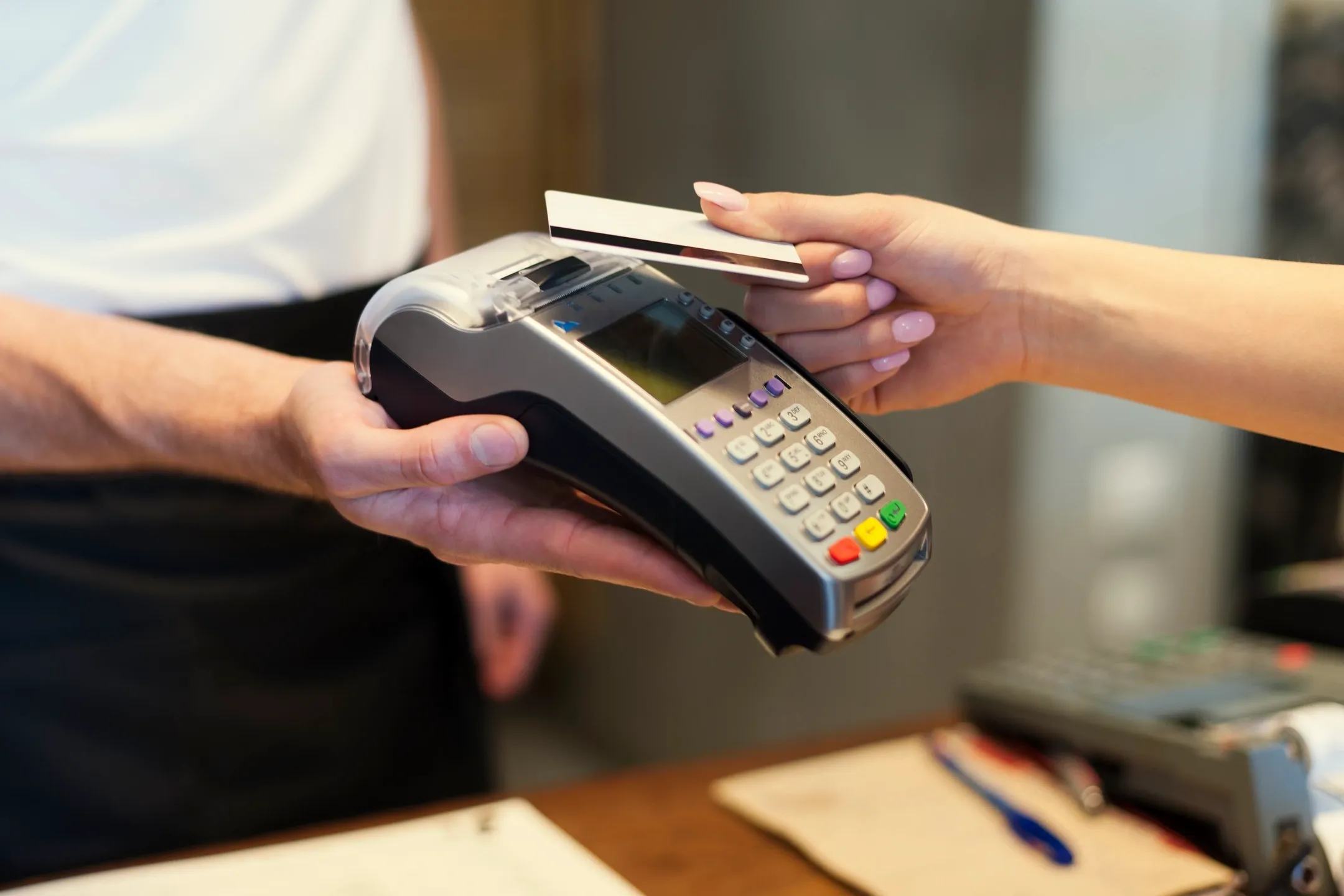
1950s–1960s: The Card and the Middleman
The Diners Club card, launched in 1950 by Frank McNamara, is where most histories start. Within a year it had tens of thousands of cardholders and merchant partners concentrated in New York.
What made it significant wasn’t the physical card — it was the three-party model underneath: a cardholder, a merchant, and a middleman absorbing the credit risk. Merchants paid a percentage. Cardholders paid an annual fee. The middleman took the margin.
This basic architecture proved remarkably durable. Decades later, its descendants are still running — from traditional acquiring banks down to newer conversion layers like crypto to fiat gateway services handling cross-border digital asset settlements. The middleman never really went away. The middleman just kept evolving.
Bank of America’s BankAmericard arrived in 1958 and added revolving credit. For merchants, that changed everything — a customer’s ability to pay right now was no longer their problem.
By the end of the 1960s, BankAmericard had been licensed to banks across the country and was on its way to becoming Visa. MasterCharge — later MasterCard — launched around the same time as a competing consortium.
The infrastructure these networks built during this decade set rules that lasted for generations:
- Authorization codes — a formal system for approving or declining transactions in real time
- Interchange fees — a percentage paid from the merchant’s bank to the cardholder’s bank on every transaction
- The four-party model — separating cardholder, merchant, issuing bank, and acquiring bank into distinct entities with distinct responsibilities
1970s–1980s: The End of the Knucklebuster
For most of the 1970s, accepting a card meant a mechanical imprinter — the “knucklebuster” — a carbon paper slip, and a phone call for authorization. When volumes were modest, fraud was manageable. As adoption grew, it became expensive.
The Magnetic Stripe Changes Everything
The magnetic stripe, standardized by IBM engineers working with Dee Hock — Visa’s founder — changed how cards communicated with readers.
Electronic point-of-sale terminals arrived in the late 1970s. VeriFone, founded in 1981, became the dominant terminal manufacturer of the era.
By the mid-1980s, electronic authorization had replaced most manual processes in high-volume retail. Settlement, which once took days and involved physical paperwork, became a batched overnight process. Merchants got funds faster. Banks got transaction data they’d never had access to before.
1990s: The Internet Arrives and Nobody Knows How to Take Payment Online
When the Web went commercial in the early 1990s, the first serious practical question wasn’t how to build websites — it was how to accept payment on them. Several attempts came and went:
- CyberCash (1994) — early digital wallet, struggled with adoption
- SET protocol (1996) — jointly developed by Visa and MasterCard, technically rigorous, practically unworkable
- First Virtual Holdings — tried processing card payments via email; interesting idea, wrong decade
What actually worked was simpler. PayPal emerged from the 1998 merger of Confinity and X.com and made online payment work by using email addresses as identifiers. No software installation, no certificate management.
Within a few years it had become the default payment layer for eBay — not because it was the most sophisticated solution, but because it was the most frictionless one.
2000s: Aggregators, APIs, and Small Business Access
Before 2010, accepting credit cards as a small merchant was genuinely difficult. A formal merchant account required bank underwriting, minimum volumes, and monthly fees. A freelance contractor or market stall vendor often simply didn’t qualify.
Square changed this in 2009 with a card reader that plugged into a smartphone’s headphone jack — flat fees, no long-term contract, no underwriting interview. For a huge segment of the small business market, card acceptance became accessible for the first time.
Stripe, launching publicly in 2011, solved the equivalent problem on the developer side. Its API cut card integration from weeks of bank negotiations to a few lines of code.
By the mid-2010s, a business could integrate payments, subscriptions, invoicing, and fraud detection through a single API provider without signing a single bank agreement.
2010s: Real-Time Rails and a Rethink of Settlement
Apple Pay and Google Pay brought NFC-based payments into mainstream U.S. consumer behavior, years after contactless had normalized across Europe. EMV chip cards arrived in America in 2015, shifting fraud liability to merchants who hadn’t upgraded terminals.
The more structurally significant shift happened at infrastructure level. Several countries rebuilt their national payment rails around real-time settlement:
| Country | System | Launched | Key Feature |
| United Kingdom | Faster Payments Service | 2008 | Seconds-level bank transfers |
| India | Unified Payments Interface | 2016 | QR-based, interoperable wallets |
| Brazil | PIX | 2020 | 24/7 instant transfers |
| European Union | SEPA Instant Credit Transfer | 2017 | Cross-border EUR real-time rail |
Real-time bank rails changed settlement economics in a way card networks structurally couldn’t match — no two-day float, no interchange on the transfer, funds available immediately.
2020s: Cross-Border Pressure and Hybrid Infrastructure
The shift toward digital asset infrastructure came less from technological breakthroughs than from a business case that became harder to ignore.
Cross-border commerce grew, wire transfer costs stayed high, and businesses started examining settlement rails that didn’t require correspondent banking chains.
Stablecoins (digital assets pegged to fiat currencies) became particularly relevant. Unlike volatile cryptocurrencies, their value stays stable between transaction initiation and settlement, making them practically usable for merchant settlement in cross-border scenarios.
Visa and Mastercard networks still span virtually every market on earth — these aren’t systems being phased out. What’s actually happening is layering. Merchants increasingly maintain parallel acceptance channels:
- Traditional card rails for familiar consumer checkout
- Real-time bank transfers for domestic high-volume transactions
- Mobile wallets integrated into platform ecosystems
- Digital asset settlement for cross-border and unbanked-market scenarios
Seven Decades, One Pattern
Every significant shift in merchant payment infrastructure came from someone identifying a friction point that existing systems couldn’t solve and building around it rather than through it.
Diners Club built around the friction of carrying cash. VeriFone built around manual authorization. Stripe built around bank underwriting requirements.
The current generation of real-time and digital-asset infrastructure is building around cross-border settlement cost and latency.
For merchants navigating payment infrastructure decisions today, the relevant question isn’t which technology is winning.
It’s which friction point costs the most and whether a mature solution for it already exists. Given the pace of the last decade, it usually does.
