

Key Stats
Assets Under Management
$12.53 Trillion
As of June 2025
Market Capitalization
$167.68 Billion
As of October 2025
Annual Revenue
$22.89 Billion
TTM September 2025
Total Employees
21,100
As of December 2024
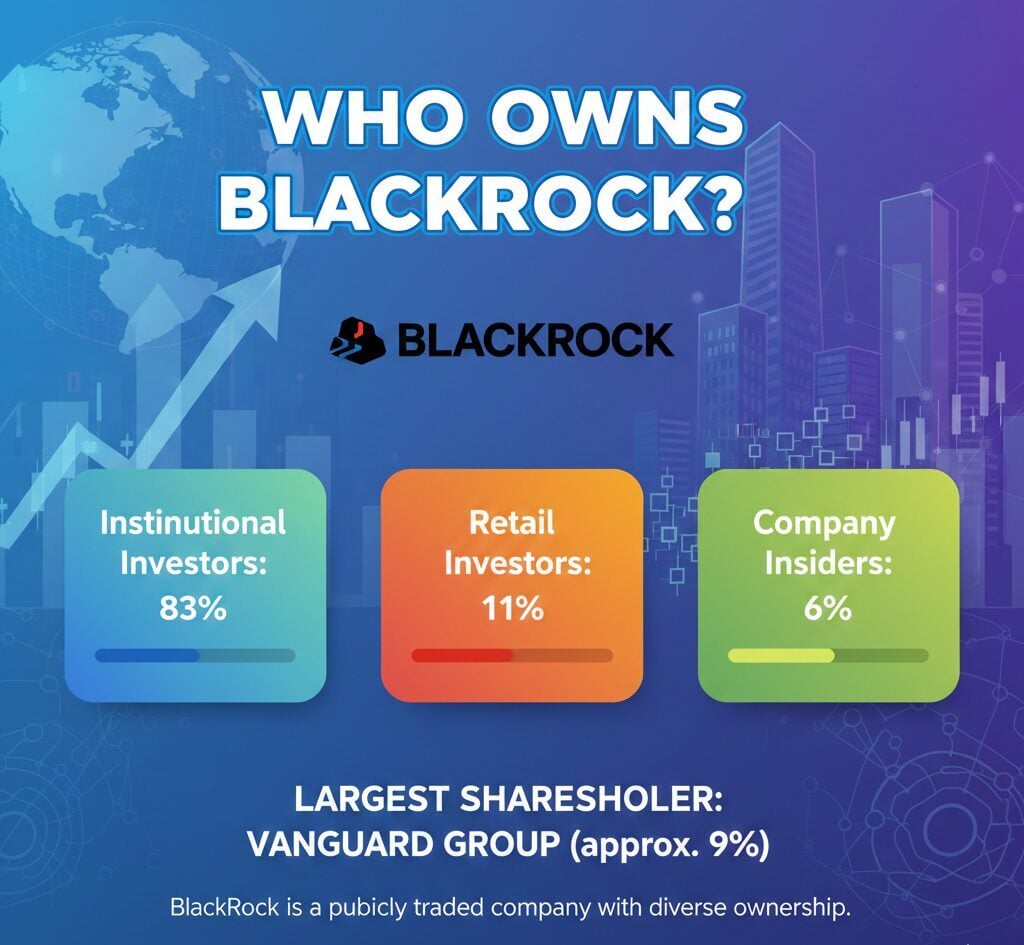
BlackRock is a publicly traded company listed on the New York Stock Exchange under the ticker symbol BLK. The asset management giant is owned by a diverse group of institutional investors and individual shareholders, with Vanguard Group holding the largest stake at approximately 9 percent of outstanding shares.
Founded in 1988 and headquartered in New York City, BlackRock has grown into the world’s largest asset manager with $12.53 trillion in assets under management as of June 2025. The company manages investments across multiple asset classes including equities, fixed income, alternatives, and real estate through its various platforms such as iShares exchange-traded funds and the Aladdin risk management system.
BlackRock’s revenue reached $22.89 billion for the twelve months ending September 2025, reflecting an 18.2 percent year-over-year increase. The company employs 21,100 people globally and maintains offices in 30 countries, serving clients in 100 countries worldwide.
Who Owns BlackRock?
BlackRock’s ownership structure consists primarily of institutional investors who collectively hold approximately 83 percent of the company’s shares. The remaining ownership is distributed among individual shareholders, including company founders, executives, and retail investors.
Institutional Ownership Structure
Institutional investors dominate BlackRock’s shareholder base, owning the vast majority of outstanding shares. These institutions include asset management firms, pension funds, sovereign wealth funds, and other financial organizations that hold shares on behalf of their clients. The concentration of institutional ownership means that major investment decisions and corporate governance matters are largely influenced by these large stakeholders rather than individual retail investors.
Public Trading Status
Since its initial public offering in 1999, BlackRock has traded on the New York Stock Exchange under the ticker BLK. The public nature of the company’s ownership means that anyone with a brokerage account can purchase shares and become a partial owner of the investment management firm. This dispersed ownership model subjects BlackRock to regulatory scrutiny from the Securities and Exchange Commission and requires regular disclosure of financial information and ownership changes.
Largest Shareholders of BlackRock
Vanguard Group maintains the position as BlackRock’s largest shareholder with approximately 9.04 percent ownership, representing around 13.9 million shares. As one of the Big Three index fund managers alongside BlackRock and State Street, Vanguard plays a central role in shaping BlackRock’s corporate governance through its significant voting power on strategic decisions, executive compensation, and policy matters.
State Street Corporation Holdings
State Street Corporation ranks as the second-largest institutional shareholder of BlackRock, holding approximately 6.2 percent of outstanding shares. The company’s substantial stake reflects the interconnected nature of the asset management industry, where major firms often hold significant positions in their competitors as part of their index fund strategies and client investment mandates.
Bank of America and Other Major Institutional Investors
Bank of America holds a significant position among BlackRock’s top shareholders, representing approximately 5.4 percent of shares outstanding. Other major institutional investors include Temasek Holdings, the investment arm of the Singaporean government, and Charles Schwab Corporation. These institutional holders acquired their positions through various investment vehicles including mutual funds, pension funds, and exchange-traded funds.
The top 16 shareholders control approximately 50 percent of BlackRock’s ownership, demonstrating the concentrated nature of voting power within the company. This concentration means that no single entity owns a majority stake, but collectively these large institutional investors significantly influence corporate decisions and strategic direction.
Individual Insider Ownership
Individual insiders own approximately 0.8 to 2.81 percent of BlackRock’s outstanding shares, valued at around $1.2 billion. Susan Wagner, a co-founder and board member who retired in 2012, holds the largest individual stake with approximately 427,887 shares valued at roughly $352.9 million, making her the largest individual BlackRock shareholder.
Laurence Fink, the co-founder and current Chairman and CEO, ranks as the second-largest individual owner. Despite his leadership position, Fink’s ownership stake represents less than 1 percent of total shares outstanding. His influence stems from his executive role rather than ownership percentage.
BlackRock Ownership Distribution
History of BlackRock Co-Founders
BlackRock was founded in 1988 by eight financial professionals who sought to revolutionize the asset management industry through technology-driven risk management. The founding team included Laurence Fink, Robert Kapito, Susan Wagner, Barbara Novick, Ben Golub, Hugh Frater, Ralph Schlosstein, and Keith Anderson.
Laurence Fink and Robert Kapito
Laurence Fink co-founded BlackRock after his experience at First Boston, where he specialized in mortgage-backed securities. His vision centered on creating an investment firm that prioritized risk management and transparency. Fink currently serves as Chairman and Chief Executive Officer, leading the firm’s global executive committee and driving its strategic direction.
Robert Kapito joined Fink as co-founder and currently holds the position of co-president. Together, Fink and Kapito established the foundational principles that guided BlackRock’s transformation from a small fixed income manager into the world’s largest asset manager. Their leadership emphasized technological innovation through platforms like Aladdin and strategic acquisitions that expanded BlackRock’s capabilities across asset classes and geographic markets.
Susan Wagner and Early Leadership Team
Susan Wagner played a critical role as one of BlackRock’s original eight founders and served as a director in the asset management company. Wagner retired from day-to-day operations in 2012 but has remained on the board of directors, continuing to provide strategic guidance. Her contributions during BlackRock’s formative years helped establish the firm’s operational framework and client-focused approach.
The collaborative vision of the founding team transformed the investment management landscape by integrating advanced technology with traditional asset management practices. Their approach of combining rigorous risk analysis with comprehensive investment solutions attracted institutional clients and positioned BlackRock for exponential growth through both organic expansion and strategic acquisitions throughout the 1990s and 2000s.
Who is on the Board of Directors for BlackRock?
BlackRock’s board of directors consists of 18 members, including 15 independent directors who provide oversight and strategic guidance to the company. The board composition reflects diverse expertise across finance, technology, corporate governance, and global business operations.
Executive Leadership on the Board
Laurence Fink serves as Chairman and Chief Executive Officer, representing management on the board alongside his operational responsibilities. As founder and long-time leader, Fink bridges executive decision-making with board oversight, ensuring alignment between day-to-day management and long-term strategic objectives.
Robert Kapito, co-founder and co-president, contributes operational expertise to board discussions regarding risk management, client relationships, and business development strategies. The presence of founding executives on the board maintains continuity with BlackRock’s original vision while adapting to evolving market conditions.
Independent Directors with Financial Expertise
Gregory Fleming joined the board in 2025 as an independent director, bringing extensive experience as Chief Executive Officer of Rockefeller Capital Management. His previous roles included President of Morgan Stanley Wealth Management and President and Chief Operating Officer of Merrill Lynch during critical periods of financial industry transformation.
Kathleen Murphy also joined as an independent director in 2025, contributing expertise from her tenure as President of Personal Investing at Fidelity Investments. Murphy’s background in wealth management and retail investing strategies provides valuable perspectives on client-facing business segments and digital transformation initiatives.
Directors with Technology and Innovation Background
Margaret Johnson serves on the board with experience in technology innovation and digital transformation. Her expertise helps BlackRock navigate the increasing integration of technology in financial services, including artificial intelligence applications, blockchain initiatives, and digital asset strategies.
The board includes directors with backgrounds in enterprise technology, cybersecurity, and data analytics who guide BlackRock’s investments in platforms like Aladdin and evaluate opportunities in emerging technologies that could reshape investment management practices.
Corporate Governance and Risk Management Specialists
William Ford brings corporate governance expertise to his board service, focusing on risk oversight, compliance frameworks, and stakeholder engagement. His experience helps ensure BlackRock maintains robust governance practices appropriate for its systemic importance in global financial markets.
The board’s governance structure emphasizes independent oversight of management decisions, particularly regarding compensation, audit functions, and strategic initiatives. Several directors serve on specialized committees addressing risk management, investment stewardship, and regulatory compliance matters.
Directors with Global Business Experience
Cheryl Mills contributes international business perspectives from her career spanning both public service and private sector leadership roles. Her experience in navigating complex regulatory environments and stakeholder relationships supports BlackRock’s operations across multiple jurisdictions.
The board composition reflects geographic diversity with directors having operational experience in North America, Europe, Asia, and emerging markets. This global representation helps BlackRock adapt strategies to regional market dynamics while maintaining consistent investment principles and risk management standards across its worldwide operations.
BlackRock Assets Under Management Growth
FAQs
Is BlackRock owned by a single person or entity?
No, BlackRock is a publicly traded company with no single majority owner. Vanguard Group holds the largest stake at approximately 9 percent of outstanding shares.
How much of BlackRock does Larry Fink own?
Larry Fink owns less than 1 percent of BlackRock’s total shares despite his role as co-founder, Chairman, and CEO. His influence comes from leadership rather than ownership percentage.
When did BlackRock become a public company?
BlackRock completed its initial public offering in 1999 and has traded on the New York Stock Exchange under ticker symbol BLK since then.
Who are the largest institutional shareholders of BlackRock?
The largest institutional shareholders include Vanguard Group with 9 percent, State Street Corporation with 6.2 percent, and Bank of America with 5.4 percent of outstanding shares.
Does BlackRock own other asset management companies?
BlackRock has acquired numerous asset management firms throughout its history, including Barclays Global Investors in 2009, Global Infrastructure Partners in 2024, and Preqin in 2024. The company also manages iShares, the world’s largest provider of exchange-traded funds, and operates through subsidiaries including BlackRock Solutions and various regional entities across North America, Europe, and Asia serving institutional and retail clients globally similar to other major financial institutions like AMP and technology-driven platforms.
