


Key Stats
Nissan is publicly traded on the Tokyo Stock Exchange (TYO: 7201) with a market cap near JPY 3–4 trillion as of mid-2025.
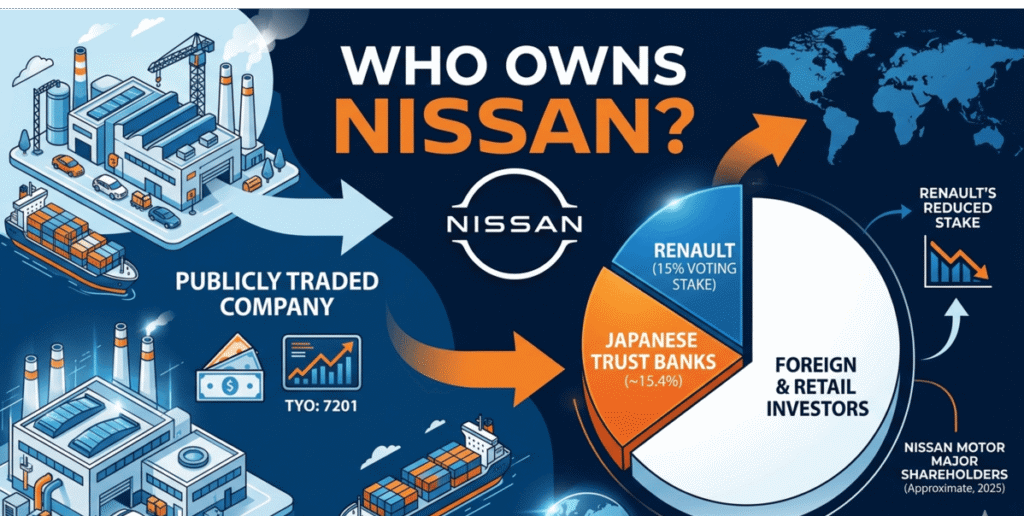
Renault holds a 15% voting stake following the 2023–2024 Alliance Reset; an additional ~18.8% sits in a French trust for phased sell-down.
Nissan posted net revenue of 12.6 trillion yen in fiscal year 2024, with a net loss of 670.9 billion yen.
The company sold 3.346 million vehicles globally and employs roughly 133,000 people across its operations.
Nissan Motor Company is a publicly traded corporation with no single controlling owner. Renault is the largest identified shareholder at 15%, but it no longer holds majority voting power. Japanese trust banks, foreign institutions, and retail investors hold the rest.
Headquartered in Yokohama, Japan, Nissan is one of the world’s largest automakers and a member of the Renault-Nissan-Mitsubishi Alliance. Ivan Espinosa took over as CEO in April 2025, replacing Makoto Uchida amid a steep financial downturn. Espinosa has launched the “Re:Nissan” turnaround plan, targeting 500 billion yen in cost reductions, cutting the workforce by roughly 20,000, and consolidating production from 17 plants to 10. Nissan also owns the Infiniti luxury brand and held a 24% stake in Mitsubishi Motors as of late 2024.
Who Owns Nissan Motor Company?
No single entity controls Nissan. The company trades on the Tokyo Stock Exchange under a one-share-one-vote system with no dual-class shares or golden shares. Renault’s 15% stake makes it the largest single shareholder, but institutional investors and trust banks collectively hold far more.
Renault’s Reduced Stake
For over two decades, Renault held roughly 43.4% of Nissan with full voting rights — a legacy of its 1999 bailout of the nearly bankrupt Japanese automaker. That changed in 2023–2024 when both companies agreed to equalize their cross-shareholdings at 15% each. Renault placed the excess ~28% of its Nissan shares into a French trust managed by Natixis, with those shares being sold off gradually. As of mid-2025, Renault’s total economic interest (direct stake plus trust holdings) is closer to 35%, but its voting rights are limited to 15%.
Nissan’s Cross-Holdings
Nissan reciprocally holds 15% of Renault — and unlike before, those shares now carry voting rights after the 2024 reset. In March 2025, the companies agreed to further reduce cross-shareholdings to 10% each, with Nissan planning to sell 5% of its Renault stake and reinvest the proceeds in vehicle development. Nissan also reduced its Mitsubishi Motors stake from 34% to 24% in November 2024.
History of Nissan Motor Company Founders
From Kaishinsha to the Nissan Zaibatsu
Nissan’s roots go back to 1911, when Masujiro Hashimoto founded Kaishinsha Motor Car Works in Tokyo. By 1914, the company produced its first car, the DAT — named after the initials of its three investors. The company went through several reorganizations before merging into Jidosha-Seizo Co., Ltd. in 1933.
In 1934, Yoshisuke Aikawa, head of the Nihon Sangyo (“Nissan”) holding company, consolidated these automotive assets under the Nissan Motor name. Early exports carried the Datsun brand to distinguish them from vehicles sold domestically. Aikawa’s zaibatsu model meant ownership rested with a network of holding companies and affiliated banks rather than individual founders.
Postwar Dissolution and the Road to Renault
After World War II, Allied occupation forces broke up Japan’s zaibatsu conglomerates. Nissan’s ownership dispersed into public shareholders, and the company eventually listed on the Tokyo Stock Exchange. By the late 1990s, Nissan was drowning in debt while rivals like Toyota continued to grow. Renault stepped in with a 600-billion-yen investment in 1999, acquiring a 36.8% stake and sending Carlos Ghosn to execute a turnaround. Ghosn’s “Nissan Revival Plan” cut 20,000 jobs and closed five plants — a blueprint that Espinosa’s Re:Nissan plan echoes today. The Ghosn era ended abruptly in 2018 when he was arrested in Tokyo on financial misconduct charges, triggering governance reforms that reshaped the board.
Largest Shareholders of Nissan Motor
Nissan’s shareholder registry is typical of large Japanese exporters: a mix of Japanese trust banks acting as custodians, foreign institutional investors, and retail shareholders.
Nissan Motor Major Shareholders (Approximate, 2025)
Japanese Trust Banks and Custodians
The Master Trust Bank of Japan and Custody Bank of Japan are the two largest holders after Renault. These are nominee accounts — they hold shares on behalf of pension funds, mutual funds, and other institutional clients. Their combined position of roughly 15% gives them more economic exposure to Nissan than Renault itself, though the underlying beneficial owners are dispersed.
Foreign and Retail Investors
Foreign institutions typically account for 35–45% of the free float in large Japanese exporters. For Nissan, that includes global custodians like JPMorgan and passive index funds. Retail investors in Japan hold a meaningful minority, and domestic corporates like Mitsubishi Heavy Industries and other keiretsu-linked firms retain smaller legacy positions. The ongoing sell-down of Renault’s trust-held shares continues to increase the free float, drawing in more passive capital.
Who Is on the Board of Directors for Nissan?
Nissan’s board has 12 members as of June 2025. Eight are independent outside directors — a majority that was mandated by governance reforms following the Ghosn crisis. The company uses a committee-based structure with separate Audit, Compensation, and Nomination committees, each chaired by an independent director.
Board Chairman and Independent Directors
Yasushi Kimura chairs the board as an independent outside director. He previously served as chairman of JXTG Holdings (now ENEOS). Bernard Delmas, formerly a senior executive at Michelin, is the lead independent director. Other independents include Keiko Ihara (chair of the Compensation Committee), Motoo Nagai (chair of the Audit Committee), and Andrew House, the former CEO of Sony Interactive Entertainment, who chairs the Nomination Committee.
Executive Directors and Alliance Representatives
CEO Ivan Espinosa and CTO Eiichi Akashi sit on the board as executive directors. Renault nominates two directors — Valerie Landon and Timothy Ryan — though both are subject to Nissan’s independence standards and must recuse themselves from votes involving conflicts of interest with the alliance. Espinosa, a 20-year Nissan veteran who started in product planning at Nissan’s Mexico operations, has been reshaping the senior leadership team as part of the Re:Nissan recovery effort.
Nissan Board Composition (12 Members)
FAQs
Who owns Nissan Motor Company?
Nissan is a publicly traded company on the Tokyo Stock Exchange. Renault is the largest single shareholder at 15%, with Japanese trust banks and foreign institutions holding the rest.
Does Renault still control Nissan?
No. Renault reduced its voting stake from 43.4% to 15% in 2023–2024. The two companies now hold equal 15% cross-shareholdings with mutual voting rights.
Who is the CEO of Nissan?
Ivan Espinosa became CEO in April 2025, replacing Makoto Uchida. He launched the Re: Nissan turnaround plan to restore profitability by fiscal year 2026.
Who founded Nissan?
Nissan traces back to Masujiro Hashimoto’s Kaishinsha Motor Car Works in 1911. Yoshisuke Aikawa formally consolidated the company as Nissan Motor in 1934.
Did Nissan merge with Honda?
No. Nissan and Honda announced merger talks in December 2024 but abandoned them in February 2025 after disagreements over whether Nissan would become a subsidiary.