


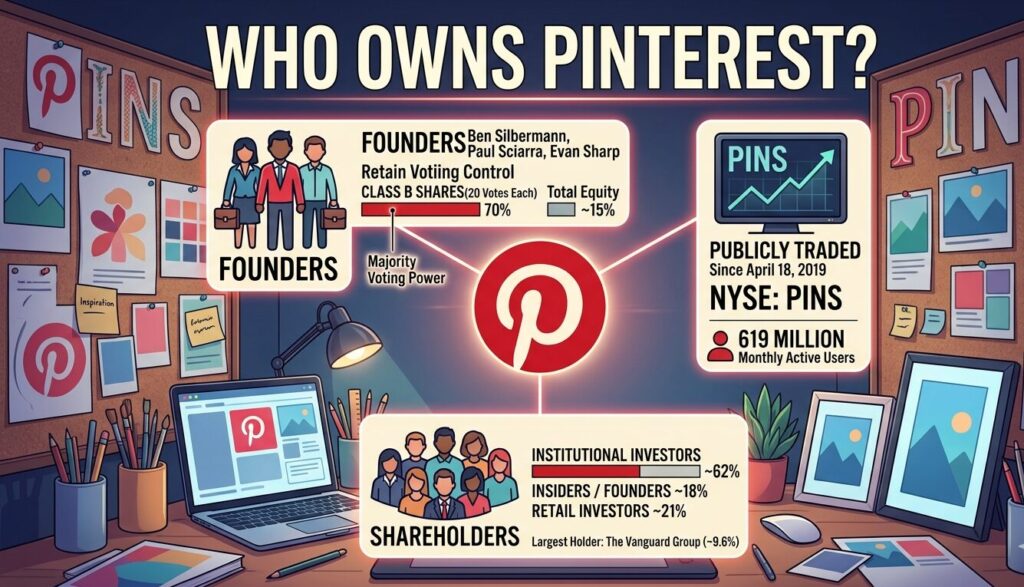
Founded in March 2010 by Ben Silbermann, Paul Sciarra, and Evan Sharp. Went public on the NYSE on April 18, 2019, under ticker PINS.
Founders retain control through a dual-class share structure. Class B shares carry 20 votes each versus 1 vote for Class A. Institutional investors hold roughly 62% of shares; insiders hold about 18% (WallStreetZen).
Full-year 2025 revenue of $4.2 billion, up 16% year over year, with a record 619 million monthly active users as of Q4 2025 (Pinterest IR).
Market capitalization of approximately $10.4 billion as of mid-February 2026. Bill Ready has served as CEO since June 2022.
Pinterest is a publicly traded company, but not a conventionally governed one. Its dual-class share structure gives co-founders Ben Silbermann and Paul Sciarra control over the majority of voting power despite owning a combined equity stake well below 20%. That arrangement has defined Pinterest’s direction since its 2019 IPO and continues to shape how it operates under CEO Bill Ready. The Vanguard Group is the largest institutional shareholder at roughly 9.6% of outstanding shares.
Headquartered in San Francisco, Pinterest runs a visual search and discovery platform where users save images, shop products, and plan projects. The platform draws over 619 million monthly active users worldwide, with more than half now in the Gen Z demographic. Pinterest generates almost all its revenue from digital advertising, competing for ad dollars against Meta‘s Instagram, TikTok, and YouTube.
Who Founded Pinterest?
From Tote to Pinterest
Pinterest grew out of an earlier app called Tote, a mobile product catalog that Ben Silbermann built after leaving Google‘s advertising group. Tote flopped, but Silbermann noticed users cared more about saving and organizing images than buying. He teamed up with Evan Sharp, a Columbia architecture student, and Paul Sciarra, a Yale classmate. They launched Pinterest in March 2010 as an invite-only service. The name combined “pin” and “interest.”
Early growth and funding
FirstMark Capital provided seed money. Andreessen Horowitz led a $27 million Series B in 2011, and by 2014 Pinterest had raised $200 million at a $5 billion valuation. Total pre-IPO funding exceeded $1.3 billion. Pinterest went public on April 18, 2019, raising about $1.4 billion at a valuation of roughly $12.7 billion.
The leadership transition
Silbermann ran Pinterest as CEO for twelve years. In June 2022, he became Executive Chairman and handed the CEO role to Bill Ready, who had been president of commerce and payments at Google and previously COO of PayPal. Ready also ran Braintree and Venmo before their acquisition by PayPal. Evan Sharp had shifted to an advisory role in October 2021 and left the board in May 2024.
Who Owns Pinterest?
Pinterest (NYSE: PINS) has three distinct ownership tiers: institutional investors at about 62%, insiders (founders and executives) at roughly 18%, and retail investors at around 21%. But these equity percentages don’t tell the full story, because Pinterest uses a dual-class share structure that concentrates voting power with the founders.
The dual-class share structure
Class A shares, which trade publicly, carry one vote each. Class B shares carry 20 votes each and are held primarily by the founders and early investors. Class B shares convert to Class A upon transfer, keeping the super-voting stock with original holders as long as they don’t sell. As of the most recent proxy data, Silbermann controlled about 37% of total voting power and Sciarra about 33% — together roughly 70% of all votes despite holding significantly less than 20% of total equity. Institutional investors and the public have limited ability to override founder-backed decisions.
Largest Shareholders of Pinterest
Pinterest ownership breakdown (as of early 2026)
Top institutional holders
The Vanguard Group holds the largest institutional position, with roughly 57.7 million shares — about 9.6% of the company. BlackRock owns approximately 4.0%, and Elliott Management, the activist hedge fund that took a stake in 2022 and pressed for board changes and operational improvements, holds around 4.7%. State Street and Fidelity Management & Research also rank among significant holders. The top three institutional holders together account for roughly 18% of outstanding shares.
Founder and insider holdings
Ben Silbermann is the largest individual shareholder, with about 50.8 million shares representing approximately 7.6% of equity. His Class B holdings give him a much larger share of voting power. Paul Sciarra, while no longer on the board, retains a material equity stake and also holds Class B shares. Insider transactions in 2025 included Silbermann selling shares worth about $6.9 million across two prearranged 10b5-1 trades that involved converting Class B stock to Class A before sale.
Share repurchases
Pinterest has been buying back its own stock. The company repurchased $600 million worth of shares in 2024 and announced a new $2 billion buyback program in November 2024.
Who Is on the Board of Directors for Pinterest?
Pinterest’s board had 11 members as of its 2025 proxy filing and has since added two more. Ben Silbermann chairs the board as Executive Chairman. Nine of the 11 directors at the time of the 2025 proxy were classified as independent under NYSE rules.
Recent board additions
Emily Reuter, CFO of Instacart and a former senior finance executive at Uber, joined the board in September 2025. Kecia Steelman, President and CEO of Ulta Beauty, was appointed effective February 16, 2026 — the most recent addition. Both appointments reflect Pinterest’s push to strengthen its commerce and retail advertising capabilities.
Other directors
Charles “Chip” Bergh, former CEO of Levi Strauss & Co., joined in May 2024 and chairs the governance committee. Leslie Kilgore, a former Netflix chief marketing officer, and Andrea Wishom, previously president of Skywalker Sound, also sit on the board. Other members include Gokul Rajaram, Fred Reynolds, Scott Schenkel, Salaam Coleman Smith, and Marc Steinberg.
Key executives
Bill Ready serves as CEO and a director. Julia Donnelly is CFO. Matt Madrigal, who joined in August 2024, is CTO. Pinterest announced in January 2026 that it would lay off less than 15% of its workforce and consolidate office space as part of a restructuring to redirect resources toward AI-related projects and roles.
FAQs
Who owns Pinterest?
Pinterest is publicly traded on the NYSE under ticker PINS. Institutional investors hold about 62% of shares, insiders hold roughly 18%, and retail investors own the remaining 21%. Co-founders Ben Silbermann and Paul Sciarra control approximately 70% of voting power through Class B super-voting shares.
Who is the largest shareholder of Pinterest?
The Vanguard Group is the largest institutional shareholder at about 9.6%. Ben Silbermann is the largest individual shareholder with roughly 7.6% of equity, though his voting power is significantly higher due to Class B shares.
Who founded Pinterest?
Ben Silbermann, Paul Sciarra, and Evan Sharp co-founded Pinterest. The platform launched in March 2010 and grew out of an earlier product-cataloging app called Tote.
Who is the CEO of Pinterest?
Bill Ready became CEO in June 2022, replacing co-founder Ben Silbermann, who moved to the Executive Chairman role. Ready previously held senior roles at Google, PayPal, Braintree, and Venmo.
Does Pinterest have a dual-class share structure?
Yes. Class A shares carry one vote each and trade publicly. Class B shares carry 20 votes each and are held by founders and early investors. This structure gives the founders majority voting control even though institutional investors hold the larger equity stake.