


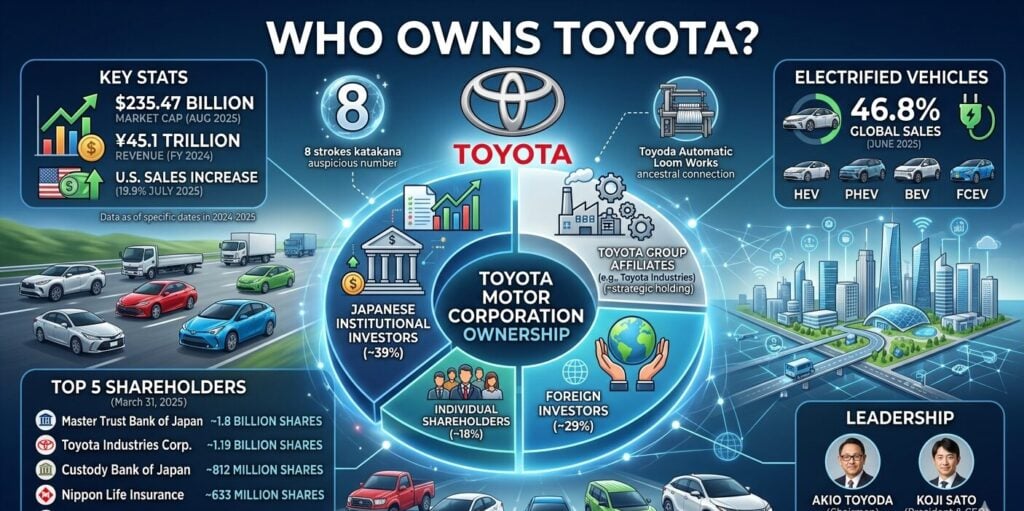
Toyota Motor Corporation is majority-owned by institutional investors and affiliated corporate entities, with no single individual holding a controlling stake. As of August 2025, Toyota’s market capitalization stood at $235.47 billion USD, making it one of the most valuable automakers in the world.
- Toyota’s market capitalization reached $235.47 billion USD in August 2025.
- Toyota reported revenue of ¥45.1 trillion (approximately $410.89 billion USD) in fiscal year 2024.
- Toyota’s U.S. sales recorded a 19.9% year-over-year increase in July 2025.
- Electrified models accounted for 46.8% of Toyota’s global vehicle sales in June 2025.
- Toyota repurchased more than 810 million shares at a cost exceeding ¥2.227 trillion between May 2024 and April 2025.
Top 5 Shareholders of Toyota Motor — Shares Held (millions), March 31, 2025
Who Owns Toyota Motor Company?
Toyota Motor Corporation’s ownership is distributed across Japanese institutional investors, affiliated Toyota Group companies, and international shareholders. As of March 31, 2025, Japanese institutional investors collectively held 39% of shares, foreign investors 29%, and individual shareholders 18%.
The Master Trust Bank of Japan holds the largest single position at approximately 1.8 billion shares. Toyota Industries Corporation, descended from the founding Toyoda family’s loom business, is the largest strategic shareholder with 1.19 billion shares.
Toyota Motor Origin, Founders and Early Years
Kiichiro Toyoda established Toyota’s automotive operations within Toyoda Automatic Loom Works in 1933, drawing on his father Sakichi Toyoda’s principles of continuous improvement. The company formally declared its intention to manufacture automobiles on January 29, 1934.
Toyota Motor Company, Ltd. incorporated on August 28, 1937, with initial capital of ¥12 million. Kiichiro’s brother-in-law, Rizaburo Toyoda, served as the first president. The founding shareholder was Toyoda Automatic Loom Works with 180,400 shares—the corporate ancestor of today’s Toyota Industries Corporation.
Largest Shareholders of Toyota Motor Company
The Master Trust Bank of Japan, Ltd.
- Shares held: 1,805,605 thousand (approx. 1.8 billion)
- Acts as custodian for domestic investment trusts and pension funds
- Largest single shareholder position as of March 31, 2025
Toyota Industries Corporation
- Shares held: 1,192,331 thousand (approx. 1.19 billion)
- Direct descendant of Toyoda Automatic Loom Works (est. 1926)
- Maintains the founding family’s strategic influence in Toyota Motor
Custody Bank of Japan, Ltd.
- Shares held: 811,647 thousand (approx. 812 million)
- Operates as custodian for Japanese institutional investors including pension funds
- Third-largest position in Toyota’s shareholder register
Nippon Life Insurance Company
- Shares held: 633,221 thousand (approx. 633 million)
- One of Japan’s largest life insurers; a long-term strategic holder
- Part of Toyota’s broader network of Japanese institutional cross-holdings
State Street Bank and Trust Company
- Shares held: 572,148 thousand (approx. 572 million)
- Primary U.S.-based custodian holding shares on behalf of global index funds
- Largest foreign institutional position in Toyota’s shareholder structure
Who Is on the Board of Directors for Toyota Motor?
Akio Toyoda — Chairman of the Board and Representative Director
Grandson of founder Kiichiro Toyoda. Served as President and CEO from 2009 through April 2023 before moving to Chairman. Retains the founding family’s philosophical direction within the board, particularly on long-term manufacturing and electrification strategy.
Koji Sato — President, CEO, and Representative Director
Appointed President and CEO in April 2023, succeeding Akio Toyoda. Previously led Lexus International as its chief. Sato is steering Toyota’s transition to electrification, including a $12 billion U.S. battery plant slated to open in 2027.
Shigeru Hayakawa — Vice Chairman and Representative Director
Oversees key operational divisions alongside the president. Acts as a senior liaison between executive management and the full board.
Hiroki Nakajima — Member of the Board
Leads Toyota’s technology development division, including work on advanced driver assistance, connected vehicle systems, and next-generation powertrains.
Simon Humphries — Member of the Board
Heads Toyota’s global design function. Oversees the visual direction of both Toyota and Lexus vehicle lines across all markets.
Emi Osono — Independent Outside Director
Professor at Hitotsubashi University Business School and a management scholar with expertise in organizational learning. Her research has focused on Toyota’s production and knowledge management systems.
Sir Philip Craven — Independent Outside Director
Former President of the International Paralympic Committee. Brings international governance experience and a perspective on inclusive mobility—a growing area within Toyota’s product and social investment programs.
Ikuro Sugawara / Masahiko Oshima — Independent Outside Directors
Both provide external accountability and oversight on financial controls, compliance, and major strategic decisions, consistent with Tokyo Stock Exchange governance requirements for listed companies.
How Did Toyota Get Its Name?
The company officially changed its name from “Toyoda” to “Toyota” in September 1936. The primary reason was phonetic: “Toyota” required eight brush strokes to write in Japanese katakana, a number considered auspicious in Japanese culture. The original spelling, “Toyoda,” required ten strokes.
The new name also created a cleaner separation between the automotive business and the founding family surname, helping position Toyota Motor as a distinct corporate brand rather than a family extension of Toyoda Automatic Loom Works. The name change predated the company’s formal incorporation by one year. Today, both the city in Aichi Prefecture and the company share the Toyota name.
Toyota Motor Company Products and Services
Toyota Passenger Vehicles
- Camry, Corolla, RAV4, Tacoma, Tundra, Hilux among flagship models
- Sold across more than 170 countries globally
- Toyota ranked among the top three automakers by global sales volume each year since 2020
Lexus
- Toyota’s wholly owned luxury brand, launched in the United States in 1989
- Sells approximately 750,000 vehicles annually across more than 90 countries
- Lexus IS, RX, NX, LX, and LC make up its core lineup
Electrified Vehicles
- Includes hybrid (HEV), plug-in hybrid (PHEV), battery electric (BEV), and hydrogen fuel cell (FCEV) models
- Electrified models accounted for 46.8% of June 2025 global sales
- Toyota Prius pioneered mass-market hybrid technology in 1997
Hino Motors & Daihatsu
- Hino produces heavy trucks and buses; established 1942
- Daihatsu manufactures compact passenger and commercial vehicles; established 1907
- Both operate as Toyota Group subsidiaries with independent manufacturing footprints
Toyota Financial Services
- Provides auto loans, leasing, and dealer financing in over 40 countries
- Operates as Toyota Financial Services Corporation (TFS)
- One of the largest auto finance companies in the world by loan portfolio size
Toyota Motor Mission Statement
Toyota’s stated mission centers on producing happiness for all—a philosophy grounded in its founding principle of Kaizen, meaning continuous improvement. Toyota aims to lead the future of mobility by providing safe, sustainable, and responsible transportation across every market it serves.
This mission extends beyond vehicle production. Toyota Financial Services, Toyota Housing Corporation, and the company’s robotics and marine divisions each reflect a broader ambition to apply Toyota’s production philosophy across multiple sectors of everyday life.
The Toyota Production System, developed in the postwar decades, forms the operational foundation. It prioritizes the elimination of waste, quality control at every production stage, and what Toyota terms “respect for people” — the principles that align with Toyota’s cross-industry role within the Toyota Group conglomerate.
FAQ
Is Toyota Motor Company still operational?
Yes. Toyota Motor Corporation remains one of the world’s largest automakers, selling vehicles in more than 170 countries. In fiscal year 2024, Toyota reported revenue of approximately $410.89 billion USD and net income of approximately $45.06 billion USD.
When did Toyota Motor Company come out?
Toyota Motor Company, Ltd. was formally incorporated on August 28, 1937. Its automotive operations began within Toyoda Automatic Loom Works in 1933, and the company first declared its intention to manufacture automobiles on January 29, 1934.
Who owns Toyota Motor Company?
Toyota’s ownership is spread across institutional investors and affiliates. The Master Trust Bank of Japan is the largest shareholder (1.8 billion shares). Toyota Industries Corporation holds the largest strategic stake. Japanese institutions collectively hold 39% of shares; foreign investors hold 29%.
Is Toyota Motor Company an American company?
No. Toyota Motor Corporation is a Japanese multinational headquartered in Toyota City, Aichi, Japan. It operates manufacturing plants in the United States and globally, but it was founded in Japan in 1937 and trades on the Tokyo Stock Exchange. For comparison, see Nissan’s ownership structure, another Japanese automaker with significant U.S. operations.
What is Toyota Motor’s market cap in 2026?
Toyota’s market capitalization reached $235.47 billion USD in August 2025. The figure fluctuates with stock performance on the Tokyo Stock Exchange (TYO: 7203), where Toyota trades as one of Japan’s most valued listed companies.