


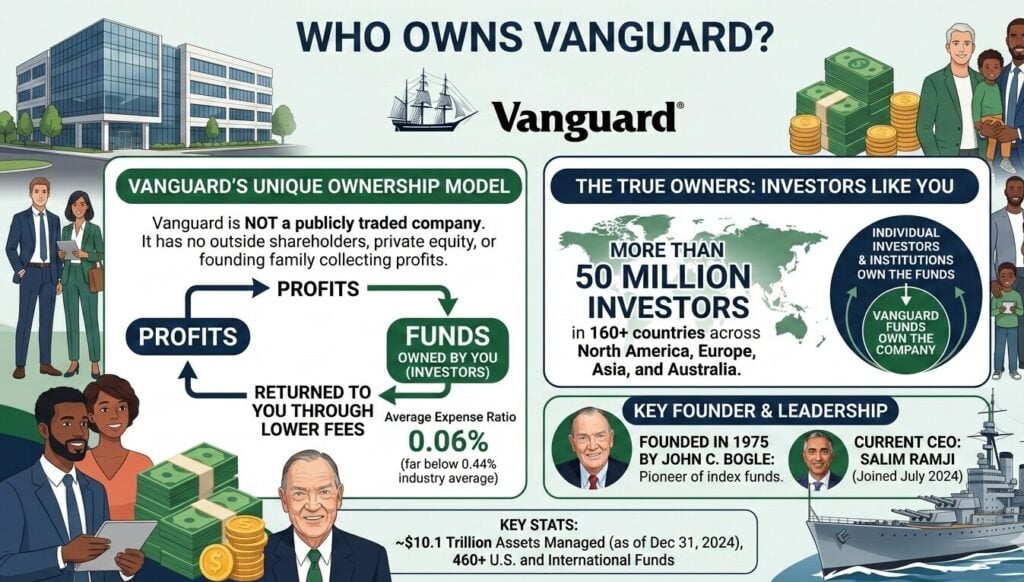
Key Stats
Vanguard manages approximately $10.1 trillion in assets as of December 31, 2024, with estimates above $11 trillion by late 2025.
The firm offers 228 U.S. funds and 232 international funds as of December 31, 2025.
Vanguard serves more than 50 million investors across 160-plus countries.
The average expense ratio across Vanguard’s product lineup is 0.06%, far below the industry average of 0.44%.
Vanguard Group is owned by its member funds, and those funds are owned by their shareholders. This means Vanguard’s investors are its actual owners — a structure unlike any other major asset manager. There are no outside stockholders, no private equity backers, and no founding family collecting profits.
Headquartered in Malvern, Pennsylvania, Vanguard is the world’s largest mutual fund issuer and the second-largest ETF provider after BlackRock. Salim Ramji took over as CEO in July 2024, succeeding Tim Buckley. Under Ramji, Vanguard has announced nearly $600 million in combined expense ratio reductions across 2025 and 2026. The company employs about 20,000 people worldwide and operates 17 offices across North America, Europe, Asia, and Australia.
Who Owns Vanguard Group?
No single person, corporation, or investment fund owns Vanguard. The company is owned by the Vanguard funds themselves, and those funds are in turn owned by the people who invest in them. If you hold shares of any Vanguard fund, you are, in a technical sense, a part-owner of the company.
How Vanguard’s Ownership Model Works
Most asset managers operate for the benefit of outside shareholders or private owners who extract profits. Vanguard flipped this model. Because the funds own the company, profits that would normally go to outside owners are returned to fund shareholders through lower fees. This eliminates a common tension in the industry: the conflict between keeping costs low for investors and maximizing profits for company owners. At Vanguard, those two groups are the same people. Bogle designed this structure in 1975, and no competitor has replicated it at the same scale.
Largest Shareholders of Vanguard Group
Since Vanguard is not publicly traded, it has no institutional or individual shareholders in the traditional sense. Its owners are the millions of people and institutions that invest in Vanguard funds. The largest funds give a picture of where the money sits.
Vanguard’s Biggest Funds by Assets
Largest Vanguard Funds (Approximate Assets)
The Vanguard Total Stock Market Index Fund is the company’s single largest fund, holding shares in thousands of U.S. companies. The Vanguard 500 Index Fund, Bogle’s original index fund from 1976, tracks the S&P 500 and remains one of the biggest equity funds on the planet.
What Vanguard’s Funds Own
Through its index and actively managed funds, Vanguard is one of the top three shareholders in most major publicly traded companies. Its funds hold significant stakes in Apple, Microsoft, Amazon, and Alphabet. Vanguard also holds approximately 8.9% of Meta Platforms and is the largest institutional shareholder of BlackRock. Along with BlackRock and State Street, Vanguard is one of the “Big Three” index fund managers — a trio that collectively votes on shareholder proposals at most large public companies.
Vanguard does not own these companies in a controlling sense. The fund shareholders do. Vanguard votes on their behalf through its investment stewardship team, but the economic interest belongs to individual investors.
History of Vanguard Group Founder
John C. Bogle and the Princeton Thesis
Vanguard’s origins trace back to a 1951 undergraduate thesis at Princeton University. John C. Bogle studied the mutual fund industry and concluded that most actively managed funds failed to outperform broad stock market indexes after fees. That finding shaped every business decision he would make for the next five decades.
After graduating, Bogle joined Wellington Management Company and rose to become president and CEO. A merger he championed in 1966 went sour, and Bogle was fired in 1974.
Founding Vanguard in 1975
Rather than leave the fund business, Bogle convinced Wellington’s fund board to let him start a new entity. He named it Vanguard after HMS Vanguard, the flagship of British Admiral Horatio Nelson — a fitting choice, given what he was about to build.
In 1976, Bogle launched the First Index Investment Trust, now known as the Vanguard 500 Index Fund. The initial public offering raised just $11 million against a target of $150 million. Wall Street mocked the idea of a fund that simply tracked an index, but Bogle refused to shut it down. By the 1980s, other firms began copying the index approach. Bogle retired as CEO in 1996 and as board chairman in 1999. He died on January 16, 2019, at age 89.
Who Is on the Board of Directors for Vanguard Group?
Vanguard’s governance differs from a typical public company. The board of directors (known internally as the board of trustees) oversees the Vanguard funds and, by extension, the company itself. Board members are elected by fund shareholders.
Current CEO and Executive Leadership
Salim Ramji became Vanguard’s CEO in July 2024 — the first outsider to lead the firm. He joined from BlackRock, where he ran the iShares and Index Investing division for a decade. His appointment split the top job: Ramji is CEO, Greg Davis (a 25-year Vanguard veteran) is president and chief investment officer, and Mark Loughridge chairs the board.
Ramji holds a BA in economics and politics from the University of Toronto and an MA in law from the University of Cambridge. Before BlackRock, he was a senior partner at McKinsey and Company and practiced law at Clifford Chance in London and Hong Kong.
Board Structure and Independence
Vanguard’s board includes both internal executives and independent directors. Mark Loughridge, the lead independent director, now chairs the board. The independent directors bring experience from outside finance to prevent insular thinking. The board meets regularly to review fund performance, expense ratios, compliance, and strategic direction.
Key Senior Leaders
Beyond the CEO and president, Vanguard’s senior management includes Michael Rollings as CFO, Nitin Tandon as chief information officer, and Joseph Brennan as chief risk officer. Natalie Lamarque joined as chief legal officer in 2025 after serving as general counsel at Principal Financial Group. In early 2026, Ramji made at least 10 senior hires from firms including Goldman Sachs, BlackRock, and Fidelity.
Vanguard CEO Timeline
FAQs
Who is the owner of Vanguard Group?
Vanguard is owned by its member funds, which are owned by fund shareholders. There are no outside investors or private owners — the people who invest in Vanguard funds are its owners.
Is Vanguard a publicly traded company?
No. Vanguard is not listed on any stock exchange. Its unique structure means the funds own the company, so there is no publicly traded stock to buy.
Who is the CEO of Vanguard Group?
Salim Ramji has been Vanguard’s CEO since July 2024. He is the first external hire to lead the firm in its history.
Who founded Vanguard Group?
John C. Bogle founded Vanguard in 1975 after being fired from Wellington Management. He created the first index fund for individual investors in 1976.
How big is Vanguard Group?
Vanguard manages over $10 trillion in assets, serves more than 50 million investors worldwide, and offers over 450 funds. It is the second-largest asset manager globally.