

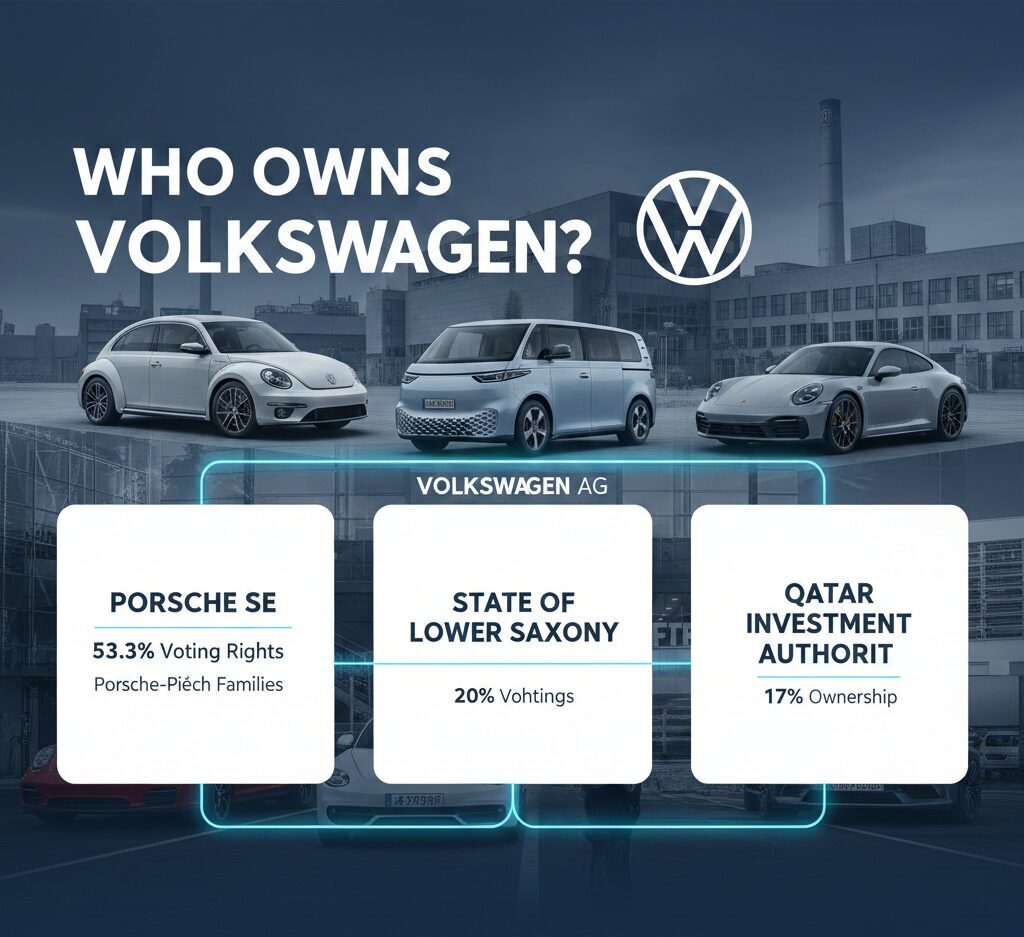
Volkswagen is owned by multiple entities, with Porsche SE holding 53.3% of voting rights through the Porsche-Piëch families. The State of Lower Saxony controls 20% of voting rights, while Qatar Investment Authority holds 17% ownership. Individual shareholders and institutional investors own the remaining stake in this publicly traded automotive giant.
Volkswagen delivered 6.6 million vehicles globally in the first nine months of 2025, marking a 1% increase from the same period in 2024. The company achieved this growth despite challenges in China and North America, driven by strong demand in Europe and South America. Battery electric vehicle deliveries surged 42% to 717,500 units during this period, while the company launched over 60 new models across its brand portfolio in 2024 and 2025.
Key Stats
- Volkswagen recorded a market capitalization of approximately $60.87 billion as of January 2026.
- The company generated trailing twelve-month revenue of $360 billion in 2025, representing a 2.49% increase year-over-year.
- Volkswagen delivered 9 million vehicles worldwide in 2024 across all brands including Audi, Porsche, and Skoda.
- The automaker operates over 100 manufacturing facilities across 27 countries with more than 295,000 employees globally.
How did Volkswagen get its name?
The name Volkswagen derives from two German words that together reveal the company’s original mission. “Volks” translates to “people” or “folk” while “wagen” means “car” or “wagon.”
This straightforward name was chosen in 1937 when the German government established the company. The goal was creating an affordable vehicle accessible to ordinary German citizens during a period when car ownership remained beyond most families’ reach.
Ferdinand Porsche, the automotive engineer commissioned to design the vehicle, developed the iconic Beetle that would eventually embody the people’s car concept. The factory in Wolfsburg began operations under the name “Gesellschaft zur Vorbereitung des Deutschen Volkswagens mbH” before being shortened to Volkswagenwerk.
After World War II, British Army officer Ivan Hirst revitalized the bomb-damaged factory. The company retained its meaningful name as it transformed from wartime production into the global automotive manufacturer known today. The “people’s car” designation proved prescient when the Beetle became one of history’s best-selling vehicles with over 21 million units produced.
Who owns Volkswagen?
Volkswagen AG operates as a publicly traded company with a complex ownership structure that balances family control, government involvement, and public shareholders. The company’s shares trade on multiple German stock exchanges including Frankfurt, Berlin, and Stuttgart.
Porsche SE serves as the controlling entity through its 53.3% voting rights stake. The Porsche-Piëch families, descendants of Ferdinand Porsche who designed the original Volkswagen, maintain ultimate control through this holding company.
The State of Lower Saxony holds 20% of voting rights as the second-largest stakeholder. This government position dates back to 1960 when the company transitioned from state ownership. Qatar Investment Authority represents the third major shareholder with 17% ownership acquired in 2022.
Ownership Structure and Voting Power
Volkswagen AG maintains two share classes that create distinct voting arrangements. Ordinary shares carry standard voting rights at one vote per share. Preferred shares offer higher dividends but exclude voting privileges.
This dual-class structure allows Porsche SE to control 53.3% of votes while holding only 31.9% of total equity. The arrangement grants the Porsche-Piëch families decisive influence over corporate strategy and management appointments despite not owning an outright majority of shares.
Volkswagen Origin, Founders and Early Years
The German Labour Front established Volkswagen on May 28, 1937, under directive from the Nazi government. Ferdinand Porsche received the commission to design an affordable “people’s car” that could sell for under 1,000 Reich marks.
Porsche created the first prototypes in his Stuttgart garage with assistance from his son Ferry Porsche. The distinctive rounded shape and air-cooled rear engine became defining characteristics. Construction of the Wolfsburg factory began in 1938, though World War II interrupted civilian production.
British Major Ivan Hirst took control of the war-damaged facility in 1945. Under his management, the factory resumed Beetle production for occupying forces. The German government privatized 60% of the company in 1960, transforming Volkswagen into the public corporation that exists today.
Largest Shareholders of Volkswagen
Porsche Automobil Holding SE dominates the shareholder landscape with 53.3% of voting rights derived from 31.9% equity ownership. The Porsche-Piëch families control this holding company, providing them with decisive authority over Volkswagen’s strategic direction and major decisions.
The State of Lower Saxony maintains its historical 20% voting stake. This government position originated during the 1960 partial privatization and continues providing regional political influence over the automaker’s operations. The “Volkswagen Law” grants Lower Saxony veto power over major corporate decisions despite EU legal challenges.
Qatar Investment Authority entered as a major shareholder in 2022 with 17% ownership. The sovereign wealth fund’s investment strengthened Volkswagen’s financial position while diversifying the shareholder base beyond European interests.
Institutional investors including Cacti Asset Management, Magallanes Value Investors, and various pension funds collectively hold smaller positions. These financial institutions provide market liquidity and represent diverse global investment interests in the automotive sector.
Who is on the board of directors for Volkswagen?
Volkswagen’s governance structure includes both a Board of Management and a Supervisory Board that oversee operations and strategic planning. Oliver Blume serves as Chairman of the Board of Management since 2022, simultaneously holding the CEO position at Porsche AG.
Executive Leadership
Arno Antlitz holds responsibility for Finance and Operations as Member of the Board of Management. Thomas Schäfer leads the Core brand group as CEO of the Volkswagen brand, managing the company’s volume vehicle operations.
Ralf Brandstätter oversees China operations as Member of the Board of Management, reflecting the market’s importance for Volkswagen’s luxury subsidiary Audi and other brands. Hauke Stars manages IT operations and digital transformation initiatives across the group.
Supervisory Board Structure
Hans Dieter Pötsch chairs the Supervisory Board, serving simultaneously as Chairman of Porsche Automobil Holding SE. Wolfgang Porsche represents the founding family interests as Vice Chairman, maintaining the Porsche-Piëch legacy in corporate governance.
Daniela Cavallo leads employee representation as Chairwoman of the General and Group Works Councils. Her position ensures worker interests receive consideration in major corporate decisions affecting Volkswagen’s extensive manufacturing operations.
Technology and Innovation Leadership
Gernot Döllner serves as CEO of Audi AG within the Progressive brand group, driving electric vehicle development and autonomous technology initiatives. His appointment in 2023 signals Volkswagen’s commitment to technological transformation across premium segments.
The board composition reflects German corporate governance requirements for employee co-determination. Half the Supervisory Board seats represent labor interests, balancing shareholder and workforce perspectives in strategic planning and operational oversight.
Volkswagen Mission Statement
Volkswagen articulates its corporate purpose through the mission “Shaping mobility for generations to come.” This statement emphasizes the company’s commitment to sustainable transportation solutions that serve multiple generations of customers worldwide.
The mission reflects three core priorities that guide strategic decisions. First, sustainability drives the transition to electric vehicles and carbon-neutral manufacturing. Second, connectivity integrates digital technology into vehicle design and customer experience. Third, emotional appeal maintains the brand’s heritage while embracing innovation.
Volkswagen complements this mission with the vision “The Global Automotive Tech Driver.” This forward-looking statement positions the company as an industry leader in technological transformation. The vision encompasses autonomous driving capabilities, software platforms, and battery technology development.
The company targets achieving 6.5% return on sales by 2026 through operational efficiency improvements. This financial objective supports continued investment in future technologies including the unified cell platform for next-generation electric vehicles. Similar to innovations at Chinese electric vehicle manufacturer BYD, Volkswagen pursues vertical integration in battery production.
Core values of customer focus, performance excellence, and responsibility underpin these strategic statements. The mission and vision guide decisions affecting over 295,000 employees and millions of customers across global markets while maintaining accountability to diverse stakeholder interests.
Volkswagen Company History Timeline
Volkswagen Products and Services
Volkswagen operates through two primary divisions that deliver comprehensive automotive solutions. The Automotive Division manufactures passenger cars, commercial vehicles, and power engineering products across multiple brand segments. The Financial Services Division provides customer financing, leasing, insurance, and fleet management services.
The passenger car portfolio includes twelve distinct brands targeting different market segments. Core brands like Volkswagen, Skoda, and SEAT serve volume markets with affordable vehicles. Progressive brands including Audi, Bentley, and Lamborghini compete in luxury segments. Porsche occupies the sports luxury category with performance-oriented models.
Commercial vehicle operations occur through TRATON Group subsidiary brands including MAN, Scania, and Navistar. These brands manufacture heavy trucks, buses, and specialized commercial vehicles serving logistics, construction, and public transportation sectors globally.
Electric vehicle development focuses on the MEB platform that underpins ID-series models. The company invested €20 billion in battery technology through Mission SalzGiga gigafactory operations. Scout Motors, established in 2022, develops all-terrain electric vehicles specifically for the American market.
Financial services generated 11.2% of group revenue in recent years through Volkswagen Financial Services and Volkswagen Bank operations. These divisions offer retail financing, dealer wholesale funding, insurance products, and subscription mobility services across 50 countries. The integrated approach combines vehicle manufacturing with complete lifecycle support including maintenance programs and remarketing services.
FAQ
What is the net worth of Volkswagen?
Volkswagen’s estimated net worth stands at approximately $60.87 billion as of January 2026, based on market capitalization. The company’s enterprise value includes substantial manufacturing assets, intellectual property, and global brand portfolio encompassing twelve automotive brands.
When did Volkswagen come out?
Volkswagen was established on May 28, 1937, when the German government formed the company. Production began with the iconic Beetle design created by Ferdinand Porsche. Mass production started in 1945 after British forces revitalized the war-damaged Wolfsburg factory.
Volkswagen market cap in 2026?
Volkswagen recorded a market capitalization of $60.87 billion as of January 2026. The valuation increased 31.19% over the previous year driven by electric vehicle sales growth and successful new model launches across its brand portfolio.
Is Volkswagen an American company?
Volkswagen is a German company headquartered in Wolfsburg, Lower Saxony, Germany. Volkswagen Group of America operates as a subsidiary managing American operations including a manufacturing facility in Chattanooga, Tennessee, which produces approximately 175,000 vehicles annually.
Who owns Volkswagen?
Porsche SE controls Volkswagen with 53.3% of voting rights through the Porsche-Piëch families. The State of Lower Saxony holds 20% voting rights while Qatar Investment Authority owns 17%. Public shareholders and institutional investors own remaining stakes in this publicly traded company.
Is Volkswagen still operational?
Volkswagen remains fully operational as one of the world’s largest automotive manufacturers. The company delivered 6.6 million vehicles in the first nine months of 2025, achieving 1% growth. Operations continue across over 100 manufacturing facilities in 27 countries worldwide.
